Space Development Agency Completes Successful Launch of T1DES Prototype Satellite
SDA delivers first of 12 risk reduction satellites on orbit for experimentation and demonstration
(JUN 24) WASHINGTON, D.C.- The Space Development Agency today announced the successful launch from Vandenberg Space Force Base, California, of the first prototype among 12 risk reduction satellites comprising the Tranche 1 Demonstration and Experimentation System (T1DES) constellation that will demonstrate tactical data delivery to warfighter platforms to support capabilities like targeting, and missile warning and tracking of advanced missile threats.
The prototype satellite will support integration with tactical satellite communication (TACSATCOM) system capabilities from low Earth orbit. The launch also serves as a pathfinder for York Space Systems' LX-CLASS satellite platform, which is slated for use in other existing award agreements between SDA and York.
"T1DES will demonstrate mission payloads and configurations for potential proliferation through future tranches of the Proliferated Warfighter Space Architecture in an effort to lower latency of tactical data delivery and enhance beyond line-of-sight targeting capability," said SDA Director Derek Tournear. "We're very pleased to see this prototype space vehicle launch four months ahead of the original T1DES baseline schedule and before the first launch of Tranche 1's operational space vehicles."
The launch, which took place Monday, June 23, on SpaceX's Falcon 9 rocket under the Transporter 14 rideshare mission, carried to orbit SDA's single risk reduction space vehicle referred to as T1DES Proto or by the York Space Systems' name, Dragoon.
The remaining 11 T1DES satellite vehicles, planned for launch in fiscal year 2026, will conduct demonstrations and experimentation of TACSATCOM, advanced waveforms, and Integrated Broadcast Service (IBS) capabilities, which are key for future connectivity of joint warfighters around the globe.
Space Development Agency
Dusk Display
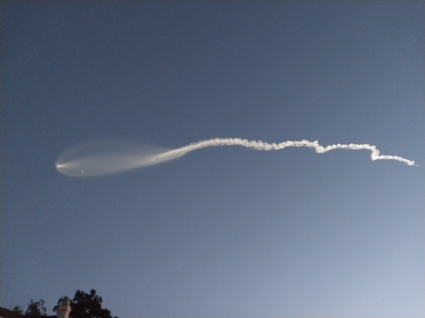
A Falcon 9 rocket creates a light show over a wide area following liftoff from Vandenberg SFB, Calif. on the evening of June 16. In this image taken during the second stage burn, the vehicle's exhaust is illuminated by the Sun at high altitude while observers on the ground are in evening twilight. The white dot behind and below the tip of the exhaust plume is the jettisoned rocket first stage.
Millennium Space Systems Delivers Pair of Space Vehicles to Launch Site for NASA's TRACERS Mission
(JUN 16) EL SEGUNDO, Calif. -- Millennium Space Systems, a Boeing Company, delivered two space vehicles for NASA's Tandem Reconnection and Cusp Electrodynamics Reconnaissance Satellites (TRACERS) mission to Vandenberg Space Force Base Friday, marking a key milestone in preparation for launch later this year.
"Millennium is incredibly proud of our team and partners at the University of Iowa, Southwest Research Institute, and NASA, for reaching this milestone and getting TRACERS to the launch site," said Richard Prasad, TRACERS program manager, Millennium Space Systems. "Progressing to final integration at launch site showcases the confidence from all parties that both the TRACERS space vehicles and the Millennium Mission Operations Center (MOC) are ready for launch and the start of operations. We're all excited to see TRACERS on-orbit."
The TRACERS mission will measure the connection between solar wind and the magnetic field surrounding Earth. With the completion of rigorous tests, including environmental, mechanical and systems verification, the space vehicles are now prepared to travel through Earth's polar cusp region over the north and south magnetic poles. Ultimately, the mission will enhance our understanding of space weather and its potential impacts on critical technologies such as satellites, communications networks and power grids.
"Delivering TRACERS demonstrates how the same approach we use for national security missions can support cutting-edge science," said Tony Gingiss, CEO, Millennium Space Systems. "The ability to deliver high-performance spacecraft is critical, not just for advancing scientific understanding and enabling future space weather forecasting, but also, for strengthening space resilience and readiness in support of national defense objectives."
The launch window is set to open in Summer 2025, with specific timing dependent on mission readiness and other logistics.
Millennium Space Systems
Stratolaunch Awarded Contract
(JUN 13) Stratolaunch LLC, Mojave, California, has been awarded a $9,900,000 firm-fixed-price and cost-plus-fixed-fee modification (P00003) to previously awarded (FA9300-23-C-6019) for changes to the flight specifications, requirements and deliverables being produced under the basic contract for the Talon-A campaign 2 contract. The modification brings the total cumulative face value of the contract to $28,063,854. Work will be performed at Mojave, California, and is expected to be completed by Sept. 16, 2026. Fiscal 2024 research, development, test, and evaluation funds in the amount of $9,900,000 are being obligated at the time of award. The Air Force Test Center, Edwards Air Force Base, California, is the contracting activity.
Department of Defense
RTS Professionals Support Air Force Glory Trip
(JUN 5) REDSTONE ARSENAL, Ala. - A U.S. Army Space and Missile Defense Command team played an important behind-the-scenes role in supporting the Air Force's Glory Trip-253. More
Fiery Return
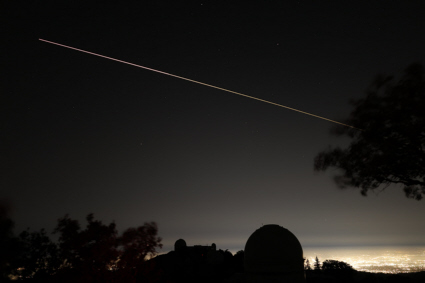
A Dragon cargo ship streaks across the sky on the evening of May 24 as it reenters the atmosphere moments before splashing down in the Pacific west of Oceanside, Calif. Rick Baldridge recorded the scene from Lick Observatory above San Jose, Calif. Image copyright 2025, Rick Baldridge. Used with permission.
Minuteman III Test Launch Showcases Readiness of U.S. Nuclear Force's Safe, Effective Deterrent
(MAY 21) BARKSDALE AIR FORCE BASE, La. -- A joint team of Air Force Global Strike Command Airmen launched an unarmed Minuteman III intercontinental ballistic missile equipped with a single Mark-21 High Fidelity Re-Entry Vehicle May 21 at 12:01 a.m. Pacific Time from Vandenberg Space Force Base, California. More
Unarmed Minuteman III Test Launch to Showcase Readiness OF U.S. Nuclear Force's Safe, Effective Deterrent
(MAY 16) Vandenberg Space Force Base, Calif. -- An operational test launch of an Air Force Global Strike Command unarmed Minuteman III intercontinental ballistic missile is scheduled between 12:01 to 5:01 a.m. Pacific Time, May 21, from north Vandenberg.
The purpose of the ICBM test launch program is to demonstrate the readiness of U.S. nuclear forces and provide confidence in the lethality and effectiveness of the nation's nuclear deterrent, according to Air Force Global Strike Command.
This test is routine and was scheduled years in advance. Consistent with previous test launches, this ICBM test launch will validate and verify the effectiveness, readiness and accuracy of the weapon system.
Vandenberg SFB
Department of Defense Demonstrates Reusability of Hypersonic Test Vehicle
(MAY 5) The U.S. Department of Defense Test Resource Management Center (TRMC), in partnership with Naval Surface Warfare Center Crane Division (NSWC Crane), conducted a second successful flight of a fully recoverable uncrewed hypersonic test vehicle in March 2025, within three months of the first test in December 2024. This test campaign marks the Nation's first return to reusable hypersonic flight testing since the manned X-15 program ended in 1968.
In both tests, the Stratolaunch Talon-A hypersonic vehicle launched from the Roc carrier aircraft, flew over the Pacific Ocean and achieved speeds greater than Mach 5 before landing at Vandenberg Space Force Base. The landmark tests supported the ongoing TRMC Multi-Service Advanced Capability Hypersonics Test Bed (MACH-TB) project.
George Rumford, Director of the TRMC, stated, "Demonstrating the reuse of fully recoverable hypersonic test vehicles is an important milestone for MACH-TB. Lessons learned from this test campaign will help us reduce vehicle turnaround time from months down to weeks."
MACH-TB accelerates delivery of advanced hypersonic capabilities to the warfighter by providing DoD, other Federal agencies, industry, and academia the capability to affordably and rapidly conduct hypersonic experiments and test hypersonic system components.
NSWC Crane awarded the MACH-TB contract to Leidos through the Strategic and Spectrum Missions Advanced Resilient Trusted Systems (S2MARTS) Other Transaction Authority (OTA) vehicle on behalf of the TRMC. As the prime contractor for MACH-TB, Leidos awarded Stratolaunch, LLC a competitive contract to provide flight test services for the program.
About TRMC
The U.S. Department of Defense Test Resource Management Center (TRMC) is a DoD Field Activity that reports directly to the Under Secretary of Defense for Research and Engineering within the Office of the Secretary of Defense. The mission of the TRMC is to ensure the readiness of DoD to experiment and test.
Defense Department
NASA's SPHEREx Space Telescope Begins Capturing Entire Sky
After weeks of preparation, the space observatory has begun its science mission, taking about 3,600 unique images per day to create a map of the cosmos like no other.
(MAY 1) Launched on March 11, NASA's SPHEREx space observatory has spent the last six weeks undergoing checkouts, calibrations, and other activities to ensure it is working as it should. More
Dawn Launch
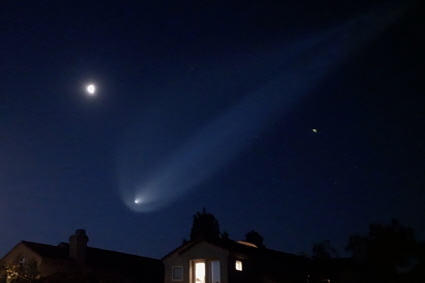
A Falcon 9 rocket crosses the southern California sky following liftoff from Vandenberg SFB, Calif. on April 20. The vehicle left south base at 05:29 PDT and carried the NROL-145 mission into orbit. This photo was taken during the second stage burn when sunlight was illuminating the vehicle's exhaust.
NRO and Space Force Partner Through the Rocket Systems Launch Program to Launch NROL-174
NRO and Space Force partner through the Rocket Systems Launch Program to launch NROL-174
(APR 16) CHANTILLY, Va. - The National Reconnaissance Office (NRO), in partnership with U.S. Space Force Space Systems Command's (SSC) Small Launch and Targets Division, Space Launch Delta 30, and Northrop Grumman, successfully launched multiple national security payloads with the NROL-174 mission aboard a Northrop Grumman Minotaur IV rocket from Space Launch Complex 8 (SLC-8) at Vandenberg Space Force Base (VSFB) April 16, 2025, at 3:33 p.m. EDT. More
NRO Launches Ninth Proliferated Architecture Mission with NROL-192
(APR 12) CHANTILLY, Va. - The National Reconnaissance Office (NRO), in partnership with U.S. Space Force Space Launch Delta 30 and SpaceX, successfully launched the NROL-192 mission aboard a SpaceX Falcon 9 rocket from Space Launch Complex-4 East at Vandenberg Space Force Base in California on April 12, 2025, at 8:25 a.m. EDT.
Today's mission is the ninth overall launch of the NRO's architecture and third proliferated launch of 2025. The rapid deployment of NRO's proliferated constellation directly supports the needs of the people NRO serves - intelligence analysts, warfighters, policymakers, and first responders. Having hundreds of NRO satellites on orbit will allow for critical data to be delivered to NRO's stakeholders faster than ever before.
Over the past two years, NRO has launched more than 150 satellites, creating the largest and most capable government constellation on orbit in our nation's history. Continuing with this momentum, 2025 is set to be another dynamic year, with approximately one dozen NRO launches scheduled. Approximately half of these launches will focus on advancing the NRO's proliferated architecture with additional proliferated launches planned through 2029, ensuring sustained growth and innovation.
For more than 60 years, the NRO has successfully met the needs of its U.S. intelligence, military, civil, and allied partners. It remains the world's leader in unique intelligence, surveillance, and reconnaissance systems. The NRO's next-generation systems will help ensure that the right data is delivered to the right user at the right time, faster than ever before.
Additional information on upcoming launches will be available at NRO.gov/launch.
National Reconnaissance Office
ULA Wins Space Force Contract
Award represents 40 percent of the country's critical satellite launches delivered to the most challenging and exotic orbits
(APR 4) Centennial, Colo. - The U.S. Space Force announced today that United Launch Alliance (ULA) was awarded a firm, fixed-price, indefinite-delivery requirements (IDR) contact to launch 40 percent of the missions to the country's most challenging and exotic orbits on its newest launch procurement contract. This contract resulted from a competitive award under the Space Force's National Security Space Launch (NSSL) Phase 3 procurement.
"We are proud that we have launched 100 national security space missions and honored to continue serving the nation with our new Vulcan rocket," said Tory Bruno, ULA's president and CEO. "We are very pleased to be awarded 40 percent of the Phase 3 procurement. Vulcan is the right choice for critical national security space missions and is the only rocket today designed to meet all the requirements of our nation's space launch needs."
The competitive process ensures the U.S. has continued assured access to space and supports a robust domestic national security industrial base. The award represents missions ordered in fiscal years 2025 through 2029 with launches occurring through 2034. The missions will launch from Cape Canaveral Space Force Station in Florida, and from Vandenberg Space Force Base in California.
"This award constitutes the most complex missions required for national security space," said Bruno. "Vulcan continues to use the world's highest energy upper stage; the Centaur V. Centaur V's unmatched flexibility and extreme endurance enables the most complex orbital insertions continuing to advance our nation's capabilities in space."
United Launch Alliance
Operations Room
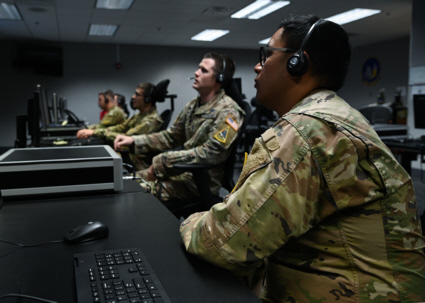
2d Space Launch Squadron members simulate usage of the newly innovated Vehicle Operations Room (VOR) at Vandenberg Space Force Base, Calif., March 5, 2025. The VOR is a newly remodeled facility designed to support the evolving needs of a diverse range of spaceport users, and signifies a significant leap forward in the base's ability to facilitate complex space missions. (U.S. Space Force photo by Senior Airman Kadielle Shaw)
ULA's Vulcan Rocket Certified to Launch National Security Missions
World's only high energy architecture rocket delivers to the country's most exotic orbits
(MAR 26) Centennial, Colo. - Following years of development and completing a comprehensive certification plan including two successful certification missions, the United Launch Alliance (ULA) Vulcan rocket has been certified by the United States Space Force to fly National Security Space Launch (NSSL) missions. More
NRO Launches Eighth Proliferated Architecture Mission with NROL-57
(MAR 21) CHANTILLY, Va. - The National Reconnaissance Office (NRO), in partnership with U.S. Space Force Space Launch Delta 30 and SpaceX, successfully launched the NROL-57 mission aboard a SpaceX Falcon 9 rocket from Space Launch Complex-4 East at Vandenberg Space Force Base in California on March 21, 2025, at 2:49 a.m. EDT.
Today's mission is the eighth overall launch of the NRO's proliferated architecture and second proliferated launch of 2025. The steady deployment of this program is quickly growing the U.S. government's largest and most resilient intelligence, surveillance, and reconnaissance constellation. This latest proliferated NRO mission continues to increase our space-based intelligence capabilities to address strategic national security needs.
Over the past two years, NRO has launched more than 150 satellites, creating the largest and most capable government constellation on orbit in our nation's history. Continuing with this momentum, 2025 is set to be another dynamic year, with approximately one dozen NRO launches scheduled. Approximately half of these launches will focus on advancing the NRO's proliferated architecture with additional proliferated launches planned through 2029, ensuring sustained growth and innovation.
For more than 60 years, the NRO has successfully met the needs of its U.S. intelligence, military, civil, and allied partners. It remains the world's leader in unique intelligence, surveillance, and reconnaissance systems. The NRO's next-generation systems will help ensure that the right data is delivered to the right user at the right time, faster than ever before.
Additional information on upcoming launches will be available at NRO.gov/launch.
National Reconnaissance Office
X-37B Orbital Test Vehicle Concludes Seventh Successful Mission
(MAR 7) VANDENBERG SPACE FORCE BASE, Calif. (AFNS) -- The X-37B Orbital Test Vehicle-7 (OTV-7), the U.S. Space Force's dynamic unmanned spaceplane, successfully deorbited and landed at Vandenberg Space Force Base, California, March 7, 2025 at 02:22 a.m. EST. More
NASA's EZIE Launching to Study Magnetic Fingerprints of Earth's Aurora
All three spacecraft carry an instrument called the Microwave Electrojet Magnetogram, built by NASA JPL, that will map electrojets to help uncover their structure and evolution.
(FEB 25) High above Earth's poles, intense electrical currents called electrojets flow through the upper atmosphere when auroras glow in the sky. More
Minuteman III Launched
(FEB 19) VANDENBERG SPACE FORCE BASE, Calif. -- A joint team of Air Force Global Strike Command Airmen and Vandenberg Space Force Base Guardians launched an unarmed Minuteman III intercontinental ballistic missile equipped with a single telemetered joint test assembly re-entry vehicle Feb. 19 at 1:00 a.m. Pacific Time from Vandenberg Space Force Base. More
Unarmed Minuteman III Test Launch to Showcase Readiness of U.S. Nuclear Force's Safe, Effective Deterrent
(FEB 12) Vandenberg Space Force Base, Calif. -- An operational test launch of an Air Force Global Strike Command unarmed Minuteman III intercontinental ballistic missile is scheduled between 11:01 p.m. Pacific Time on Feb. 18 to 5:01 a.m. Pacific Time, Feb. 19, from north Vandenberg.
The purpose of the ICBM test launch program is to demonstrate the readiness of U.S. nuclear forces and provide confidence in the lethality and effectiveness of the nation's nuclear deterrent, according to Air Force Global Strike Command.
This test is routine and was scheduled years in advance. Consistent with previous test launches, this ICBM test launch will validate and verify the effectiveness, readiness and accuracy of the weapon system.
In accordance with standard procedures, the United States will transmit a pre-launch notification pursuant to the Hague Code of Conduct, and notified the Russian government in advance, per our existing bi-lateral obligations.
Vandenberg SFB
Winter Sky
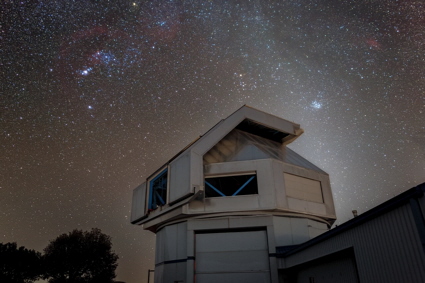
The winter sky (click to enlarge) arcs over the WIYN 3.5-meter Telescope at Kitt Peak National Observatory (KPNO) in Arizona. Visible in the upper left is the constellation Orion. The concentration of stars in the right is the Pleaides star cluster. Image Credit KPNO/NOIRLab/NSF/AURA/T. Matsopoulos
Sidus Space Announces LizzieSat™ Has Arrived at Vandenberg Space Force Base in California for Launch
Milestone positions LizzieSat™-3 for operational deployment in early 2025, bringing AI- powered advanced data services to critical industries
CAPE CANAVERAL, Fla.-- Sidus Space (NASDAQ: SIDU) (the "Company" or "Sidus"), an innovative, agile space mission enabler, today announced that LizzieSat™-3 has arrived at Vandenberg Space Force Base in California to begin spacecraft integration in preparation for its scheduled launch and deployment into low Earth orbit no earlier than the first quarter of 2025 as part of the Transporter-13 rideshare mission with SpaceX.
"With LizzieSat™-3 ready for launch, we are taking another significant step in expanding our on-orbit capabilities and delivering critical, near real-time data solutions to our customers," said Carol Craig, founder and CEO of Sidus Space. "This milestone demonstrates our commitment to providing scalable, cost-effective solutions tailored to diverse mission needs while showcasing the adaptability of our modular satellite platform."
Equipped with an advanced payload suite, LizzieSat™-3 features an AIS sensor, a high-resolution visual spectrum sensor and the HEO Holmes Imager, which powers HEO Inspect for non-Earth imaging and space object characterization. The satellite also features the next generation of Sidus' proprietary artificial intelligence system, enabling on-orbit data processing that combines multiple sources of data to provide timely, actionable insights for applications such as environmental monitoring, border security and disaster response. Through use of its space-to-space data relay module, Sidus expects to be able to provide rapid direct-to-user data transfer capability and significantly reduce data latency.
Following the successful launch of LizzieSat™-2 on December 21, 2024, which is currently in its commissioning phase, LizzieSat™-3 represents the next step in Sidus Space's commitment to delivering rapid response, flexible and cost-effective solutions tailored to the unique needs of government, defense, intelligence and commercial customers.
Sidus Space
Berkeley Lab Helps Explore Mysteries of Asteroid Bennu
The Advanced Light Source and Molecular Foundry provided powerful tools to study asteroid samples returned by NASA's OSIRIS-REx mission. Researchers found a telltale set of salts formed by evaporation that illuminate Bennu's watery past.
(JAN 29) During the past year, there's been an unusual set of samples at the Department of Energy's Lawrence Berkeley National Laboratory (Berkeley Lab): material gathered from the 4.5-billion-year-old asteroid Bennu when it was roughly 200 million miles from Earth. More
Falcon 9 Launch Delights Skywatchers
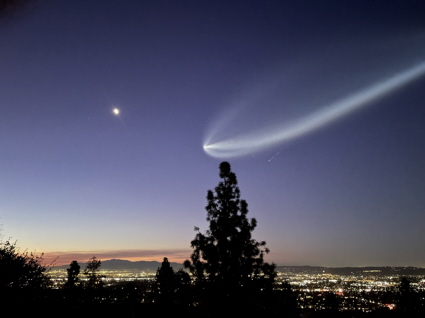
A Falcon 9 rocket creates an impressive display as it climbs into orbit at dawn on Friday. Sue Wessler recorded the event from Claremont, Calif. Image copyright 2025, Sue Wessler. Used with permission
(JAN 26) A dawn rocket from California on Friday created a light show for skywatchers over a wide area.
The SpaceX Falcon 9 rocket lifted off from Space Launch Complex 4-East (SLC-4E) at south Vandenberg Space Force Base at 06:07 PST. After rising vertically for several seconds, the vehicle turned towards the south-southeast and roughly paralleled the coast as it carried 23 Starlink satellites into orbit
During the second stage burn, at approximately T+3 minutes 30 seconds, the rocket climbed high enough for sunlight to begin illumiating the exhaust plume, resulting in an impressive display. The jettisoned first stage and payload shroud halves appeared as orange dots as they fell away from the rocket. Later, a tenuous trail from the first stage was visible as it descended for landing on a drone ship down range.
Friday's event was among the five or six most impressive Vandenberg launches I have seen since I began watching them in November of 1967.
Brian Webb
NASA's SPHEREx Telescope Arrives for Final Launch Preparations
(JAN 16) NASA's SPHEREx spacecraft arrived Tuesday, Jan. 14, at Astrotech Space Operations located inside Vandenberg Space Force Base in California for final processing before launching on its two-year mission.
The SPHEREx (Spectro-Photometer for the History of the Universe, Epoch of Reionization and Ices Explorer) observatory is targeted to launch at the end of February on a SpaceX Falcon 9 rocket from Space Launch Complex 4E.
Following launch, SPHEREx will support NASA's goals of discovering the secrets of the universe and searching for the ingredients for life elsewhere. The telescope will scan the sky in the infrared spectrum from a position in Earth orbit and complete four all-sky maps. These will allow scientists to learn about a variety of topics, including the origins of water on planets like Earth, to the physics that governed the universe less than one second after its birth.
After final tests and checkouts, teams will mate SPHEREx and its rideshare PUNCH (Polarimeter to Unify the Corona and Heliosphere) in preparation for encapsulation in the payload fairings of the Falcon 9 rocket.
NASA
SATCOM Prototype
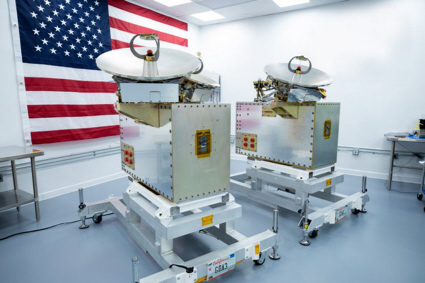
Northrop Grumman Corporation successfully completed assembly and testing of its Protected Tactical Satcom Rapid Prototype (PTS-P) payload and delivered it to the company's facility in Gilbert, Arizona, where it will be integrated with an ESPAStar-HP bus and next-generation digital processing subsystem. Built in partnership with the U.S. Space Force's Space Systems Command, the company's PTS rapid prototype delivers a modular, flexible and scalable system that offers a path toward fielding a next-generation anti-jam, protected tactical satellite communications architecture. Photo Credit: Northrop Grumman
NRO Successfully Launches First Mission of 2025 with NROL-153
First of approximately a dozen NRO launches planned for 2025
(JAN 9) CHANTILLY, Va. - The National Reconnaissance Office (NRO), in partnership with U.S. Space Force Space Launch Delta 30 and SpaceX, successfully launched the NROL-153 mission aboard a SpaceX Falcon 9 rocket from Space Launch Complex-4 East at Vandenberg Space Force Base in California on Jan. 9, 2025, at 10:53 p.m. EST.
This mission is the seventh launch of the NRO's proliferated architecture and marks the first NRO launch of 2025. Building on the success of the NROL-149 launch on Dec. 17, today's mission demonstrates the ongoing launch cadence that is strengthening the NRO's intelligence, surveillance, and reconnaissance capabilities.
NRO achieved significant success in the past year with the deployment of nearly 100 satellites on orbit. Continuing with this momentum, 2025 is set to be another dynamic year, with approximately a dozen NRO launches scheduled. Half of these launches will focus on advancing the NRO's proliferated architecture with additional proliferated launches planned through 2028, ensuring sustained growth and innovation.
For more than 60 years, the NRO has successfully met the needs of its U.S. intelligence, military, civil, and allied partners. It remains the world's leader in unique intelligence, surveillance, and reconnaissance systems. The NRO's next-generation systems will help ensure that the right data is delivered to the right user at the right time, faster than ever before.
Additional information on upcoming launches will be available at NRO.gov/launch.
National Reconnaissance Office
Ursa Major Awarded Contract
(DEC 31) URSA Major Technologies Inc., Berthoud, Colorado, was awarded a $7,650,000 firm-fixed-price contract for space launch system propulsion technology. This contract provides for follow-on work to mature advanced liquid rocket engines. Work will be performed in Berthoud, Colorado, and is expected to be completed by May 11, 2027. This contract was a competitive broad agency announcement acquisition, and one offer was received. Fiscal 2024 research and development funds in the amount of $7,650,000 are being obligated at the time of award. The Air Force Research Laboratory, Edwards Air Force Base, California, is the contracting activity (FA9300-25-C-6001).
Depatment of Defense
Falcon 9 Launched
(DEC 28) A Falcon 9 rocket carrying 22 Starlink satellites was launched this evening at 5:58:30 p.m. PST from Vandenberg SFB, Calif. Eight minutes after liftoff, the rocket's first stage landed on a downrage drone ship. SpaceX later confirmed deployment of the satellites.
The launch was probably visible over a wide area and produced a sonic boom. Liftoff was too long after sunset for the Sun to illuminate the rocket's exhaust at high altitude.
Brian Webb
Falcon 9 Launched
(DEC 21) On Saturday, December 21 at 3:34 a.m. PT, Falcon 9 launched the Bandwagon-2 mission to orbit from Space Launch Complex 4 East (SLC-4E) at Vandenberg Space Force Base in California. On board this mission were 30 payloads for KOREA ADD, Arrow Science and Technology, Exolaunch, HawkEye 360, Maverick Space Systems, Sidus Space, Tomorrow Companies Inc., True Anomaly, and Think Orbital.
This was thee 21st flight of the first stage booster supporting this mission, which previously launched NROL-87, NROL-85, SARah-1, SWOT, Transporter-8, Transporter-9, NROL-146, and 13 Starlink missions.
SpaceX
Northrop Grumman Launches Black Dagger Target to Test New Patriot Missile System Sensor
(DEC 18) CHANDLER, Ariz. - Northrop Grumman Corporation (NYSE: NOC) launched a Zombie target vehicle variation, known as "Black Dagger," from Fort Wingate to White Sands Missile Range, New Mexico, for the U.S. Army Space and Missile Defense Command's (USASMDC) LTZ-3 test mission. Zombie targets get their name because they bring "new life" to demilitarized solid rocket motors by repurposing them to create threat-representative tactical ballistic missiles.
The successful test demonstrated the capabilities of the Integrated Battle Command System (IBCS), the Lower Tier Air and Missile Defense Sensor and Patriot Advanced Capability-3 air defense systems.
-
Zombie targets repurpose demilitarized solid rocket motors to simulate adversary tactical ballistic missiles while driving affordability and cutting development time for advanced missile defense testing.
-
Northrop Grumman, in partnership with Teledyne Brown Engineering and Peraton, Inc., have developed, delivered and successfully launched nine Zombie targets as intercept test vehicles for the USASMDC's Tactical Range Air Defense Missile (TACRAM) contract.
-
Northrop Grumman produces six Zombie configurations that offer varying capabilities and emulate customer-specified threats, including the "Black Dagger" configuration tested.
Zombie targets are a suite of low-cost tactical ballistic missile targets which test and verify U.S. missile defense systems.
The TACRAM program reduces the cost of Army missile defense programs' test and evaluation efforts by creating low-cost, threat-representative target solutions. Northrop Grumman will continue partnering to build and launch Zombie targets to test advanced missile defense systems under the TACRAM 2 contract, awarded earlier this year and extending to 2028.
Satellites Launched from California
(DEC 13) A Falcon 9 rocket was launched today from Vandenberg SFB, Calif. The vehicle lifted off from Space Launch Complex 4 East (SLC-4E) on south base at 1:55 p.m. PST (21:55 UTC) and carried 22 Starlink satellites into orbit. Several minutes after launch, the rocket's first stage successfully landed on a drone ship down range. At 3:44 p.m. PST, SpaceX confirmed deployment of the satellites.
Brian Webb
NASA Eyes SPHEREx Launch in Early 2025
(DEC 9) NASA and SpaceX are targeting late February 2025 for the launch of the agency's next astrophysics observatory, SPHEREx. Short for Spectro-Photometer for the History of the Universe, Epoch of Reionization and Ices Explorer, SPHEREx will launch aboard a SpaceX Falcon 9 rocket from Vandenberg Space Force Base in California.
About the size of a subcompact car, SPHEREx will enter a polar orbit around Earth and create a map of the entire sky in 3D, taking images in every direction, like scanning the inside of a globe. The map will contain hundreds of millions of stars and galaxies, showing them in 102 colors (each a different wavelength of light).
Scientists will use SPHEREx's all-sky map to achieve the mission's three key science goals. The first is to shed light on a cosmic phenomenon called inflation, a brief but powerful cosmic event when space itself increased in size by a trillion-trillionfold less than a second after the big bang. The observatory will measure the distribution of hundreds of millions of galaxies to improve understanding of what drove inflation and of the physics behind this event.
The SPHEREx mission will also measure the collective glow from galaxies near and far, including light from hidden galaxies that haven't been individually observed. This data will provide a more complete picture of all the objects and sources radiating in the universe.
Its third key science goal is to search the Milky Way galaxy for icy granules of water, carbon dioxide, and other essential building blocks of life. The mission will help scientists discover the location and abundance of these icy compounds in our galaxy, giving them a better sense of how likely they are to be incorporated into newly forming planets.
Launching as a secondary payload on the same Falcon 9 rocket as SPHEREx will be NASA's PUNCH mission (Polarimeter to Unify the Corona and Heliosphere). Led by Southwest Research Institute's office in Boulder, Colorado, and managed by NASA's Goddard Space Flight Center in Greenbelt, Maryland, PUNCH is a constellation of four small satellites heading to low Earth orbit that will make global, 3D observations of the Sun's corona to learn how the mass and energy there become solar wind.
Jet Propulsion Laboratory
Northern Lava
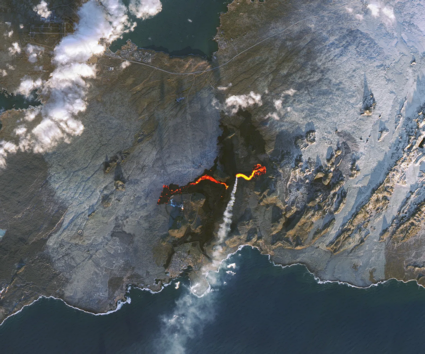
Lava encroaches on the Blue Lagoon, a popular tourist destination in Iceland, in this November 24 Landsat 9 image overlaid with an infrared signal. The infrared signal helps distinguish the lava's heat signature. Landsat 9 was launched in 2021 from Vandenberg Space Force Base in California onboard a United Launch Alliance Atlas rocket. Image: NASA/Michala Garrison/U.S. Geological Survey/Suomi National Polar-orbiting Partnership
Zwicky Transient Facility Leads to Classification of 10,000 Supernovae
(DEC 4) In the 1930s, Caltech astronomer Fritz Zwicky would brave the chill atop Palomar Mountain near San Diego to peer through a small survey telescope in search of eruptions in the night sky. In the 1940s, he and his collaborator, astronomer Walter Baade, continued the quest using a larger survey telescope, the 48-inch Samuel Oschin telescope at Palomar Observatory, still in operation today. More
Varda Awarded Contract
(NOV 26) Varda Space Industries Inc., El Segundo, California, was awarded a maximum $48,000,000 firm-fixed-price, indefinite-delivery/indefinite-quantity contract for space reentry payload testing. This contract provides for a series of space reentry payload flights with multiple possible configurations. Work will be performed in El Segundo, California, and is expected to be completed by May 4, 2028. This contract was a sole source acquisition under Small Business Innovation Research Phase III. No funds are being obligated at time of award. The Air Force Research Labs, Space Vehicles Directorate, Kirtland Air Force Base, New Mexico, is the contracting activity.
Department of Defense
Space Watch
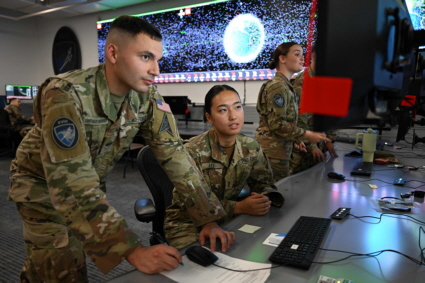
Space Force guardians observe orbital data at Vandenberg Space Force Base, Calif. on October 4. U.S. Space Force photo by David Dozoretz
Trident II Contract Awarded
(NOV 19) Northrop Grumman Systems Corp., Marine Systems (NGSC-MS), Sunnyvale, California, is being awarded a $42,364,171 cost-plus-incentive-fee and cost-plus-fixed-fee contract (N0003025C1010) to provide ongoing support of the Trident II (D-5) deployed ballistic missile submarines and the guided missile submarines (SSGN) underwater launcher systems (ULS). NGSC-MS will provide technical engineering support and integration for D-5 and the SSGN attack weapon system. This support includes field services at sites and shipyards. The contract also has optional line items for continued support in the total amount of $318,716,528. This contract award also benefits a Foreign Military Sale. Work will be performed in Sunnyvale, California (51%); Bangor, Washington (18%); Kings Bay, Georgia (15%); Cape Canaveral, Florida (10%); Rocket Center, West Virginia (5%); and Annapolis, Maryland (1%). Work is expected to be completed by Sept. 30, 2031. Fiscal 2025 operations and maintenance (Navy) funds in the amount of $10,179,650 will be obligated at time of award and will expire at the end of the current fiscal year; and fiscal 2024 research development test and evaluation (Navy) funds in the amount of $7,716,758 will be obligated at time of award and will expire at the end of the current fiscal year. This contract is being awarded as a sole-source acquisition pursuant to 10 U.S. Code 3204(a)(1) and was previously synopsized on the System for Award Management (SAM.gov) online portal. Strategic Systems Programs, Washington, D.C., is the contracting activity.
Department of Defense
SMDC Supports Air Force Readiness Test
(NOV 14) REDSTONE ARSENAL, Ala. - A U.S. Army Space and Missile Defense Command team played an important behind-the-scenes role in Air Force Global Strike Command's recent operational test to showcase readiness of U.S. nuclear forces as safe, secure, reliable and effective. More
Minuteman III Test Showcases Readiness of U.S. Nuclear Force's Safe, Effective Deterrent
(NOV 6) BARKSDALE AIR FORCE BASE, La. -- A joint team of Air Force Global Strike Command Airmen and Navy aircrew launched an unarmed Minuteman III intercontinental ballistic missile equipped with multiple targetable re-entry vehicles from aboard the Airborne Launch Control System Nov. 5, 2024 at 11:01 p.m. Pacific Time from Vandenberg Space Force Base, California. More
Phobos Transit
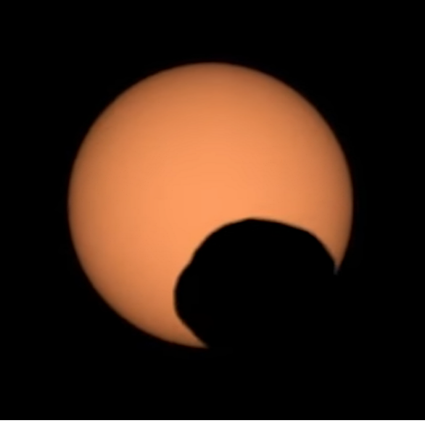
NASA's Perseverance Mars rover recently captured the silhouette of the Martian moon Phobos as it passed in front of the Sun. This image from a video of the event released by the Jet Propulsion Laboratory (JPL) shows the moon's distinctive potato shape. JPL in Pasadena, Calif., built and manages operations of the Perseverance rover. Credit: NASA/JPL-Caltech/ASU/MSSS
Why NASA's SPHEREx Mission Will Make 'Most Colorful' Cosmic Map Ever
(OCT 31) NASA's SPHEREx mission won't be the first space telescope to observe hundreds of millions of stars and galaxies when it launches no later than April 2025, but it will be the first to observe them in 102 colors. More
An X-Class Double Solar Flare
(OCT 26) Solar activity remains high with an X-class double solar flare on Oct. 26th. The explosion hurled an impressive CME into space, and it appears to have an Earth-directed component. Several big sunspots are turning toward Earth, so this could be the beginning of a week of stormy space weather. Full story @ Spaceweather.com.
Spaceweather.com
Sandia Tests Heat Shields for Space
(OCT 15) ALBUQUERQUE, N.M. - For decades, Sandia National Laboratories' National Solar Thermal Test Facility has harnessed the power of the sun to expose aerospace materials to intense heat, replicating the harsh conditions of faster-than-sound flight and atmospheric reentry to ensure the materials' ability to protect the rest of the vehicle. More
Methane Plume
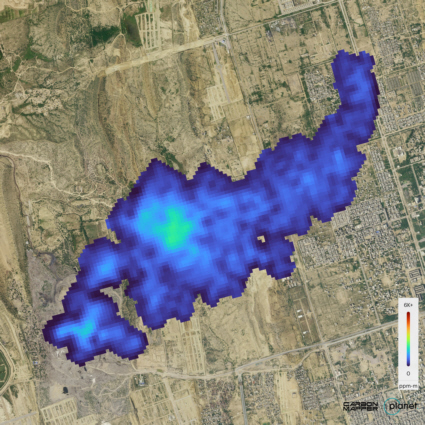
Using an instrument designed by the Jet Propulsion Laboratory in California, the Tanager-1 satellite recently detected this 2.25-mile long methane plume from a landfill in Karachi, Pakistan. Methane is classified as a greenhouse gas and is belived to be linked to climate change. Tanager-1 was launched from Vandenberg Space Force Base on August 16. Image: Credit: Carbon Mapper/Planet Labs PBC. Caption: JPL
NASA Turns Off Science Instrument to Save Voyager 2 Power
(OCT 1) Mission engineers at NASA have turned off the plasma science instrument aboard the Voyager 2 spacecraft due to the probe's gradually shrinking electrical power supply. More
Falcon 9 Sonic Boom Advisory
(SEP 27) SpaceX is targeting Sunday, September 29 for Falcon 9's launch of the OneWeb Launch 20 mission to low-Earth orbit from Space Launch Complex 4E (SLC-4E) at Vandenberg Space Force Base in California. The window opens at 11:54 p.m. PT. If needed, there is a backup opportunity on Monday, September 30 at 11:49 p.m. PT.
About eight minutes after liftoff, Falcon 9's first stage will land on SpaceX's Landing Zone 4 (LZ-4) at Vandenberg Space Force Base, California. There is the possibility that residents of Santa Barbara, San Luis Obispo, and Ventura counties may hear one or more sonic booms during the landing, but what residents experience will depend on weather and other conditions.
SpaceX's live webcast will begin approximately 10 minutes before Falcon 9's liftoff at spacex.com/launches.
SpaceX
Lockheed Martin Selected for Lightning Mapper
(SEP 17) NASA, on behalf of the National Oceanic and Atmospheric Administration (NOAA), has selected Lockheed Martin Corp. of Littleton, Colorado, to develop a lightning mapping instrument as part of NOAA's Geostationary Extended Observations (GeoXO) satellite program.
This cost-plus-award-fee contract is valued at approximately $297.1 million. It includes the development of two flight instruments as well as options for two additional units. The anticipated period of performance for this contract includes support for 10 years of on-orbit operations and five years of on-orbit storage, for a total of 15 years for each flight model. The work will take place at Lockheed Martin's facilities in Sunnyvale, California, and Littleton, Colorado, NASA's Goddard Space Flight Center in Greenbelt, Maryland, and the agency's Kennedy Space Center in Florida.
The GeoXO Lightning Mapper will detect, locate, and measure the intensity, duration, and extent of lightning flashes. The instrument will continue critical observations provided by the Geostationary Operational Environmental Satellites-R (GOES-R) Series Geostationary Lightning Mapper. Data from Lightning Mapper will be used to analyze severe storms, increase warning lead time for hazardous weather, and provide earlier indications of impending lightning strikes to the ground. The data will also be used for hurricane intensity prediction, wildfire detection and response, precipitation estimation, and to mitigate aviation hazards.
Forecasters need lightning information from geostationary orbit because the data are available where other sources are more limited, especially over oceans and in mountainous and rural areas. The data are also available more frequently than local radar and fill in radar coverage gaps.
The GeoXO Program is the follow-on to the GOES-R Series Program. The GeoXO satellite system will advance Earth observations from geostationary orbit. The mission will supply vital information to address major environmental challenges of the future in support of weather, ocean, and climate operations in the United States. The advanced capabilities from GeoXO will help address our changing planet and the evolving needs of the nation's data users. Both NASA and NOAA are working to ensure these critical observations are in place by the early 2030s when the GOES-R Series nears the end of its operational lifetime.
Together, NOAA and NASA oversee the development, launch, testing, and operation of all the satellites in the GeoXO Program. NOAA funds and manages the program, operations, and data products. On behalf of NOAA, NASA and commercial partners develop and build the instruments and spacecraft and launch the satellites.
NASA
Pyrocumulus
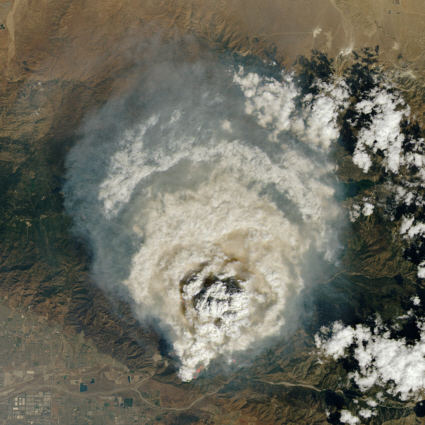
Clouds created partly by the heat from an intense wildfire known as the "Line Fire" rise above the southern California mountains. Known as pyrocumulus, these tall, billowing features typically have a column of smoke at their base and powerful updrafts that channel large amounts of smoke high into the atmosphere. As the convective plume rises, water vapor condenses around small particles to form cloud droplets and eventually visible clouds at the top of the smoke plume. The Operational Land Imager on the Landsat 8 spacecraft recorded this view of the clouds during a daylight pass over the Line Fire on September 9. Image and caption courtesy of NASA, the U.S. Geological Survey, Lauren Dauphin, and Adam Voiland.
Boeing Pioneering Quantum Communications Technology with In-Space Test Satellite
(SEP 10) EL SEGUNDO, Calif. -- Boeing [NYSE: BA] today announced the scheduled 2026 launch of a satellite - dubbed Q4S - which is designed to demonstrate quantum entanglement swapping capabilities on orbit. More
NASA, Boeing Welcome Starliner Spacecraft to Earth
(SEP 6) NASA and Boeing safely returned the uncrewed Starliner spacecraft following its landing at 10:01 p.m. MDT Sept. 6 at White Sands Space Harbor in New Mexico, concluding a three-month flight test to the International Space Station.
The flight on June 5 was the first time astronauts launched aboard the Starliner. It was the third orbital flight of the spacecraft, and its second return from the orbiting laboratory. Starliner now will ship to NASA's Kennedy Space Center in Florida for inspection and processing.
NASA's Commercial Crew Program requires a spacecraft to fly a crewed test flight to prove the system is ready for regular flights to and from the orbiting laboratory. Following Starliner's return, the agency will review all mission-related data.
NASA astronauts Butch Wilmore and Suni Williams launched on June 5 aboard Starliner for the agency's Boeing Crewed Flight Test from Cape Canaveral Space Force Station in Florida. On June 6, as Starliner approached the space station, NASA and Boeing identified helium leaks and experienced issues with the spacecraft's reaction control thrusters. Following weeks of in-space and ground testing, technical interchange meetings, and agency reviews, NASA made the decision to prioritize safety and return Starliner without its crew. Wilmore and Williams will continue their work aboard station as part of the Expedition 71/72 crew, returning in February 2025 with the agency's SpaceX Crew-9 mission.
The crew flight test is part of NASA's Commercial Crew Program. The goal of NASA's Commercial Crew Program is safe, reliable, and cost-effective transportation to and from the International Space Station and low Earth orbit. This already is providing additional research time and has increased the opportunity for discovery aboard humanity's microgravity testbed, including helping NASA prepare for human exploration of the Moon and Mars.
Learn more about NASA's Commercial Crew program at:
https://www.nasa.gov/commercialcrew
NASA
Falcon 9 Launched
(SEP 6) A Falcon 9 rocket was launched from Vandenberg SFB, Calif. Thursday evening (September 5) at 20:20 PDT. The launch was conducted to place the NROL-113 mission into orbit.
Liftoff occurred too long after sunset to produce a Twilight Effect.
Brian Webb
Los Angeles Native Assigned to Space Station Mission

Official portrait of NASA astronaut Jonny Kim in an EMU suit. Credit: NASA
(AUG 28) During his first mission to the International Space Station, NASA astronaut Jonny Kim will serve as a flight engineer and member of the upcoming Expedition 72/73 crew.
Kim will launch on the Roscosmos Soyuz MS-27 spacecraft in March 2025, accompanied by Roscosmos cosmonauts Sergey Ryzhikov and Alexey Zubritsky. The trio will spend approximately eight months at the space station.
While aboard the orbiting laboratory, Kim will conduct scientific investigations and technology demonstrations to help prepare the crew for future space missions and provide benefits to people on Earth.
NASA selected Kim as an astronaut in 2017. After completing the initial astronaut candidate training, Kim supported mission and crew operations in various roles including the Expedition 65 lead operations officer, T-38 operations liaison, and space station capcom chief engineer.
A native of Los Angeles, Kim is a United States Navy lieutenant commander and dual designated naval aviator and flight surgeon. Kim also served as an enlisted Navy SEAL. He holds a bachelor's degree in Mathematics from the University of San Diego and a medical degree from Harvard Medical School in Boston, and completed his internship with the Harvard Affiliated Emergency Medicine Residency at Massachusetts General Hospital and Brigham and Women's Hospital.
NASA
NASA's EXCITE Mission Prepared for Scientific Balloon Flight
(AUG 22) Scientists and engineers are ready to fly an infrared mission called EXCITE (EXoplanet Climate Infrared TElescope) to the edge of space. More
Falcon 9 Launched
(AUG 17) A Falcon 9 rocket carrying numerous small satellites was launched from Space Launch Complex-4E at Vandenberg SFB, Calif. on Friday at 11:56 a.m. PDT.
After reaching orbit, a fuel dump from the rocket's second stage was seen and imaged by space enthusiasts in Finland.
Brian Webb
Western Wildfires

Dry weather, high temperatures, and strong winds are key components that set the stage for numerous and fierce wildland fires in the Western United States in the summer of 2024. On August 6, the Moderate Resolution Imaging Spectroradiometer (MODIS) on NASA's Aqua satellite acquired this true-color image of fire and smoke across the Western United State. Each red hot spot marks an area where the thermal bands on the instrument detected high temperatures. This image sweeps across the boundary with Canada in the north and across parts of California, Nevada, and Utah in the south. The largest fire in the U.S. is the Park Fire, and it is visible in the seen in the southwest (lower left) of the image. Image and caption courtesy of NASA GSFC
NASA to Launch 8 Scientific Balloons From New Mexico
(AUG 9) NASA's Scientific Balloon Program has kicked off its annual fall balloon campaign at the agency's balloon launch facility in Fort Sumner, New Mexico. More
Sunspot Counts Hit a 23-year High
(AUG 2) The sun is partying like it's 2001. That's the last time sunspot counts were as high as they are now. The monthly average sunspot number for July 2024 was 196.5, according to the Royal Observatory of Belgium's Solar Influences Data Analysis Center. This eclipses every month since Dec. 2001:
Solar Cycle 25 wasn't expected to be this strong. When it began in Dec. 2019, experts predicted it would be a weak cycle like its immediate predecessor Solar Cycle 24. If that forecast had panned out, Solar Cycle 25 would be one of the weakest solar cycles in a century.
Instead, Solar Cycle 25 has shot past Solar Cycle 24 and may be on pace to rival some of the stronger cycles of the 20th century. Already in May 2024 we have experienced a century-class geomagnetic storm with auroras sighted in the South Pacific, central America and south Africa.
The last time sunspot numbers were this high, the sun was on the verge of launching the Great Halloween Storms of 2003, which included the strongest X-ray solar flare ever recorded (X45) and a CME so powerful it was ultimately detected by the Voyager spacecraft at the edge of the solar system.
Is this Solar Max? The jury is still out. Sunspot numbers may continue to rise in the months ahead and, based on the behavior of previous cycles, we can confidently expect high solar activity for at least 2 to 3 more years. Stay tuned! Solar flare alerts: SMS Text SMS Text
SpaceWeather.com
Falcon 9 Launched
(JUL 28) On Sunday, July 28 at 2:22 a.m. PT, Falcon 9 launched 21 Starlink satellites, including 13 with Direct to Cell capabilities, to low-Earth orbit from Space Launch Complex 4 East (SLC-4E) at Vandenberg Space Force Base in California.
This was the 17th flight for the first stage booster supporting this mission, which previously launched NROL-87, NROL-85, SARah-1, SWOT, Transporter-8, Transporter-9, NROL-146, and now 10 Starlink missions.
SpaceX
SpaceX Awarded Launch Contract
(JUL 22) NASA, on behalf of the National Oceanic and Atmospheric Administration (NOAA), has selected SpaceX (Space Exploration Technologies Corporation) to provide launch services for NOAA's JPSS-4 mission. The spacecraft is part of the multi-satellite cooperative Joint Polar Satellite System (JPSS) program, a partnership between NASA and NOAA. This mission is the next satellite in the program, which began with the Suomi National Polar-orbiting Partnership.
This is a firm fixed price contract with a value of approximately $112.7 million, which includes launch services and other mission related costs. The JPSS-4 mission currently is targeted to launch in 2027, on a SpaceX Falcon 9 rocket from Space Launch Complex 4 East at Vandenberg Space Force Base in California.
The JPSS constellation of satellites collects global multi-spectral radiometry and other specialized meteorologic, oceanographic, and solar-geophysical data via remote sensing of land, sea, and atmospheric properties. These data support NOAA's mission for continuous observation of Earth's environment to understand and predict changes in weather, climate, oceans, and coasts to support the nation's economy and protect lives and property. NASA uses the instruments aboard the JPSS satellites to continue decades of Earth science research for the betterment of humanity. When launched, JPSS-4, will carry the NASA Earth Venture mission Libera, an instrument that will improve our understanding of trends in Earth's energy imbalance and our changing climate.
NASA's Launch Services Program at the agency's Kennedy Space Center in Florida is responsible for managing the launch services. NASA's Goddard Space Flight Center in Greenbelt, Maryland, manages the JPSS Flight Projects Office, which oversees the acquisition of the JPSS series instruments and spacecraft. A collaborative NOAA and NASA team manages the JPSS Program.
For more information about NASA programs and missions, visit:
https://www.nasa.gov
NASA
City Hall

Ten weeks after launch from Vandenberg SFB, Calif., the first images from Maxar's WorldView Earth imaging spacecraft were released. This view (click to enlarge) of San Francisco city hall was taken on July 16 and demonstrates the spacecraft's 30-cm resolution imaging capability. Image Credit: Maxar
NASA Sounding Rocket Launches, Studies Heating of Sun's Active Regions
(JUL 18) Investigators at NASA's Marshall Space Flight Center in Huntsville, Alabama, will use observations from a recently-launched sounding rocket mission to provide a clearer image of how and why the Sun's corona grows so much hotter than the visible surface of Earth's parent star. The MaGIXS-2 mission - short for the second flight of the Marshall Grazing Incidence X-ray Spectrometer - launched from White Sands Missile Range in New Mexico on Tuesday, July 16. More
Unsuccessful Launch
(JUL 12) A Falcon 9 rocket carrying several Starlink satellites was launched at 7:35 p.m. PDT Thursday (July 11) from Vandenberg SFB, Calif. The second stage engine experienced a problem and the satellites were deployed into a lower than planned orbit.
Brian Webb
Flyby
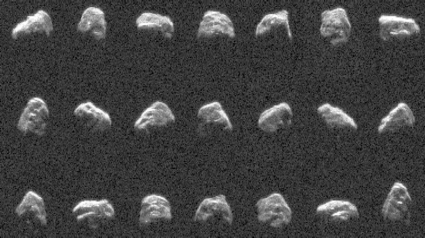
The Goldstone Solar System Radar in the California desert, part of NASA's Deep Space Network, imaged the recently discovered 500-foot-wide (150-meter-wide) asteroid 2024 MK, which made its closest approach - within about 184,000 miles (295,000 kilometers) of Earth - on June 29. This mosaic (click to enlarge) shows the spinning asteroid in one-minute increments about 16 hours after its closest approach. Image Credit: NASA/JPL-Caltech
Firefly Aerospace Successfully Launches Alpha FLTA005 Noise of Summer Mission for NASA
(JUL 4) VANDENBERG SPACE FORCE BASE, Calif., - Firefly Aerospace, an end-to-end space transportation company, today announced it successfully launched its Alpha Flight 5 (FLTA005) rocket and completed the payload deployment sequence as part of the company's Venture-Class Launch Services Demonstration 2 (VCLS Demo 2) contract with NASA.
The mission, called Noise of Summer, lifted off from Firefly's SLC-2 launch site at the Vandenberg Space Force Base at 9:04 p.m. PDT on July 3, 2024. Following payload deployment, Firefly successfully performed a second stage relight and plane change maneuver to further test and validate Alpha's on-orbit capabilities.
"The Firefly team knocked it out of the park," said Bill Weber, CEO of Firefly Aerospace. "As a NASA vendor for both launch and lunar services, we look forward to continuing this partnership and supporting the agency's larger space exploration goals from Earth to the Moon and beyond."
As a NASA VCLS Demo 2 task order, the successful mission further validates Alpha's capabilities to provide small satellite launches for NASA on a recurring basis. The mission's CubeSats were selected through NASA's CubeSat Launch Initiative (CSLI) that provides U.S. educational institutions and nonprofits with low-cost access to space.
"The launch of Firefly Aerospace's demonstration mission marks one more way NASA is innovating for the benefit of humanity," said Hamilton Fernandez, mission manager for NASA's Launch Services Program. "NASA is using CubeSat missions to demonstrate the capability of small rockets and build relationships with this new part of the U.S. launch vehicle industry."
At the time of this release, ongoing activities are underway by NASA and the CubeSat teams as they work to acquire signals for all satellites. Additional updates will be posted to the mission webpage.
Looking ahead, Firefly is in the final testing phase for its next Alpha launch, FLTA006, in support of a dedicated commercial mission for Lockheed Martin. The Firefly team is concurrently ramping up for a responsive on-orbit Elytra mission that will launch on Alpha FLTA007 later this year while also working to complete the final readiness milestones for its first Blue Ghost mission to the Moon launching in Q4 2024.
Firefly Aerospace
NRO Launches Second Mission of Proliferated System with NROL-186
Second launch highlights persistent pace of system deployment
(JUN 28) CHANTILLY, Va. - The National Reconnaissance Office (NRO), in partnership with U.S.
Space Force Space Launch Delta 30 and SpaceX, successfully launched the NROL-186 mission
aboard a SpaceX Falcon 9 rocket from Space Launch Complex-4 East at Vandenberg Space
Force Base in California on June 28, 2024 at 11:14 p.m. EDT.
This mission is the second launch of the NRO's proliferated architecture and signifies the
persistent pace of deployment that is expected with this program. Today's successful mission
follows NROL-146, launched last month.
"Our new, proliferated systems enhance our ability to collect and deliver critical information at
the speed our users demand," said Dr. Chris Scolese, director of the NRO. "The diversity of our
overhead architecture allows us to remain agile and resilient amid increasing competition and
emerging threats, ensuring we are well positioned now and in the future to deliver on our mission
of keeping our nation safe."
For more than 60 years, the NRO has successfully met the needs of its U.S. intelligence, military,
civil, and allied partners. It remains the world's leader in unique intelligence, surveillance, and
reconnaissance systems. The NRO's next-generation systems will help ensure that the right data
is delivered to the right user at the right time, faster than ever before.
Approximately half a dozen launches supporting NRO's proliferated architecture are planned for
2024, with additional launches expected through 2028.
Additional information on upcoming launches will be available at NRO.gov/launch.
National Reconnaissance Office
Twilight Effect
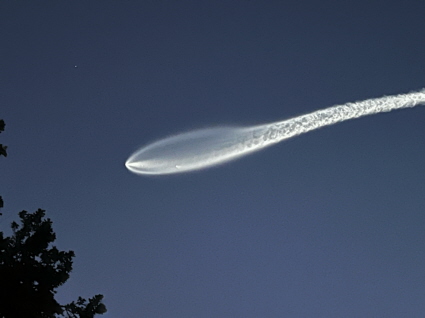
Much to the delight of sky watchers, a dusk Falcon 9 launch from Vandenberg SFB, Calif. on June 18 created a display visible to the unaided eye over a wide area. The spectacle was created as the rocket's exhaust was ilumminated at high altitude by the Sun with a dusk or night sky as a background. Lonnie Balderston recorded this view of the event from Thousand Oaks, Calif. using an Apple iPhone 13 Pro. Copyright 2024, Lonnie Balderston. Used with permission.
Mk21A RV Test Launch Showcases Readiness
(JUN 18) VANDENBERG SPACE FORCE BASE, Calif. -- An operational test launch of an unarmed Mk21A reentry vehicle was launched from Vandenberg Space Force Base aboard a Minotaur I rocket, Monday, June 17, at 11:01 p.m. PT.
The Mk21A RV is currently under contract with Lockheed Martin for its engineering and manufacturing development phase. After attaining full operational capability, the Mk21A RV will be integrated on the nation's intercontinental ballistic missile weapon system. The Mk21A program is currently in early development and overseen by the Air Force Nuclear Weapons Center.
The Minotaur family of launch vehicles is based on government-furnished Peacekeeper and Minuteman rocket motors that Northrop Grumman has integrated with modern flight proven avionics and other subsystems to produce cost-effective, responsive launch vehicles to support missile defense testing and other suborbital applications.
"Test launches like these are crucial for protecting our nation's defense," stated Col. Mark Shoemaker, Commander of Space Launch Delta 30. "As global threats evolve, it's essential to support these launches and maintain access to space to safeguard our nation."
Vandenberg Space Force Base is the United States Space Force's West Coast Spaceport and Test Range, and one of only two high-capacity spaceports for the United States. Vandenberg plays a pivotal role in maintaining our national security posture by leveraging advanced space launch and test range capabilities to deter and defend against emerging threats in the global theatre.
Vandenberg SFB
Voyager 1 Returning Science Data From All Four Instruments
The spacecraft has resumed gathering information about interstellar space.
(JUN 13) PASADENA, Calif. - NASA's Voyager 1 spacecraft is conducting normal science operations for the first time following a technical issue that arose in November 2023.
The team partially resolved the issue in April when they prompted the spacecraft to begin returning engineering data, which includes information about the health and status of the spacecraft. On May 19, the mission team executed the second step of that repair process and beamed a command to the spacecraft to begin returning science data. Two of the four science instruments returned to their normal operating modes immediately. Two other instruments required some additional work, but now, all four are returning usable science data.
The four instruments study plasma waves, magnetic fields, and particles. Voyager 1 and Voyager 2 are the only spacecraft to directly sample interstellar space, which is the region outside the heliosphere - the protective bubble of magnetic fields and solar wind created by the Sun.
While Voyager 1 is back to conducting science, additional minor work is needed to clean up the effects of the issue. Among other tasks, engineers will resynchronize timekeeping software in the spacecraft's three onboard computers so they can execute commands at the right time. The team will also perform maintenance on the digital tape recorder, which records some data for the plasma wave instrument that is sent to Earth twice per year. (Most of the Voyagers' science data is sent directly to Earth and not recorded.)
Voyager 1 is more than 15 billion miles (24 billion kilometers) from Earth, and Voyager 2 is more than 12 billion miles (20 billion kilometers) from the planet. The probes will mark 47 years of operations later this year. They are NASA's longest-running and most-distant spacecraft. Both spacecraft flew past Jupiter and Saturn, while Voyager 2 also flew past Uranus and Neptune.
Jet Propulsion Laboratory
Test Launch
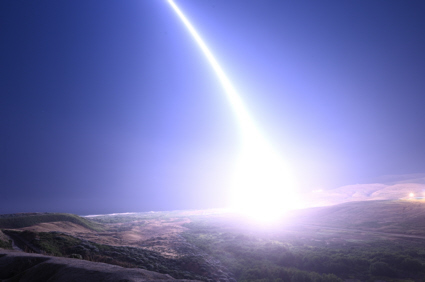
A joint team of Air Force Global Strike Command Airmen supported by Space Force Guardians launch an unarmed Minuteman III missile with one re-entry vehicle early on the morning of June 4 from Vandenberg Space Force Base, Calif. The test launch was part of routine and periodic activities to demonstrate that the United States' nuclear deterrent is safe, secure, reliable and effective to deter 21st century threats and reassure our allies. Such tests have occurred over 300 times before, and this test is not the result of current world events. U.S. Space Force photo by Airman 1st Class Olga Houtsma
Second Minuteman III Test in Week's Time Showcases Readiness of U.S. ICBM Fleet
(JUN 6) BARKSDALE AIR FORCE BASE, La. -- For the second time in a week, a joint team of Air Force Global Strike Command Airmen supported by Space Force Guardians launched an unarmed Minuteman III intercontinental ballistic missile equipped with one re-entry vehicle June 6 at 1:46 a.m. Pacific Time from Vandenberg Space Force Base, California. More
Minuteman III Test Launch Showcases Readiness of U.S. Nuclear Force's Safe, Effective Deterrent
(JUN 4) A joint team of Air Force Global Strike Command Airmen supported by Space Force Guardians launched an unarmed Minuteman III intercontinental ballistic missile equipped with one re-entry vehicle June 4 at 12:56 a.m. Pacific Time from Vandenberg Space Force Base, California. This test launch is part of routine and periodic activities intended to demonstrate that the United States' nuclear deterrent is safe, secure, reliable and effective to deter 21st century threats and reassure our allies. Such tests have occurred over 300 times before, and this test is not the result of current world events.
Vandenberg SFB
Unarmed Minuteman III Test Launch to Showcase Readiness of U.S. Nuclear Force's Safe, Effective Deterrent
(MAY 30) VANDENBERG SPACE FORCE BASE, Calif. -- Vandenberg Guardians and Airmen will support two separate operational test launches of an Air Force Global Strike Command unarmed Minuteman III intercontinental ballistic missile off the Vandenberg Test Range scheduled for the first week of June.
The first test is scheduled for June 4 from 12:01 a.m. to June 4, 2024, 6:01 a.m., Pacific Time from north Vandenberg.
The second test is scheduled for June 6 from 12:01 a.m. to June 6, 6:01 a.m., Pacific Time from north Vandenberg.
The purpose of the ICBM test launch program is to demonstrate the readiness of U.S. nuclear forces and provide confidence in the lethality and effectiveness of the nation's nuclear deterrent, according to Air Force Global Strike Command.
"Vandenberg Guardians and Airmen are committed to supporting our mission partners and these vitally important test launches from the Western Range," said Col. Mark Shoemaker, Space Launch Delta 30 commander. "Test launches like these are critical in safeguarding the defense our nation."
Consistent with previous test launches, this routine, unarmed ICBM test launch will validate and verify the effectiveness, readiness and accuracy of the weapon system.
"A previous test launch slated for February 2024 had to be postponed due to some needed repairs at Reagan Test Site," said Col. Chris Cruise, 377th Test and Evaluation Group commander. "This summer's test launch was already scheduled so it made sense to do them both while all the necessary personnel were in place. The launches were scheduled well in advance and have nothing to do with world events."
In accordance with standard procedures, the United States has transmitted a pre-launch notification pursuant to the Hague Code of Conduct, and notified the Russian government in advance, per our existing bi-lateral obligations.
Vandenberg SFB
Electrifying
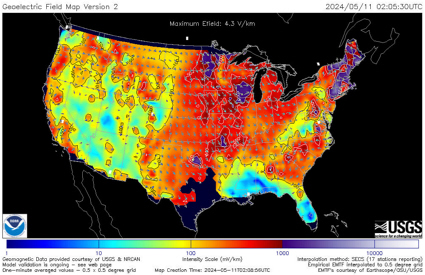
Intense solar activity in early May triggered the biggest geomagnetic storm and brightest auroras in decades. Below ground, the geomagnetic storm caused strong electrical currents to surge through rocks and soil with voltages 10,000 times greater than normal along the U.S. eastern seaboard and in the Midwest. This map shows the geoelectric fields in the continental U.S. on May 11 during the height of the storm. Image courtesy of NOAA / USGS
NRO Launches First Mission of Proliferated System with NROL-146
NRO marks new era of increased volume and diversity of on-orbit and ground systems
(MAY 22) CHANTILLY, Va. - The National Reconnaissance Office (NRO), in partnership with U.S.
Space Force Space Launch Delta 30 and Space Exploration Technologies Corporation (SpaceX),
successfully launched the NROL-146 mission aboard a SpaceX Falcon 9 rocket from Space
Launch Complex-4 East at Vandenberg Space Force Base in California at 4:00 a.m. EDT.
This mission is the first launch of the NRO's proliferated systems featuring responsive collection
and rapid data delivery. NROL-146 represents the first launch of an operational system following
demonstrations in recent years to verify cost and performance.
"Our nation's evolving threats and challenges require constant vigilance, innovation, and
agility," said Dr. Chris Scolese, director of the NRO. "The NROL-146 mission that launched
today reflects the NRO's commitment to developing innovative, faster, and more resilient
technologies and providing greater capabilities to our IC, DoD, and allied partners. These
systems provide key information that can only be obtained from the vantage point of space."
For the past 60 years, the NRO has successfully met the needs of its U.S. intelligence, military,
civil, and allied partners. It remains the world's leader in unique intelligence, surveillance, and
reconnaissance systems. The NRO's next-generation systems will help ensure that the right data
is delivered to the right user at the right time, faster than ever before.
"Over the next decade, we will continue to increase the number of satellites operating across
multiple orbits - complementing the NRO's cutting-edge, highly-capable satellites that are the
traditional hallmark of the NRO - by adding responsive, proliferated systems," said Dr. Troy
Meink, principal deputy director of the NRO. "Our proliferated systems will increase timeliness
of access, diversify communications pathways, and enhance our resilience."
Approximately half a dozen launches supporting NRO's proliferated architecture are planned for
2024, with additional launches expected through 2028.
Additional information on upcoming launches will be available at NRO.gov/launch.
National Reconnaissance Office
Launch Delayed
(MAY 18) Tomorrow morning's planned launch of a Falcon 9 rocket from Vandenberg SFB, Calif. has been delayed to no earlier than May 21. The launch will place the NROL-146 mission into orbit.
Brian Webb
Sunday Rocket Launch
(MAY 17) A Falcon 9 rocket is scheduled for launch early Sunday morning (May 19) from Vandenberg SFB, Calif. The vehicle is slated to lift off from south base at 00:22 PDT and carry the NROL-146 mission into orbit.
Weather permitting, a night launch could be visible over a wide area, but a nearly full Moon in the sky early Sunday morning will probably impair launch viewing.
For countdown status and video feeds of the launch, go to:
https://www.spacex.com/launches/mission
https://spaceflightnow.com
X @SpaceX
This information is preliminary and subject to change.
Brian Webb
Northern Lights
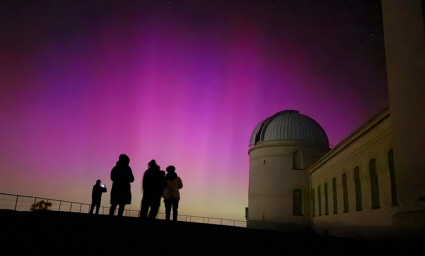
Intense solar activity this week caused auroras over a much wider area than normal including California. Amateur astronomer Rick Baldridge photographed this aurora early on the morning of May 11 from Lick Observatory near San Jose, Calif. Image copyright 2024, Richard Baldridge. Used with permission.
Falcon 9 Launched
(MAY 10) A Falcon 9 rocket carrying 20 Starlink satellites was launched from Vandenberg SFB, Calif. Thursday evening (May 9) at 9:30 p.m. PDT.
Ryan B. in northern California provided the following observation: "I watched the launch from Sacramento and the visibility was good. We had the ISS pass overhead at the same time extremely bright, which was a nice addition."
Brian Webb
First Two WorldView Legion Spacecraft Performing Well After Launch
(MAY 2) WESTMINSTER, Colo. -- Maxar Intelligence, provider of secure, precise geospatial intelligence, today confirmed the first two WorldView Legion satellites are performing well after being launched on a SpaceX Falcon 9 rocket earlier today from Vandenberg Space Force Base, California.
Shortly after launch, the satellites deployed their solar arrays and began receiving and sending signals. These satellites will undergo commissioning, and Maxar Intelligence expects first images from the spacecraft later this spring.
These two satellites are part of a first block of six WorldView Legion satellites. When these six satellites join Maxar Intelligence's constellation, the business will be able to collect imagery of the most rapidly changing areas on Earth as frequently as every 20 to 30 minutes.
"The successful launch of the first two WorldView Legion satellites represents a transformational moment for our business," said Maxar Intelligence CEO Dan Smoot. "These first-of-a-kind satellites will extend the quality and capability of our industry-leading constellation, tripling our ability to collect 30 cm-class imagery with high revisit rates and at more varied times throughout the day - meaning faster, more actionable insights for our customers. Thank you to all team members across Maxar who have worked tirelessly on this program to get us to this moment."
Built by Maxar Space Systems, the two Earth observation satellites are the first Maxar 500TM series high-stability platforms to reach space. WorldView Legion spacecraft are a new approach to Earth imaging satellites. Its optical instrument, provided by Raytheon, delivers the same 30 cm-class imagery that Maxar is known for and benefits from the high stability and pointing accuracy of the Maxar 500 series bus.
"We are proud to partner with Maxar Intelligence on the WorldView Legion program," said Maxar Space Systems CEO Chris Johnson. "We are happy to report the first two satellites launched and are performing nominally, and we remain focused on preparing to launch the additional four satellites later this year."
Learn more about WorldView Legion's features: https://www.maxar.com/worldview-legion
Maxar
Falcon 9 Launched
(MAY 2) A Falcon 9 rocket was launched Thursday morning (May 2) from Vandenberg SFB, Calif. at 11:36 a.m. PDT. The vehicle carried the WorldView 1 and 2 Earth imaging satellites into orbit.
Brian Webb
Next Generation Weather Satellite Launched from California
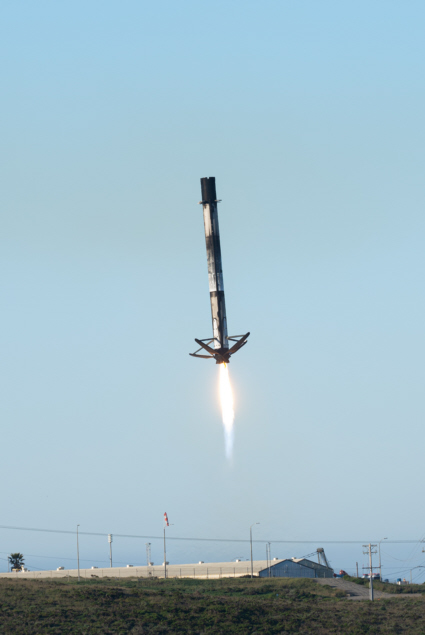
A Falcon 9 rocket first stage lands at Vandenberg SFB, Calif. following the launch of the first Weather System Follow-on - Microwave (WSF-M) satellite. U.S. Space Force photo by Airman 1st Class Olga Houtsma.
(APR 11) EL SEGUNDO, Calif. - Space Systems Command (SSC) and its mission partners successfully launched the United States Space Force (USSF)-62 Weather System Follow-on - Microwave (WSF-M) satellite aboard a SpaceX Falcon 9 rocket at 7:25 a.m. PDT, today, from Space Launch Complex 4 (SLC-4) at Vandenberg Space Force Base in northern Santa Barbara County, California. More
Second Falcon 9 Launch in a Week
(APR 7) A Falcon 9 rocket was launched Saturday evening (April 6) from Vandenberg SFB, Calif. at 7:25 p.m. PDT. The vehicle subsequently placed 21 Starlink satellites into orbit.
Liftoff occurred around local sunset at Vandenberg SFB, making the event likely visible over a wide area (possibly as far away as far northern California; western New Mexico; and Mazatlan, Mexico).
Brian Webb
Falcon 9 Launched
(APR 2) A Falcon 9 rocket was launched Monday evening (April 1) from Vandenberg SFB, Calif. at 7:30 p.m. PDT. The vehicle subsequently placed 22 Starlink satellites into low Earth orbit.
Liftoff occurred shortly after sunset at the launch site. As expected, the rocket's exhaust plume was illuminated by the Sun at high altitude, creating an interesting display. The event was probably more impressive for observers farther east where the sky was darker.
At press time, I have not received any launch observations from outlying areas.
Brian Webb
Environmental Testing
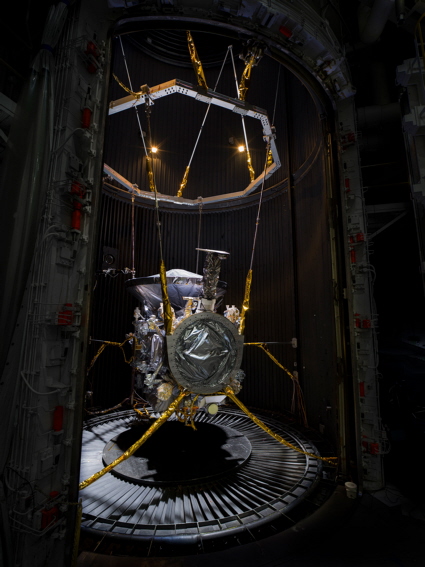
The Europa Clipper is seen in the 25-Foot Space Simulator at the Jet Propulsion Laboratory in Pasadena, Calif. before the start of thermal vacuum testing. A battery of tests ensures that the NASA spacecraft can withstand the extreme hot, cold, and airless environment of space. Europa Clipper, set to launch in October from Kennedy Space Center in Florida, will arrive at Jupiter and conduct flybys of the moon Europa. The mission's main science goal is to determine whether there are places below the surface of Europa that could support life. Credit: NASA/JPL-Caltech
UC Berkeley will Manage $300 Million NASA Mission to Map the UV Universe
(MAR 25) An orbiting space telescope approved by NASA last month and scheduled for launch in 2030 will conduct the first all-sky survey of ultraviolet (UV) sources in the cosmos, providing valuable information on how galaxies and stars evolve, both today and in the distant past. More
Frontier Aerospace to Advance its 500-lbf Engine Design
(MAR 19) THOUSAND OAKS, Calif. -- Frontier Aerospace, a leader in next-generation liquid rocket engines used for commercial space, exploration, and missile defense, announced it had received a contract to advance its 500-lbf engine through Critical Design Review (CDR) in mid-2024.
The 500-lbf engine design has been iterated through internal research and development campaigns to optimize performance with hypergolic propellants. Contract funding will support design and analysis, leading to CDR and achieving engine qualification by 2025.
"We are excited to advance our design and assess the performance as we work to showcase the engine technology and demonstrate its range of capabilities," said Jim McKinnon, president of Frontier Aerospace. "This contract validates our approach to engine development and results."
Frontier Aerospace
Monday Rocket Launch
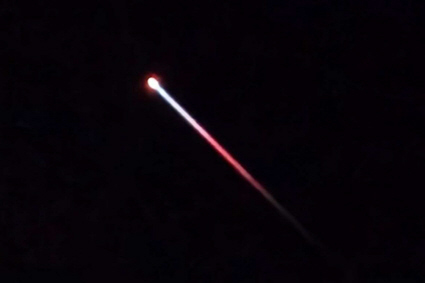
A Falcon 9 rocket climbs into the night sky in Ventura, Calif. on March 10 following launch from Vandenberg SFB. This image shows what some observers may see during tomorrow evening's launch.
(MAR 17) A Falcon 9 rocket is scheduled for launch from Vandenberg SFB, Calif. tomorrow evening (March 18). The vehicle is slated to leave south base between approximately 7:20 and 11:42 p.m. PDT and carry 23 Starlink satellites into orbit.
If the vehicle lifts off early in the launch window, a large portion of the southwestern U.S. and northwest Mexico could be treated to an interesting display as the rocket's exhaust is illuminated by the Sun at high altitude while suspended in a dusk or night sky.
If the Falcon 9 is launched later, the event could still be visible to the unaided eye for hundreds of miles, but the exhaust plume will be much less pronounced.
Observers within several miles of the coast between La Conchita and Zuma Beach may hear a sonic boom from the launch several minutes after liftoff.
For countdown status and video feeds of the launch, go to:
https://www.spacex.com/launches/mission
https://spaceflightnow.com
This information is preliminary and subject to change.
Brian Webb
Space Systems Command Issues Solicitation for On Ramp to OSP-4 Launch Contract
(MAR 15) EL SEGUNDO, Calif. - The U.S. Space Force's Small Launch and Targets Division at Kirtland Air Force Base, Albuquerque, New Mexico, part of Space Systems Command's (SSC) Assured Access to Space (AATS) program executive office, issued a solicitation today to on ramp additional launch providers to the Orbital Services Program (OSP)-4 Indefinite Delivery/Indefinite Quantity (IDIQ) contract. Periodic on ramp opportunities ensure all eligible launch providers within one year of their initial orbital launch are included in OSP-4 mission competitions.
OSP-4 is executed as part of the Rocket Systems Launch Program (RSLP). It allows for the rapid acquisition of launch services to meet mission requirements for payloads 400 pounds or greater, enabling launch within 12-24 months from task order award. Task orders under the contract can be tailored to meet more demanding timelines for Tactically Responsive Space (TacRS) missions or other needs. The contract has a $986 million ceiling with ordering through October 2028. The Space Force will compete each mission ordered under the contract among the IDIQ awardees.
This is the second OSP-4 on ramp opportunity. SSC initially awarded the OSP-4 contract in 2019 followed by the first on ramp in 2021. While there is not an upper limit on the size or performance of launch systems available on the contract, OSP-4 missions are typically structured with an emphasis on small launch capabilities.
There are currently 10 launch providers on the contract: ABL Space Systems, Aevum, Astra, Firefly Aerospace, Northrop Grumman, Relativity Space, Rocket Lab, SpaceX, United Launch Alliance (ULA), and X-Bow.
Space Systems Command
Muon Space Establishes Communications, Confirms Health of Weather Satellite
Building upon NASA heritage, MuSat2 pioneers software-defined sensing to deliver advanced Space Based Environmental Monitoring products to DoD customers.
(MAR 5) MOUNTAIN VIEW, CALIFORNIA - Muon Space, an end-to-end Space Systems Provider revolutionizing the way Earth is monitored from space, proudly announces the successful deployment and operational status of its second ESPA-class satellite, MuSat2. Launched aboard SpaceX's Transporter-10 mission from Vandenberg Space Force Base in California on March 4, MuSat2 is equipped with advanced software-defined radio frequency instrumentation to gather new insights for DoD weather programs.
MuSat2 includes Muon Space's advanced space-qualified software-defined radio system, which performs high speed bi-directional communications and produces science-quality radio frequency (RF) signal observations with very high bandwidth.
In addition to its advanced communication functions, MuSat2 uses signals of opportunity from GPS and other satellites to produce high-gain, dual-polarization, bi-static radar measurements for DoD customers, filling critical observational gaps in soil moisture, ocean winds, and space weather conditions.
Innovative missions like MuSat2 are enabled by Muon Space's high performance, modular satellite architecture. Its flexibility empowers customers to customize and deploy mission-specific payloads with speed, reliability, and efficiency.
The Defense Innovation Unit (DIU) announced a partnership with the Air Force Life Cycle Management Center (AFLCMC)'s Weather Systems Branch to develop ground, air, and space-based prototypes for global weather sensing. Muon Space was one of five companies selected in October, 2022 to demonstrate new approaches to addressing key Space-based Environmental Monitoring gaps. AFLCMC's Weather Systems Branch then awarded Muon Space an option to their contract in July 2023.
Muon Space
Northrop Grumman Completes First BOLE Solid Rocket Motor Segment for NASA's Space Launch System
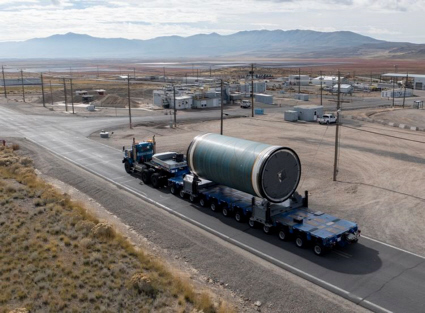
A Booster Obsolescence and Life Extension motor segment is transported to final assembly ahead of its first demonstration test scheduled for late 2024. (Photo Credit: Northrop Grumman)
(FEB 26) PROMONTORY, Utah - Northrop Grumman Corporation (NYSE: NOC) completed the first Booster Obsolescence and Life Extension (BOLE) motor segment for the next-generation Space Launch System (SLS) solid rocket booster. BOLE adds nearly five metric tons of payload capacity for SLS Block 2 Moon and Mars missions above the enhancements already in work for the SLS Block 1B configuration slated to fly on Artemis IV. The new solid rocket boosters will be used on Block 2 beginning with Artemis IX when all the recovered and refurbished shuttle-era steel cases have been expended.
Building on the foundation of the largest and most powerful solid rocket boosters ever flown, Northrop Grumman's BOLE booster incorporates cutting-edge carbon fiber technology and a weight-saving composite case. Combined with other upgrades, it generates 11% more total impulse than the current five-segment solid rocket boosters. The first BOLE demonstration test is scheduled for this year, featuring a full-scale static test with all five segments integrated and horizontally fired in a test bay.
Northrop Grumman
Falcon 9 Launched
(FEB 23) A Falcon 9 rocket was launched last night (February 22) from Vandenberg SFB, Calif. The vehicle lifted off from south base at 8:11 p.m. PST and carried 22 Starlink satellites into orbit.
The launch was visible to the naked eye along the Southern California coast and neighboring areas well into the second stage burn. The rocket's tenuous exhaust plume was not seen due to the bright sky from the nearly full Moon.
A sonic boom from the launch was heard at T+10 minutes in Thousand Oaks and Moorpark, Calif.
Brian Webb
Winter Storm

A strong winter storm approaches the U.S. West Cost in this composite image (click to enlarge) released February 6. The Moderate Resolution Imaging Spectroradiometer (MODIS) on NASA's Terra satellite acquired the true-color view image two days earlier. Terra was launched from Vandenberg SFB in 1999. Image Credit: MODIS Land Rapid Response Team, NASA GSFC
First WSF-M Satellite Delivered to Launch Site
(FEB 6) EL SEGUNDO, Calif. - Space Systems Command (SSC) has successfully delivered the U.S. Space
Force (USSF)-62 Weather System Follow-on - Microwave (WSF-M) Space Vehicle (SV) from Ball
Aerospace, Boulder, Co. to Vandenberg Space Force Base, Ca., where it will be processed at the
Space Vehicle processing facility.
The satellite will undergo a series of post-shipment functional testing, followed by the
loading of onboard propellant. After accomplishing these vital testing procedures, the WSF-M
satellite will enter the encapsulation phase, after which the payload will be horizontally
integrated with the SpaceX Falcon 9 launch vehicle before its voyage to space projected for late
March.
"This delivery represents a major milestone for the WSF-M program and is a critical step
towards putting the first WSF-M satellite on-orbit for the warfighter," said Col. Daniel Visosky,
senior materiel leader, SSC's Space Sensing Environmental and Tactical Surveillance program
office. "It represents a long-term collaboration and unity-of-effort between the Space Force
and our combined teams at Ball Aerospace, support contractors and government personnel."
Under the leadership of SSC Space Sensing's Environmental and Tactical Surveillance
program office, the WSF-M satellite is the first of two satellites that Ball Aerospace will deliver.
This innovative spacecraft represents a new era in the U.S. Space Force's next generation of
modernized, space-based environmental monitoring (SBEM) systems that will augment
capabilities provided by the legacy Defense Meteorological Satellite Program (DMSP). WSF-M
will enable the production of enhanced weather prediction and analysis capabilities for joint
warfighters conducting mission planning and operations globally.
"The WSF-M satellite is a strategic solution tailored to address three high-priority
Department of Defense SBEM gaps - specifically, ocean surface vector winds, tropical cyclone
intensity, and energetic charged particles in low Earth orbit," said David Betz, WSF-M program
manager, SSC Space Sensing. "Beyond these primary capabilities, our instruments also provide
vital data on sea ice characterization, soil moisture, and snow depth."
Space Systems Command is the U.S. Space Force's field command responsible for
acquiring, developing, and delivering resilient capabilities and groundbreaking technologies to
protect our nation's strategic advantage in and from space. SSC manages an $15 billion space
acquisition budget for the Department of Defense and works in partnership with joint forces,
industry, government agencies, academic and allied organizations to accelerate innovation and
outpace emerging threats. Our actions today are making the world a better space for
tomorrow.
U.S. Space System Command
Poised for Science: NASA's Europa Clipper Instruments Are All Aboard
(JAN 30) With less than nine months remaining in the countdown to launch, NASA's Europa Clipper mission has passed a major milestone: Its science instruments have been added to the massive spacecraft, which is being assembled at the agency's Jet Propulsion Laboratory in Southern California. More
After Three Years on Mars, NASA's Ingenuity Helicopter Mission Ends
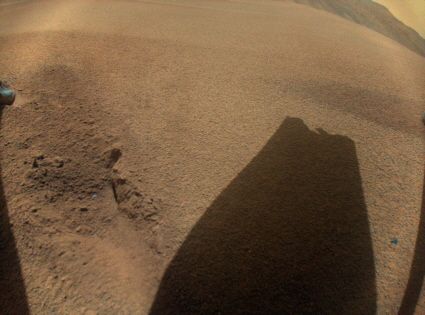
A jagged shadow reveals damage to a blade on NASA'a Ingenuity Mars helicopter. The craft was grounded following damage to one or more rotor blades during landing. Image credit: NASA/JPL
(DEC 25) NASA's history-making Ingenuity Mars Helicopter has ended its mission at the Red Planet after surpassing expectations and making dozens more flights than planned. While the helicopter remains upright and in communication with ground controllers, imagery of its Jan. 18 flight sent to Earth this week indicates one or more of its rotor blades sustained damage during landing and it is no longer capable of flight.
Originally designed as a technology demonstration to perform up to five experimental test flights over 30 days, the first aircraft on another world operated from the Martian surface for almost three years, performed 72 flights, and flew more than 14 times farther than planned while logging more than two hours of total flight time.
"The historic journey of Ingenuity, the first aircraft on another planet, has come to end," said NASA Administrator Bill Nelson. "That remarkable helicopter flew higher and farther than we ever imagined and helped NASA do what we do best - make the impossible, possible. Through missions like Ingenuity, NASA is paving the way for future flight in our solar system and smarter, safer human exploration to Mars and beyond."
Jet Propulsion Laboratory
New Instrument to Capture Stardust as Part of NASA Mission
(JAN 11) Scientists and engineers at the CU Boulder will soon take part in an effort to collect a bit of stardust - the tiny bits of matter that flow through the Milky Way Galaxy and were once the initial building blocks of our solar system. More
Muddy Waters

Sediment carried out to sea by winter storms muddies the waters off the southern California coast in this photo released January 7 (click to enlarge). NASA's Aqua spacecraft collected the image during a recent daylight pass over the region. Image Credit: MODIS Land Rapid Response Team, NASA GSFC
California Army Guard Brigade
Works 24/7 to Defend Nation
(JAN 5) VANDENBERG SPACE FORCE BASE, Calif. - Seven California Army National Guard members of Detachment 1, 100th Missile Defense Brigade, epitomize the National Guard's motto, "Always ready, always there." More
Falcon 9 Carries German Satellites into Orbit
(DEC 24) A Falcon 9 rocket carrying two German military satellites lifted off this morning (December 24) from Vandenberg SFB, Calif. The vehicle left south base at 5:11 a.m. PST (13:11 UTC), the start of an 83-minute launch window. The Falcon then headed towards the south-southeast and paralleled the coast as it carried the SARah-2 and SARah-3 Earth-imaging spacecraft into orbit.
The launch will complete a system of three satellites that will collect high-resolution images by bouncing radar signals off the Earth's surface. Using radar will allow the system to gather images day or night and to see through clouds.
The launch produced a nice visual display that was probably visible to the unaided eye over a wide area. The vehicle's exhaust plume emerged late in the first stage burn. The plume was apparently illuminated by the Sun at high altitude during the second-stage burn and produced long rays of semi-transparent white light similar in shape to the light rays on the Arizona state flag.
Brian Webb
Firefly's Fly the Lightning Mission Launches from Vandenberg
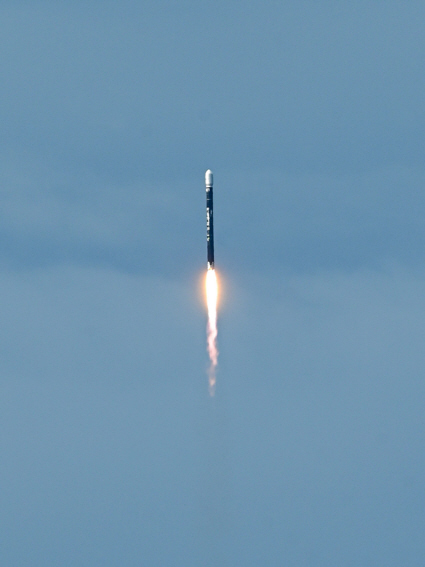
Firefly Aerospace's Alpha FLTA004 rocket launches from Space Launch Complex 2 at Vandenberg Space Force Base, Calif., Dec. 22. This mission marks the 40th launch from Vandenberg in the last 12 months. (U.S. Space Force photo by Airman 1st Class Ryan Quijas
(DEC 22) VANDENBERG SPACE FORCE BASE, Calif. -- Firefly Aerospace's Alpha FLTA004 rocket launches from Space Launch Complex 2 at 9:32 a.m. PST at Vandenberg Space Force Base, Calif., Dec. 22, 2023. Space Launch Delta 30 Guardians and Airmen provided vital spaceport capabilities in support of the Firefly Aerospace mission, called Fly the Lightning, which was carrying a payload for Lockheed Martin.
Vandenberg SFB
Interceptor Launched
(DEC 11) An upgraded Ground-based Interceptor (GBI) was launched from Vandenberg SFB, Calif. this morning at 6:38 a.m. PST as part of a missile defense test. The GBI later successfully intercepted an Intermediate Range Ballistic Missile (IRBM).
The launch occurred during morning twilight for observers in western California, making the interceptor's sunlit exhaust plume and contrail visible as far away as San Francisco.
Brian Webb
Northrop Grumman Successfully Tests a New Solid Rocket Motor Developed in Less Than a Year
(DEC 8) PROMONTORY, Utah - Northrop Grumman Corporation (NYSE: NOC) successfully conducted a full-scale static test fire of a new solid rocket motor that was developed in less than a year as part of its Solid Motor Annual Rocket Technology Demonstrator (SMART Demo).
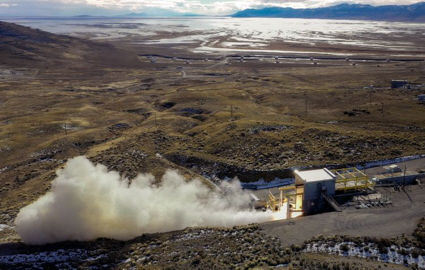
Northrop Grumman's SMART Demo static test successfully demonstrates several solid rocket motor innovations at the company's Promontory, Utah, test area. (Photo Credit: Northrop Grumman)
The SMART Demo successfully demonstrated several innovative technologies, alternate manufacturing materials and processes to reduce lead times by 75 percent, including:
-
Several advanced, long-lead tooling products as well as components of the solid rocket motor's nozzle structure, constructed with additive manufacturing techniques
-
A new cost-effective solid rocket motor propellant capable of operating at cold temperatures
-
Alternative suppliers and new materials that could supplement or replace other long-lead materials experiencing challenged supply chains
Northrop Grumman
NASA's 6-Pack of Mini-Satellites Ready for Their Moment in the Sun
(NOV 30) Most NASA missions feature one spacecraft or, occasionally, a few. More
Falcon 9 Launched
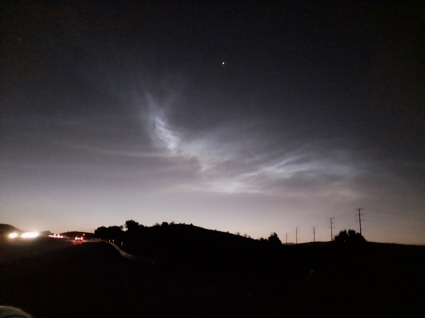
Early risers across Southern California were treated to an interesting display on November 20th thanks to a Falcon 9 rocket launch from Vandenberg SFB, Calif. Exhaust left over from the 2:30 a.m. PST launch was illuminated at high altitude by the Sun at dawn, creating a mysterious, glowing cloud. The white spot above the cloud is the planet Venus.
(NOV 20) A Falcon 9 rocket was successfully launched this morning from Vandenberg SFB, Calif. The vehicle lifted off from Space Launch Complex 4 East (SLC-4E) at 2:30 a.m. PST and carried 22 Starlink satellites into orbit.
As expected, the launch was apparently visible over a wide area. One observer told the webmaster "If you care to know, I live in postal area 95033, Santa Cruz Mountains and observed the launch this AM. It was very clear once it cleared above the Monterey Peninsula."
The remnants of the rocket's exhaust plume persisted and created an interesting luminous cloud at dawn as the exhaust was illuminated at high altitude by the Sun and suspended against a dark sky.
Brian Webb
NASA's Deep Space Optical Comm Demo Sends, Receives First Data
(NOV 16) NASA's Deep Space Optical Communications (DSOC) experiment has beamed a near-infrared laser encoded with test data from nearly 10 million miles (16 million kilometers) away - about 40 times farther than the Moon is from Earth - to the Hale Telescope at Caltech's Palomar Observatory in San Diego County, California. More
Vibration Testing
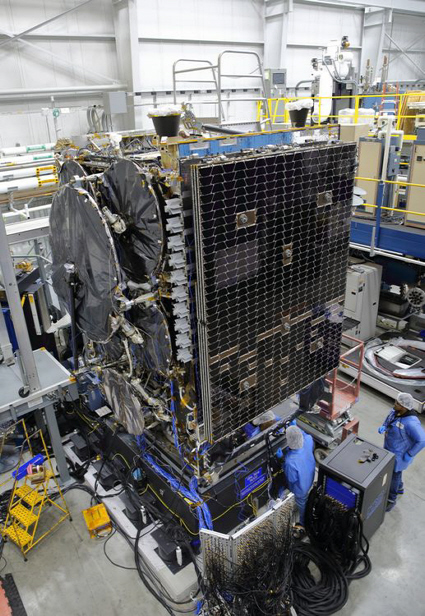
The Northrop Grumman-built ASBM-1 spacecraft undergoes vibration testing at the company's satellite manufacturing facility in Dulles, Virginia. The Arctic Satellite Broadband Mission is a two-satellite constellation designed to deliver broadband communications to the Northern polar region for the U.S. Space Force and Space Norway. ASBM-1 is scheduled for launch from Vandenberg SFB, Calif. in 2024. Photo Credit: Northrop Grumman
Falcon 9 Launched
(NOV 11) A Falcon 9 rocket was successfully launch from Vandenberg SFB, Calif. on November 11 at 10:29 a.m. PST. Following liftoff from Space Launch Complex 4E, the rocket carried 90 payloads into a Sun-synchronous orbit. At press time, deployment of most of the payloads has been confirmed.
Clear skies and the rocket's bright orange flame made the early portion of the event visible to the unaidied eye for a distance of at least 100 statute miles.
Brian Webb
Minuteman III Test Provides Vital Data Before Termination
(NOV 1) VANDENBERG SPACE FORCE BASE, Calif. -- Space Launch Delta 30 safely terminated an unarmed Minuteman III intercontinental ballistic missile over the Pacific Ocean at 12:06 a.m. Pacific Time Nov. 1, due to an anomaly during a test launch from Vandenberg Space Force Base, California.
An anomaly is any unexpected event during the test. Since anomalies may arise from many factors relating to the operational platform itself, or the test equipment, careful analysis is needed to identify the cause.
A Launch Analysis Group is forming to investigate the cause. The group will include representatives from Air Force Global Strike Command, the 377th Test and Evaluation Group, the 576th Flight Test Squadron, Space Launch Delta 30 Safety Office and Air Force Nuclear Weapons Center, among other organizations.
The test launch program helps the command evaluate the Minuteman III and gather data to keep the system effective. The command learns lessons from every test launch. Gathering data from the launch allows AFGSC to identify and correct any issues with the weapon system to ensure the Minuteman III's continued reliability and accuracy.
Air Force Global Strike Command is a major command with headquarters at Barksdale Air Force Base, Louisiana, in the Shreveport-Bossier City community. The command overseas the nation's three intercontinental ballistic missile wings, the Air Force's entire bomber force, to include B-52, B-1 and B-2 wings, the Long Range Strike Bomber program, Air Force Nuclear Command, Control and Communications systems, and operational and maintenance support to organizations within the nuclear enterprise. Approximately 33,700 professionals are assigned to two Numbered Air Forces, nine wings, two geographically-separated squadrons and one detachment in the continental United States and deployed to locations around the globe.
More information can be found at: https://www.afgsc.af.mil/About/Fact-Sheets/Article/454593/air-force-global-strike-command-air-forces-strategic-air/.
The LGM-35A Sentinel will replace the Minuteman III ICBM with an initial capability of 2029. Until full capability is achieved in the mid-2030s, the Air Force is committed to ensuring Minuteman III remains a viable deterrent.
Air Force Global Strike Command
Radiation Vault
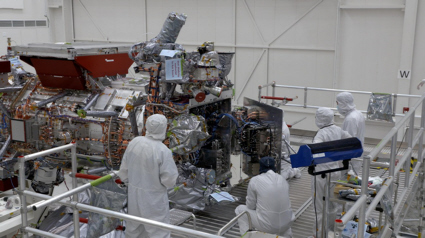
Engineers and technicians close the radiation vault of NASA's Europa Clipper in the Spacecraft Assembly Facility at the Jet Propulsion Laboratory in Pasadena, Calif. The vault will protect the spacecraft's electronics from punishing radiation and high-energy particles as it explores Jupiter's moon Europa. The mission will investigate if the ice-encased body has conditions suitable for life. Image credit: NASA/JPL-Caltech
NASA Rocket to See Sizzling Edge of Star-Forming Supernova
(OCT 27) A new sounding rocket mission is headed to space to understand how explosive stellar deaths lay the groundwork for new star systems. More
NASA's Voyager Team Focuses on Software Patch, Thrusters
(OCT 20) Engineers for NASA's Voyager mission are taking steps to help make sure both spacecraft, launched in 1977, continue to explore interstellar space for years to come. More
X-Bow Selected for Hypersonic Solid Rocket Motor Development
DoD funding will expand production capacity of the solid rocket motor industrial base
(OCT 10) ALBUQUERQUE, N.M. -- X-Bow Systems Inc (X-Bow) announces its selection by the Office of the Assistant Secretary of Defense for Industrial Base Policy, for a $64 million contract to provide large solid rocket motors (SRM) to the U.S. Navy and the U.S. Army. This contract establishes X-Bow as a new supplier of SRMs and strengthens the Defense Department supply chain in a critical period for the United States. The introduction of X-Bow's new methods for manufacturing SRMs and energetics will lead to a significant increase in SRM production capacity and decrease in cost for production of SRMs.
X-Bow's SRMs will provide boost propulsion for the Navy-designed hypersonic All Up Round (AUR) utilized by the Navy's Conventional Prompt Strike weapon system and the Army's Long Range Hypersonic Weapon System. X-Bow's world-class team includes Leidos Dynetics and Karman Space & Defense.
This collaboration adds a key capability to domestic sources for large diameter SRM production. Jason Hundley, X-Bow CEO and Founder said "This breakthrough collaboration with the Department of Defense further accelerates X-Bow's existing commitment to provide new, affordable hypersonic solutions. Our team understands the critical nature of this effort and has made this collaboration a key priority. X-Bow is in a unique position to apply our advanced manufacturing for energetics and our revolutionary approach to solid rocket motor development to add much needed production capacity quickly and efficiently."
X-Bow Systems
Missile Reentry
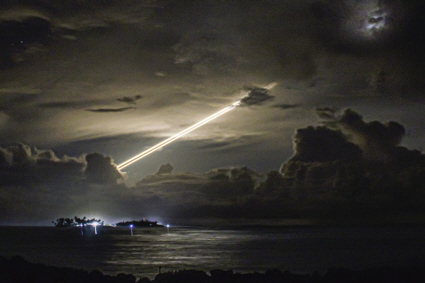
An unarmed Minuteman III missile reenters the Earth's atmosphere above the Marshall Islands following launch from Vandenberg SFB, Calif. on September 6, 2023. Photo by Ryan Sharp, U.S. Army
Northrop Grumman Awarded Contract Modification
(OCT 5) Northrop Grumman Systems Corp., Space Systems Division, Redondo Beach, California, has been awarded a $235,000,000 not-to-exceed undefinitized contract modification (P00075) to previously awarded contract FA8810-18-C-0006 for Next Generation Overhead Persistent Infrared Polar Space Vehicles 1 and 2. The modification brings the total cumulative face value of the contract to $2,147,891,819. Work will be performed at Redondo Beach, California, and is expected to be completed by July 25, 2026. No funds are being obligated at time of award. Space Systems Command, Los Angeles Air Force Base, California, is the contracting activity.
Defense Department
To Study Atmosphere, NASA Rockets Will Fly into Oct. Eclipse's Shadow
(SEP 29) A NASA sounding rocket mission will launch three rockets during the 2023 annular eclipse in October to study how the sudden drop in sunlight affects our upper atmosphere. More
Utah Test and Training Range has Vital Role in OSIRIS-REx Recovery Mission
(SEP 21) HILL AIR FORCE BASE, Utah - Members of the 388th Fighter Wing's Utah Test and Training Range are playing a key role in recovering NASA's first-ever asteroid sample return on Sept. 24. More
Surprise Launch
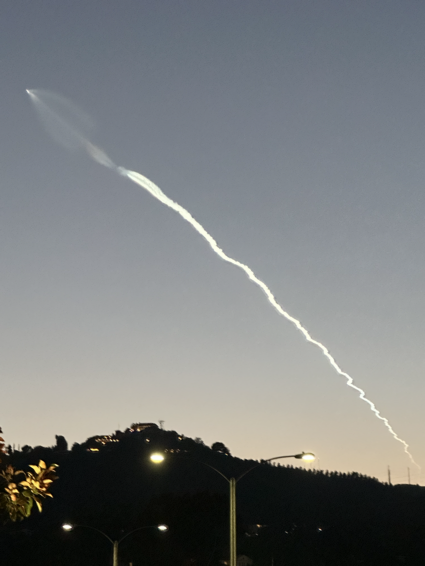
Sky watchers across the Southwest were treated to a dusk light show on September 14 thanks to an unannounced rocket launch from Vandenberg SFB, Calif. An Alpha rocket lifted off from Space Launch Complex 2-West a 7:28 p.m. PDT and carried the VICTUS NOX spacecraft into orbit. Following liftoff, the rocket's exhaust was illuminated at high altitude by the Sun and suspended against a dusk or night sky. Jay Budzik recorded the display with his iPhone 14 pro from the Rose Bowl in Pasadena, Calif. Image copyright 2023, Jay Budzik. Used with permission.
Firefly Aerospace Successfully Launches U.S. Space Force VICTUS NOX Responsive Space Mission with 24-Hour Notice
(SEP 14) VANDENBERG SPACE FORCE BASE, Calif - Firefly Aerospace, an end-to-end space transportation company, today announced the company successfully launched its Alpha rocket and deployed the VICTUS NOX spacecraft following a 24-hour notice to complete final payload operations and mission preparations. More
Minuteman III Test Launch Showcases Readiness of U.S. Nuclear Force's Safe, Effective Deterrent
(SEP 6) BARKSDALE AIR FORCE BASE, La. -- A joint team of Air Force Global Strike Command Airmen and 30th Space Launch Delta Guardians launched an unarmed Minuteman III intercontinental ballistic missile equipped with three test re-entry vehicles Sept. 6 at 1:26 a.m. Pacific Time from Vandenberg Space Force Base, California. More
Liftoff
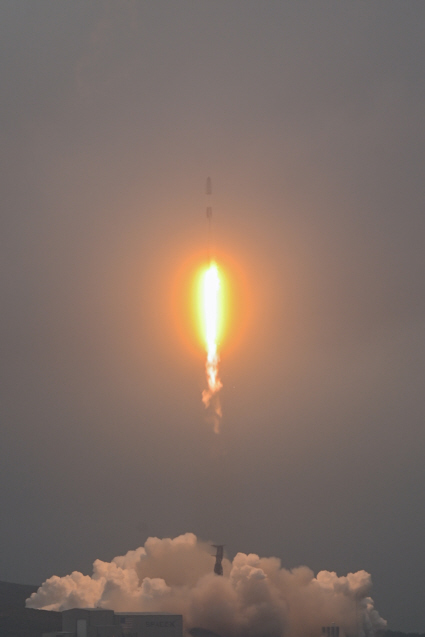
A SpaceX Falcon-9 rocket lifts off at 7:25 a.m. from Space Launch Complex 4E at Vandenberg Space Force Base, Calif., Sept. 2, 2023. This mission carried the Space Development Agency's second round of Tranche 0 satellites for its Proliferated Warfighter Space Architecture. It was also Vandenberg's 29th launch over the last year. (U.S. Space Force photo by Airman 1st Class Ryan Quijas)
Space Development Agency Completes Second Successful Launch of Tranche 0 Satellites
SDA delivers 13 additional satellites on orbit for Proliferated Warfighter Space Architecture demonstrations
(SEP 2) WASHINGTON, D.C. - The Space Development Agency (SDA) today announced the second successful launch of space vehicles from the Proliferated Warfighter Space Architecture (PWSA). More
Unarmed Minuteman III Test Launch to Showcase Readiness of U.S. Nuclear Force's Safe, Effective Deterrent
(AUG 25) VANDENBERG SPACE FORCE BASE, Calif. -- An operational test launch of an Air Force Global Strike Command unarmed Minuteman III intercontinental ballistic missile is scheduled for Sept. 5, 2023, from 11:47 p.m. to Sept. 6, 5:47 a.m. Pacific Time from North Vandenberg.
The purpose of the ICBM test launch program is to demonstrate the readiness of U.S. nuclear forces and provide confidence in the lethality and effectiveness of the nation's nuclear deterrent, according to Air Force Global Strike Command.
This test is routine and was scheduled years in advance. Consistent with previous test launches, this ICBM test launch will validate and verify the effectiveness, readiness and accuracy of the weapon system.
In accordance with standard procedures, the United States has transmitted a pre-launch notification pursuant to the Hague Code of Conduct, and notified the Russian government in advance, per our existing bi-lateral obligations.
Vandenberg SFB
Interference Training
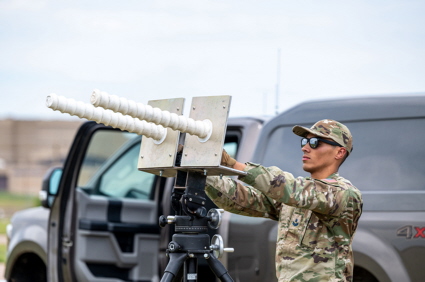
Space Force Sgt. Jonathan Ojeda conducts Global Positioning System electromagnetic interference training with a GPS electromagnetic attack system at Schriever Space Force Base, Colo. Image credit: U.S. Space Force
Space Force's First Targeting Squadron
Brought to Life
(AUG 14) PETERSON SPACE FORCE BASE, Colo. -- The 75th Intelligence, Surveillance and Reconnaissance Squadron was activated as a unit under Space Delta 7 - Intelligence, Surveillance and Reconnaissance, during a ceremony Aug. 11, 2023, at Peterson Space Force Base, Colorado.
During the activation ceremony, U.S. Space Force Col. Brett Swigert, DEL 7 commander, presented Lt. Col. Travis Anderson with the ceremonial guidon, representing the first assignment of authority from the delta commander to the 75th ISRS's first commander.
"Today is a monumental time in the history of our service," said Anderson. "The idea of this unit began four years ago on paper and has probably been in the minds of several U.S. Air Force intelligence officers even longer."
The 75th ISRS has three primary mission focuses: target analysis, target development and target engagement. Their goal is to prepare and present intelligence packages about a target and the system it is a part of. That could include information about a satellite, a ground station, or the signal in between.
"The 75th ISRS conducts advanced analysis on adversary space force and counterspace force threats along with their associated architectures," said Anderson. "Space forces are space capabilities used by a country to facilitate their joint warfighting. Counterspace forces, also called space attack forces, are space capabilities designed to deny the United States the ability to use our satellite systems during conflict."
According to Master Sgt. Desiree Cabrera, 75th ISRS operations superintendent, the new squadron is the first and only targeting unit dedicated to supporting the U.S. Space Force and its missions.
"Over the past year, the senior enlisted leader, Senior Master Sgt. Cristy Duncan, along with the first assigned members of the targeting team, led Space Delta 7's Operating Location-Bravo using an innovative approach to build the foundation and organizational structure of today's 75th ISRS." said Cabrera. "Not only are we standing up the sole targeting squadron in the U.S. Space Force, we are changing the way targeting is done across the joint community when it comes to space and electromagnetic warfare."
U.S. Space Force
A Very Good Perseid Meteor Shower
(AUG 11) Forecasters are predicting the best Perseid meteor shower in years this weekend. On Saturday night, Aug. 12-13, Earth will pass through a stream of debris from Comet 109P/Swift-Tuttle, causing dozens of meteors per hour to streak out of the constellation Perseus. The nearly New Moon will make the display unusually easy to see from dark-sky sites. Book a campsite and enjoy the show: Observing tips.
Spaceweather.com
Sea Bloom

Since its launch from Vandenberg AFB, Calif. 23 years ago, NASA's Terra spacecraft has provided a treasure trove of interesting Earth images. On August 3 the craft's MODIS instrument recorded this view of a phytoplankton bloom (blue area) in the Barents Sea adjacent to Norway and Russia. The milky-blue color that dominates this bloom points to the likely presence of coccolithophores, a type of microscopic plankton that tend to bloom in the Barents Sea from July through September. Image: MODIS Land Rapid Response Team, NASA GSFC
Planetary Defense Test Deflected an Asteroid but Unleashed a Boulder Swarm
UCLA-led study of NASA's DART mission determines that the strategy presents previously unanticipated risks
(AUG 4) In September 2022, NASA deliberately slammed a spacecraft into the asteroid Dimorphos to knock it slightly off course. More
NASA's OSIRIS-REx Spacecraft Adjusts Course to Get Closer to Earth
(JUL 26) On July 26, NASA's OSIRIS-REx spacecraft fired its engines for about 63 seconds to slightly thrust itself onto a course closer to Earth.
Preliminary tracking data indicates OSIRIS-REx changed its velocity, which includes speed and direction, by 1.3 miles, or 2 kilometers, per hour. It's a tiny but critical shift; without course adjustments like this one the spacecraft would not get close enough to Earth on Sept. 24 to drop off its sample of asteroid Bennu.
The spacecraft is currently 24 million miles, or 38.6 million kilometers, away, traveling at about 22,000 miles, or about 35,000 kilometers, per hour toward Earth.
Over the next few days, engineers will use data collected before and after today's engine burn, including Doppler radar data, to make sure the maneuver executed as planned and the spacecraft is on the right path.
Today's trajectory correction maneuver is the final adjustment needed to set up OSIRIS-REx to return to Earth on Sept. 24. Two more maneuvers, on Sept. 10 and 17, will target the precise point in Earth's atmosphere where the spacecraft's sample-return capsule must enter to land on target at the Department of Defense's Utah Test and Training Range near Salt Lake City.
NASA
Dry Run
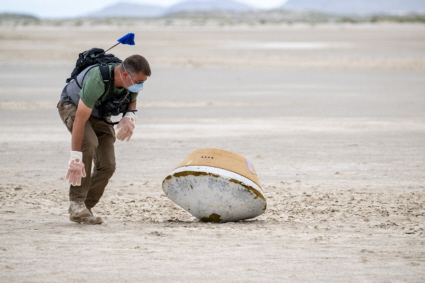
A military representative checks a mock OSIRIS-REx sample return capsule for unexploded ordnance at the Utah Test and Training Range during a July 18-20 recovery rehearsal. The actual capsule with a sample of the asteroid Bennu is scheduled to land at the range on September 24. NASA's OSIRIS-REx spacecraft collected a sample from Bennu in October 2020 and has been traveling back to Earth with it since May 2021. Credit: NASA/Keegan Barber.
SpaceX Just Punched a Hole in the Ionosphere
(JUL 21) On the evening of July 19th, SpaceX launched a Falcon 9 rocket from Vandenberg Space Force Base in California. Sky watchers from southern California to Arizona witnessed a magnificent exhaust plume. At the San Francisco Volcanic Field north of Flagstaff, photographer Jeremy Perez saw something extra:
"After the rocket passed overhead, a red fluorescent glow expanded southward and crossed over the Milky Way," says Perez. "It was visible for almost 20 minutes."
The red glow is a sign that the rocket punched a hole in the ionosphere--something SpaceX and others have been doing for years. One famous example occured on August 25, 2017, when a Falcon 9 rocket carrying Taiwan's FORMOSAT-5 satellite created a hole four times bigger than the state of California. On June 19, 2022, another Falcon 9 punched a hole over the east coast of the USA, sparking a display of red lights from New York to the Carolinas that many observers mistook for aurora borealis.
"This is a well studied phenomenon when rockets are burning their engines 200 to 300 km above Earth's surface," explains space physicist Jeff Baumgardner of Boston University. "The red glow appears when exhaust gasses from the rocket's 2nd stage cause the ionosphere to recombine quickly."
Rocket engines spray water (H2O) and carbon dioxide (CO2) into the ionosphere, quenching local ionization by as much as 70%. A complicated series of charge exchange reactions between oxygen ions (O+) and molecules from the rocket exhaust produce photons at a wavelength of 6300 Å--the same color as red auroras.
"I reviewed footage from the July 19th launch," says Baumgardner. "It shows the second stage engine burning at 286 km near the ionosphere's F-region peak for that time of day. So, it is quite possible that an ionospheric 'hole' was made."
Once rare, ionospheric "punch holes" are increasingly common with record numbers of rocket launches led by SpaceX sending Starlink satellites to low-Earth orbit. Ham radio operators may notice them when shortwave signals fail to skip over the horizon, shooting through holes instead of bouncing back to Earth. Sudden GPS errors can also result from the anomalies. These effects may be troublesome, but they are shortlived; re-ionization occurs as soon as the sun comes up again.
spaceweather.com
Anduril Awarded $8M for Space Mesh Network
(JUL 12) Anduril Industries, Inc., Costa Mesa, California, has been awarded an $8,086,934 contract modification
to a previously awarded SBIR III contract for fielding of a latticed mesh network to additional space
surveillance network sites. This is a modification that captures Space Systems Command's objectives for Phase
III SBIR to continue research and development of prototyping of reliable, secure, redundant, and resilient mesh
networking capabilities for Space Domain Awareness Space Surveillance Network Sensors. The modification brings
the total cumulative face value of the contract to $10,586,934. This effort supports adding sensor sites and
reflect hardening of the current sensor sites. Work will be performed in Colorado Springs, Colorado, and Costa
Mesa, California, and is expected to be completed by Dec. 31, 2024. Fiscal 2023 research, development, test and
evaluation funds in the amount of $5,236,000 are being obligated at the time of award. The Space Systems Center
Directorate of Contracting, Peterson Space Force Base, Colorado Springs, Colorado, is the contracting activity.
Department of Defense
NASA's Starling Prepares to Launch Small Spacecraft Swarm to Orbit
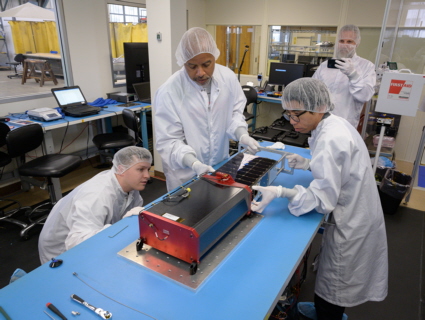
Watson Attai of Axient-MEIS, Starling integration and testing lead, right; Jeff Blair, Starling lead mechanical engineer, center; and Nick Gentz, Rocket Lab payload integration engineer, left, load a Starling spacecraft into a Rocket Lab CubeSat dispenser as Damon Flansburg, Starling chief safety officer, observes at NASA's Ames Research Center in California's Silicon Valley. Credits: NASA/ Dominic Hart
(JUL 5) A quartet of six-unit (6U) CubeSats will show off their moves in a sort of orbital line dance when NASA's Starling mission tests critical swarm technologies in space. More
Falcon 9 Launched
(JUL 7) A Falcon 9 rocket was launched today from Vandenberg SFB, Calif. Following liftoff from south base at 12:29 p.m. PDT, the vehicle placed 48 Starlink satellites into orbit.
Brian Webb
15 Years of Radio Data Reveals Evidence
of Space-Time Murmur
Scientists have found evidence of a universal background of gravitational waves, or ripples in the fabric of space-time.
(JUN 28) PASADENA, Calif. - The motion of black holes and other massive objects through space can create ripples in the fabric of the universe, called gravitational waves. On June 28 scientists announced the first evidence of a background of long-wavelength gravitational waves that fills the cosmos. These waves are thought to have been created over eons by supermassive black holes, up to billions of times the mass of our Sun, circling each other before they merge. Detecting the gravitational wave background is analogous to hearing the hum of a large group of people talking at a party, without distinguishing any particular voice.
The background ripples detected by NANOGrav could help scientists better understand how gravitational waves are created and what happens to them as they propagate through the universe. They could also be used to study supermassive black hole mergers, events that can last for millions of years. Scientists think these mergers happen in most galaxies and influence their evolution.
The North American Nanohertz Observatory for Gravitational Waves (NANOGrav) presented the evidence in a series of papers published in the Astrophysical Journal Letters. NANOGrav is a National Science Foundation-funded Physics Frontiers Center of more than 190 scientists from the United States and Canada, including scientists at NASA's Jet Propulsion Laboratory in Southern California and other NASA centers. The collaboration has spent more than 15 years collecting high-precision data from ground-based radio telescopes, looking for these gravitational waves.
The discovery complements the first-ever detection of gravitational waves in 2015 by LIGO, the Laser Interferometer Gravitational Observatory. Those signals, at a much shorter wavelength than the new discovery, were from black holes about 30 times the mass of our Sun.
NASA is contributing to the ESA (European Space Agency)-led Laser Interferometer Space Antenna mission, a future space-based observatory that will detect gravitational waves that are in a wavelength range between those detected by NANOGrav and LIGO.
To learn more about the new result, read this news release from Caltech: https://www.caltech.edu/about/news/scientists-find-evidence-for-slow-rolling-sea-of-gravitational-waves.
Jet Propulsion Laboratory
Falcon 9 Launched
(JUN 22) A Falcon 9 rocket was successfully launched Thursday monrning (June 22) from Space Launch Complex 4 East (SLC-4E) at Vandenberg SFB, Calif. Following liftoff at 00:19. PDT, the vehicle carried 47 Starlink satellites into orbit.
Brian Webb
Aerojet Rocketdyne Tests Large Rocket Motor at Edwards AFB
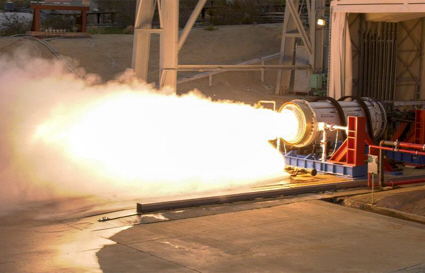
Aerojet Rocketdyne's successful qualification test of eSR-19, with the Air Force Research Laboratory at an AFRL test facility at Edwards Air Force Base, California. Image: Aerojet Rocketdyne
(JUN 19) HUNTSVILLE, Ala. - Aerojet Rocketdyne has successfully completed the qualification static fire test of the eSR-19, the advanced large solid rocket motor that will power the Missile Defense Agency's (MDA) next generation Medium Range Ballistic Missile (MRBM) target used to test our nation's missile defense systems.
The successful qualification test, conducted by Air Force Research Laboratory (AFRL) and Aerojet Rocketdyne personnel at AFRL's test facility at Edwards Air Force Base, California, paves the way for delivery of flight test motors later this year.
The eSR-19 is a redesigned version of the SR-19 that currently serves as the second stage of the nation's Minuteman III strategic missiles. Featuring a lighter, filament-wound composite case and other performance-enhancing improvements, the eSR-19 will provide the propulsion for both stages of MDA's air-launched, medium-range target vehicle, developed by Aerojet Rocketdyne subsidiary Coleman Aerospace.
The motor was designed and fabricated in Aerojet Rocketdyne facilities in Huntsville, Alabama, and cast and cured in Camden, Arkansas. The eSR-19 motors are later integrated into the target systems by the Coleman Aerospace team in Orlando, Florida.
This recent qualification test was the latest achievement in the evolution of Aerojet Rocketdyne's legacy Large Solid Rocket Motor (LSRM) capabilities, which have included investments in a talented workforce and new modern LSRM facilities.
Aerojet Rocketdyne
Rocket Lab Spacecraft Built for Varda Successfully Operating on Orbit
The spacecraft is the first of four Rocket Lab has been contracted to build for Varda Space Industries to enable in-space manufacturing.
(JUN 13) LONG BEACH, Calif.-- Rocket Lab USA, Inc. (Nasdaq: RKLB) ("Rocket Lab" or "the Company"), a global leader in launch services and space systems, today announced its spacecraft for Varda Space Industries ("Varda"), a leading in-space manufacturing and hypersonic re-entry logistics company, is successfully operating on orbit after launching from Vandenberg Space Force Base today on SpaceX's Transporter-8 mission at 14:35 PDT (21:35 UTC).
The spacecraft was developed, manufactured, and tested at Rocket Lab's Spacecraft Production Facility in Long Beach, California, and it incorporates Rocket Lab-designed and manufactured components and software including star trackers, propulsion system, reaction wheels, solar panels, flight software, radios, composite structures and tanks, and separation systems.
Now successfully operating on orbit, the spacecraft will provide power, communications, propulsion, and attitude control to Varda's 120kg capsule that will produce pharmaceutical products in microgravity and return them to Earth. Upon completion of the in-space manufacturing phase of Varda's mission, Rocket Lab's spacecraft will place Varda's hypersonic re-entry capsule (carrying finished pharmaceuticals on board) on a return trajectory to Earth. The spacecraft is the first of four ordered by Varda to support in-space pharmaceutical manufacturing, with the second spacecraft currently undergoing assembly, integration, and testing.
The Varda spacecraft are part of a growing list of complete satellites in development by Rocket Lab, including a $143 million subcontract by MDA to lead the design and manufacture of 17 spacecraft buses for Globalstar's new Low Earth Orbit satellites. Leveraging the Company's vertically integrated space systems capabilities, Rocket Lab spacecraft incorporate components and subsystems produced in-house to deliver cost efficiencies and accelerated production timelines. Rocket Lab components and subsystems have been successfully flown on more than 1,000 spacecraft globally.
Rocket Lab USA
Falcon 9 Launched
(JUN 13) A Falcon 9 rocket was successfully launched Monday afternoon (June 12) from Space Launch Complex 4 East (SLC-4E) at Vandenberg SFB, Calif. Following liftoff at 14:35 p.m. PDT, the vehicle carried 72 small satellites into orbit.
The launch was the ninth flight and recovery for the rocket's first stage.
Brian Webb
Space Systems Command, Spaceflight Inc. Prepare for Launch of Experimental Satellites
(JUN 10) EL SEGUNDO, Calif. - Space Systems Command (SSC)'s Space Domain Awareness & Combat Power (SDA&CP), is preparing to launch the Space Test Program (STP)-CR2301 mission to deliver three experimental satellites to Low Earth Orbit (LEO). More
Lockheed Awarded Contract
(JUN 2) Lockheed Martin Space, Sunnyvale, California, has been awarded a $122,213,602
modification (P00102) to contract FA8810-18-C-0005 to plan and prepare for post-launch
activities for all three Next Generation Overhead Persistent Infrared Geosynchronous
Space Vehicles. This contract provides for development of adequate program protection,
and product support planning. The modification brings the total cumulative face value
of the contract to $7,225,147,630. Work will be performed at Sunnyvale, California,
and is expected to be completed by May 31, 2024. Fiscal 2023 research, development,
test and evaluation funds in the amount of $28,727,026 are being obligated at the time
of award. The U.S. Space Force Space Systems Command, Space Sensing, Los Angeles Air
Force Base, California, is the contracting activity.
Department of Defense
Hidden Cyclone
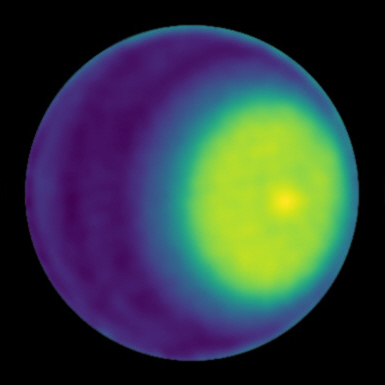
The first polar cyclone detected on Uranus appears as a bright dot in this Ka-band radio image from the Very Large
Array (VLA) in New Mexico. NASA scientists used the VLA to observe radio emissions from the planet in the K, Ka,
and Q bands, which allowed them to peer into the gas giant's atmosphere. Credit: NASA/JPL-Caltech/VLA
Northrop Grumman On Track to Produce Early-Warning Missile Defense Program
(MAY 24) REDONDO BEACH, Calif. - Northrop Grumman Corporation (NYSE: NOC) recently completed a Preliminary Design Review (PDR) for the U.S. Space Force Space Systems Command's Next Generation Overhead Persistent Infrared Polar (NGP) program. The company is on track to begin production of the early-warning missile system in defense of the nation.
The design review establishes the company's technical approach for the full integration of the Eagle-3 spacecraft with the infrared sensor, auxiliary and high-bandwidth communication payloads being developed at our Northrop Grumman site in Azusa, Calif.
"Northrop Grumman is on an accelerated path to delivering an early-warning missile system capable of surviving attacks from space, ground or cyber elements," said Alex Fax, vice president, NGP, Northrop Grumman. "NGP satellites will maintain a direct line of communication back to the continental United States, limiting dependency on overseas ground station sites."
The two NGP satellites, operating in highly elliptical orbits, are designed to detect and track ballistic and hypersonic missiles over the Northern Hemisphere. Broad coverage over the polar region offers the highest probability of spotting potential missile launches.
NGP can identify the infrared heat signatures of incoming threats and transmit this mission data to the ground. Based on the threat, decision-makers can then make responsive and informed decisions. This enhanced communication system also has resiliency features that reduce vulnerabilities to counter-space and cyberattacks.
Northrop Grumman is a leading global aerospace and defense technology company. Our pioneering solutions equip our customers with the capabilities they need to connect and protect the world, and push the boundaries of human exploration across the universe. Driven by a shared purpose to solve our customers' toughest problems, our 95,000 employees define possible every day.
Northrop Grumman
Terran Breaks Ground on Manufacturing Facility
(MAY 19) Irvine, Calif. - Terran Orbital Corporation (NYSE: LLAP), a global leader in satellite-based solutions primarily serving the aerospace and defense industries, and W. P. Carey, one of the largest U.S. net lease REITs with over 1,400 properties across the U.S. and Europe, broke ground this morning on a 94,000-square-foot, state-of-the-art satellite manufacturing facility located at 4 Goodyear in Irvine, Calif. In partnership with Terran Orbital, W. P. Carey will redevelop one of its outdated office properties into a new, Class A industrial facility, which will serve as Terran Orbital's fifth production facility. Demolition of the existing building commenced in February 2023, and the project is expected to be completed in January 2024.
The facility will be located on a five-acre site and upon completion will increase Terran Orbital's satellite assembly, integration, and test facility space by over three times the Company's current size. All satellite assembly will be transitioned to this new facility enabling the dedication of Terran Orbital's existing facilities to the production of components and modules. This optimization will enhance the efficiency and capacity of Terran Orbital's entire production system.
The property will have 36-foot clear heights and will be built with several sustainable features, including solar panels on the rooftop and electric vehicle charging stations. It is also expected to receive a LEED Gold certification.
"Terran Orbital is thrilled to break ground on 4 Goodyear," said Terran Orbital Co-Founder, Chairman, and Chief Executive Officer Marc Bell. "The new facility will propel Terran Orbital to new heights. We are currently working on 30 programs and over 375 satellites, including initial constellation orders for SDA, Rivada, and a new constellation customer announced on May 15. We also look forward to the capacity increase the new facility will create as we continue to onboard contracts and satellite orders. W. P. Carey has been a joy to work with and we look forward to developing this new facility together."
Terran Orbital
Canadian Fires
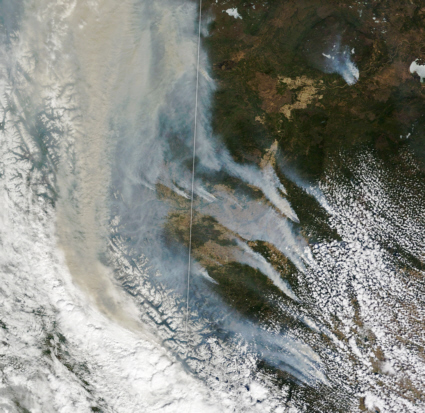
More than 100 wildland fires raged across Western Canada in early May 2023, forcing tens of thousands of people
in Alberta and British Columbia to evacuate. The fires destroyed homes and produced chimneys of smoke that
reached into the upper troposphere. The Moderate Resolution Imaging Spectroradiometer (MODIS) on NASA's Terra
satellite acquired this image of smoke billowing from fires in the two Canadian provinces on May 6. Terra was
launched from Vandenberg SFB in 1999. Image courtesy of NASA
Starlink Satellites Launched
(MAY 12) A Falcon 9 rocket was successfully launched Wednesday morning (May 10) from Space Launch Complex 4 East (SLC-4E) at Vandenberg SFB, Calif. Following liftoff at 1:09 p.m. PDT, the rocket headed towards the south-southeast and roughly paralleled the coast as it climbed into orbit. After achieving orbit, the vehicle deployed 51 Starlink Internet satellites.
At press time, the webmaster has not received any launch observations. This may be due to the hazy conditions at liftoff.
Brian Webb
Rocket Lab to Launch Small Satellite Swarm for NASA
Four Starling satellites have been added to Electron's 2023 manifest
(MAY 9) LONG BEACH, Calif. - Rocket Lab USA, Inc. (Nasdaq: RKLB) ("Rocket Lab" or "the Company"), a global leader in launch services and space systems, today announced it has signed a deal to launch NASA's Starling mission, a multi-CubeSat mission to test and demonstrate autonomous swarm technologies, as well as automated space traffic management for groups of spacecraft in low-Earth orbit.
The four Starling small satellites have been manifested on an Electron commercial rideshare mission scheduled for lift-off from Rocket Lab Launch Complex 1 in New Zealand in Q3 this year. Rocket Lab will deliver the satellites to space within three months of the contract signing.
The Starling mission is designed to test technologies to enable future "swarm" missions. Spacecraft swarms refer to multiple spacecraft autonomously coordinating their activities to achieve certain goals. Starling will explore technologies for in-space network communications, onboard relative navigation between spacecraft, autonomous maneuver planning and execution, and distributed science autonomy.
"Electron has been delivering rapid and reliable access to orbit for NASA since 2018 and we're delighted to continue that strong heritage with the Starling mission," said Rocket Lab founder and CEO Peter Beck. "Starling has the potential to revolutionize the way science is done in orbit and we're immensely proud to make that possible."
NASA's Small Spacecraft Technology program within the agency's Space Technology Mission Directorate manages the Starling project. The program is based at NASA's Ames Research Center in California's Silicon Valley. Starling joins a growing list of NASA missions launched by Rocket Lab since 2018, including the ELaNa-19 educational CubeSat program, the CAPSTONE mission to the Moon, and two dedicated Electron launches for the NASA TROPICS mission.
Rocket Lab
Massive Radio Array to Search for Extraterrestrial Signals from Other Civilizations
The SETI Institute, the National Radio Astronomy Observatory and the Breakthrough Listen Initiative team up for COSMIC and SETI
(MAY 1) Mountain View, CA - One of the world's most powerful radio telescope arrays is joining the hunt for signals from other galactic civilizations. More
Falcon 9 Launched
(APR 29) A Falcon 9 rocket was successfully launched from Vandenberg SFB, Calif. Thursday morning (April 27). Following liftoff at 6:40 a.m. PDT, the vehicle carried 46 spacecraft into orbit. The launch was the thirteenth flight and landing for the rocket's first stage.
Brian Webb
625th Strategic Operations Squadron Lights Up the Night Sky
(APR 24) VANDENBERG SPACE FORCE BASE, Calif. -- This past week, a team of dedicated Airmen and Sailors took to the skies to fire an unarmed Minuteman III intercontinental ballistic missile (ICBM) over the Pacific Ocean during an Operational Test Launch, known as a Glory Trip. More
Minuteman III Test Launch Showcases Readiness of U.S. Nuclear Force's Safe, Effective Deterrent
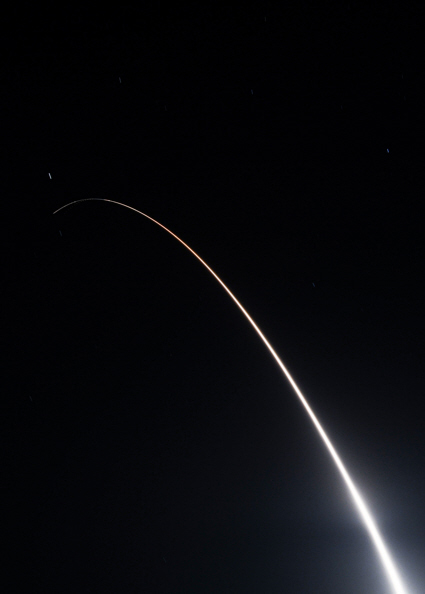
An operational test launch of an Air Force Global Strike Command unarmed Minuteman III intercontinental ballistic missile was conducted April 19 at 5:11 a.m. Pacific Time from Vandenberg Space Force Base, California. The missile used in GT-246 launched in the early hours of the morning with a launch command delivered from the Air Launch Control System on a Navy E-6 TACAMO aircraft. (U.S. Space Force photo by Airman 1st Class Ryan Quijas)
(APR 19) VANDENBERG SPACE FORCE BASE, Calif. - A joint team of Air Force Global Strike Command Airmen and Navy aircrew launched an unarmed Minuteman III intercontinental ballistic missile equipped with one test re-entry vehicle More
Falcon 9 Carries 51 Spacecraft into Orbit
(APR 15) A Falcon 9 rocket was successfully launched from Vandenberg SFB, Calif. late Friday evening (April 14). Following liftoff at 11:48 p.m. PDT, the vehicle carried 51 spacecraft into orbit. The launch was the tenth flight and recovery for the rocket's first stage.
The following links have additional information about the spacecraft launched on this mission:
Kenya launches first operational satellite into space -Space X
https://news.yahoo.com/kenya-launches-first-operational-satellite-084147053.html
Turkiye launches its 1st indigenous Earth observation satellite into space
https://www.aa.com.tr/en/science-technology/turkiye-launches-its-1st-indigenous-earth-observation-satellite-into-space/2872697
Watch: Dubai's DEWA Sat-2 nanosatellite launched on SpaceX rocket from California
https://gulfnews.com/uae/science/watch-dubais-dewa-sat-2-nanosatellite-launched-on-spacex-rocket-from-california-1.95141309
Momentus Launches Vigoride-6 Orbital Service Vehicle on SpaceX Transporter-7 Mission
https://www.businesswire.com/news/home/20230413005886/en/Momentus-Launches-Vigoride-6-Orbital-Service-Vehicle-on-SpaceX-Transporter-7-Mission
Brian Webb
Iberian Contrails
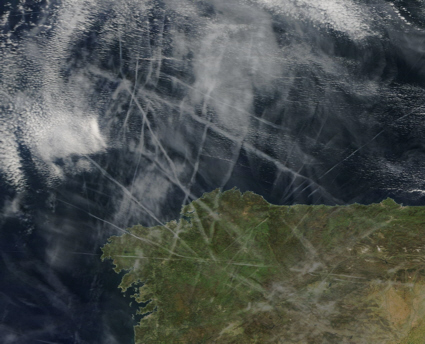
Long streaks of cloud crisscrossed the skies over the Iberian Peninsula on April 7. The Moderate Resolution Imaging Spectroradiometer (MODIS)
on board NASA's Terra satellite acquired a true-color image of the complex pattern on that same day. The streaks are a type of cirrus cloud known
as a "contrail". Cirrus clouds typically form in the sky when humidity is high, but contrails form in the wake of passing aircraft due to particles
and water vapor contained in their exhaust. Terra was launched from Vandenberg AFB in 1999. Image Credit: MODIS Land Rapid Response Team, NASA GSFC
Unarmed Minuteman III Test Launch to Showcase Readiness of U.S. Nuclear Force's Safe, Effective Deterrent
(APR 5) VANDENBERG SPACE FORCE BASE, Calif. -- An operational test launch of an Air Force Global Strike Command unarmed Minuteman III intercontinental ballistic missile is scheduled for April 19 from 11:47 p.m. to April 20, 5:47 a.m. Pacific Time from north Vandenberg.
The purpose of the ICBM test launch program is to demonstrate the readiness of U.S. nuclear forces and provide confidence in the lethality and effectiveness of the nation's nuclear deterrent, according to Air Force Global Strike Command.
This test is routine and was scheduled years in advance. Consistent with previous test launches, this ICBM test launch will validate and verify the effectiveness, readiness and accuracy of the weapon system.
In accordance with standard procedures, the United States has transmitted a pre-launch notification pursuant to the Hague Code of Conduct, and notified the Russian government in advance, per our existing bi-lateral obligations.
Vandenberg SFB
Space Development Agency Successfully Launches Tranche 0 Satellites
SDA delivers first 10 satellites on-orbit, two-and-a-half years from award to launch
(APR 2) The Space Development Agency (SDA) today announced the successful initial launch of Tranche 0 (T0) of the Proliferated Warfighter Space Architecture (PWSA), the Transport and Tracking Layer satellites that will demonstrate the low-latency communication links to support the warfighter with a resilient network of integrated capabilities, including tracking of advanced missile threats, from low-Earth orbit (LEO). More
Joint NASA, CNES Water-Tracking Satellite Reveals First Stunning Views
The Surface Water and Ocean Topography mission offers the first taste of the detailed perspectives of Earth's surface water that its cutting-edge instruments will be able to capture.
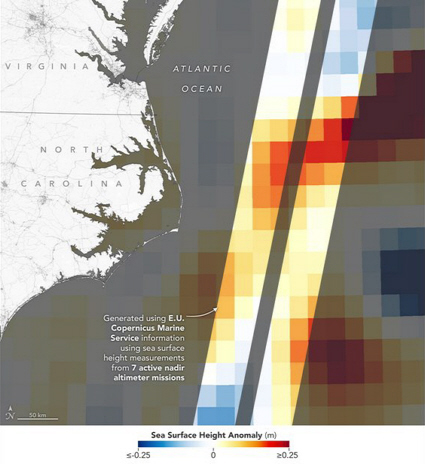
Sea level data gathered Jan. 21 in the Gulf Stream by SWOT's KaRIn instrument, visualized at left, has 10 times the spatial resolution of data taken over the same area by altimeters on seven other satellites, visualized at right. Red represents sea levels higher than the global average, while blue is lower. Credit: left: NASA/JPL-Caltech; right: NASA/JPL-Caltech/Copernicus Marine Service of ESA
(MAR 24) The international Surface Water and Ocean Topography (SWOT) mission - led by NASA and the French space agency Centre National d'Etudes Spatiales (CNES) - has sent back some of its first glimpses of water on the planet's surface, showing ocean currents like the Gulf Stream in unprecedented detail. More
Northrop Grumman Enhances Design of Next-Generation Overhead Persistent Infrared Polar Satellites
Digital technology keeps the development of polar-orbit missile-warning satellites on an accelerated pace
(MAR 14) REDONDO BEACH, Calif. - Northrop Grumman Corporation (NYSE: NOC) has refined the design of Next-Generation Overhead Persistent Infrared (OPIR) Polar (NGP) satellites by leveraging digital technology called Highly Immersive Virtual Environment (HIVE). The satellites are being built by Northrop Grumman for the U.S. Space Force's Space Systems Command (SSC).
Northrop Grumman's HIVE technology allows engineers to design, build, maintain and service satellites in virtual reality before any hardware is manufactured or procured. Real-time modeling, simulation, visualization and human interaction reduce technical costs and risks early in the development phases.
"With digital engineering, we can move through the design, testing and manufacturing phases quickly and with agility, saving money and significantly reducing development timelines for large systems," said Carol Erikson, vice president, systems engineering and digital transformation, Northrop Grumman.
As part of the Next-Generation Overhead Persistent Infrared System (Next-Gen OPIR), two NGP satellites will provide precise, timely sensor coverage over the northern hemisphere to help deter and defend against ballistic and hypersonic missiles. NGP combines Northrop Grumman's proven experience in missile warning and defense with a commitment to delivering NGP at an accelerated pace.
During a recent HIVE demonstration, conducted at the company's facility in Redondo Beach, California, Northrop Grumman engineers donned virtual-reality goggles and motion-capture suits to simulate the integration and assembly of the satellites' key components. Engineers validated the NGP design and will continue to use digital technology in the next stages of the satellites' development.
In March 2022, Northrop Grumman announced its partnership with Ball Aerospace to design and develop the two NGP satellite infrared payloads in the first phase of a $1.89 billion SSC contract.
Northrop Grumman
Northrop Grumman Test Fires Stage-One Solid Rocket Motor for Sentinel Missile
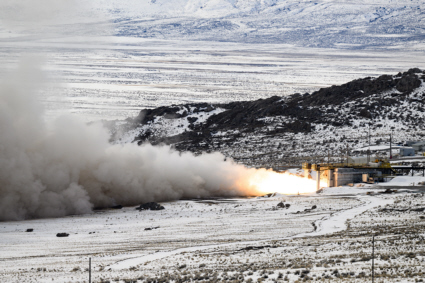
The Air Force Nuclear Weapons Center conducted its first full-scale static test fire of the LGM-35A Sentinel stage-one solid rocket motor at the Northrop Grumman test facility in Promontory, Utah, March 2. The Air Force plans to replace the fielded Minuteman III intercontinental ballistic missile with the next-generation Sentinel system currently in development. The Sentinel acquisition program represents the modernization of the land-based leg of the U.S. nuclear triad. (U.S. Air Force photo by R. Nial Bradshaw).
(MAR 6) PROMONTORY, Utah. - Northrop Grumman Corporation (NYSE: NOC) conducted its first full-scale static test fire of the Sentinel stage-one solid rocket motor at the company's test facility in Promontory. More
Falcon 9 Launched
(MAR 3) After several delays, a Falcon 9 rocket carrying 51 Starlink satelllites was launched this morning from Vandenberg SFB, Calif. at 10:38 PST.
Brian Webb
Celestial Close Encounter
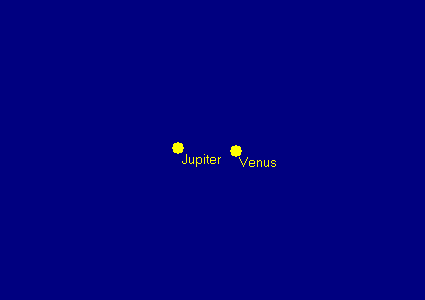
Venus and Jupiter as seen from Los Angeles, Calif. 30 minutes after sunset on March 1. Image: SkyMap
(FEB 25) Weather permitting, observers in Southwest and beyond will see a celestial close encounter the evening of March 1 when Venus and Jupiter will be separated by half a degree. Their apparent proximity will be an illusion, however. The planets will lie in the same direction as seen from Earth, but be in different parts of the solar system. To see the display, look in the west about 30 minutes after sunset.
Brian Webb
Falcon 9 Launched
(FEB 17) A Falcon 9 rocket carrying 51 Starlink satelllites was launched this morning from Vandenberg SFB, Calif. at 11:12 PST.
Brian Webb
Northrop Grumman Validates Sentinel Missile Design through Rigorous Wind Tunnel Testing Campaign
Live-fire results with scaled missiles correlate with digital models, offering further proof of design maturity
(FEB 16) ROY, Utah. - Northrop Grumman Corporation (NYSE: NOC) successfully completed a series of wind tunnel tests of the LGM-35A Sentinel intercontinental ballistic missile (ICBM). More
Minuteman III Test Launch Showcases Readiness of U.S. Nuclear Force's Safe, Effective Deterrent
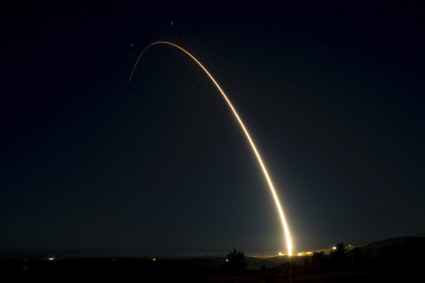
An Air Force Global Strike Command unarmed Minuteman III intercontinental ballistic missile launches during an operation test at Vandenberg Space Force Base, Calif., Feb. 9, 2023. Image Credit: Courtesy photo via Department of Defense
(FEB 10) BARKSDALE AIR FORCE BASE, La. -- A team of Air Force Global Strike Command Airmen launched an unarmed Minuteman III intercontinental ballistic missile equipped with a test reentry vehicle at 11:01 p.m. Pacific Time Feb. 9 from Vandenberg Space Force Base, California. More
Falcon 9 Launched
(FEB 3) A Falcon 9 rocket was successfully launched January 31 from Vandenberg Space Force Base, Calif. The vehicle lifted off from south base at 08:15 PST and flew southward as it carried 49 Starlink Internet satellites and an Italian rideshare payload into orbit.
A few minutes after launch, Bob Brown sent the following report to the webmaster:
"Just had to send you a note about the launch from Vandenberg that took place 5 minutes ago. In all the years that I've observed launches from my street between Santa Barbara and Goleta, this was easily the clearest,most vibrant view of the rocket (through binocs) that I've ever seen. I credit that to the crisp, clear winter air and side lighting from an early morning sun. The shock waves haven't hit here just yet but should occur any moment. Just WOW!!"
Brian Webb
Falcon 9 Launched - Finally
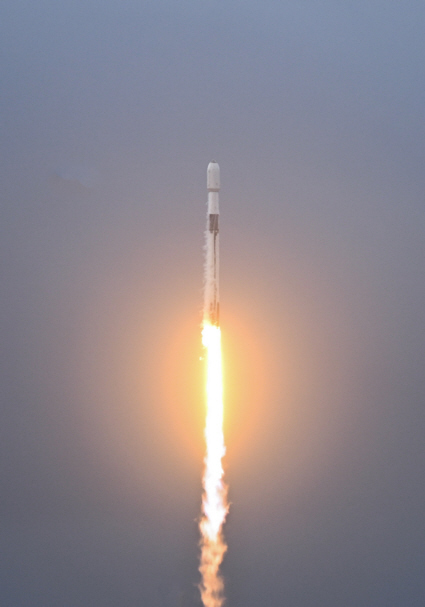
A SpaceX Falcon-9 rocket carrying Starlink mission 2-4 launches from Space Launch Complex-4E on Jan. 19, 2023, 7:43 a.m. PDT, Vandenberg Space Force Base, Calif. Since 1958, there have been 2,023 launches on base. This launch also makes it the 100th launch from SLC-4E since 1964. (U.S. Space Force photo by Airman 1st Class Tiarra Sibley)
(JAN 21) After multiple delays, a Falcon 9 rocket was launched January 19 at 7:43 a.m. PST from Vandenberg SFB. Following liftoff, the vehicle headed south-southeast and roughly paralleled the coast as it carried 51 Starlink Internet satellites into orbit. The launch was seen from Newbury Park and Simi Valley and was reportedly heard in Oxnard.
Brian Webb
Update on "Start Me Up" Mission Anomaly
(JAN 12) Preliminary analysis of data from the Start Me Up mission has begun to shed light on the outcome of the January 9th flight and next steps to follow. More
Space Systems Command Launches EWS Cubesat Technical Demonstration
(JAN 3) EL SEGUNDO, Calif. - Space Systems Command successfully launched its Electro-Optical/Infrared (EO/IR) Weather Systems (EWS) cubesat technical demonstration this morning onboard the SpaceX Transporter-6 mission at 9:56 a.m. (Eastern, 6:56 a.m. Pacific) from Cape Canaveral Space Force Station, Florida.
This one-year EWS cubesat technical demonstration will prove out emerging space-based EO/IR radiometric imaging technology, using a smaller sensor to provide timely weather imagery data from low Earth orbit (LEO).
"The EWS cubesat technical demonstration effort represents SSC's continued commitment to working with non-traditional partners to broaden the competitive industrial base. If successful, this will provide an innovative option to deliver Space-Based Environmental Monitoring data to the warfighter at an operationally relevant speed," said Lt. Col. Joe Maguadog, EWS Materiel Leader and Program Manager. "This demonstration will inform our transition toward a more affordable, scalable, and resilient EO/IR weather constellation."
In February 2002, the EWS program competitively selected two vendors to develop and launch two separate sensor prototypes. Orion Space Solutions, a non-traditional government contractor, delivered the cubesat for this demonstration. General Atomics Electromagnetic Systems Group will deliver the second prototype by 2025.
This launch satisfies the FY20 National Defense Authorization Act (NDAA) Congressional mandate to launch a weather EO/IR pathfinder prototype by FY23. The program expects the first transmittal of data early in the new year.
Space Systems Command
Past News
|