

2010 MAY 2
(DEC 29) If you can't afford a trip to space, JPL Wallpapers can at least give you the visual - even while you check your Facebook page. With more than 80 wallpapers to choose from in six different screen resolutions, you can sit poolside at the moon one day and get lost in a Snowflake Cluster the next.
The wallpapers are completely free and easy to set up. Organized into six categories, including Earth, Mars, Saturn, and Stars & Galaxies, the wallpapers include some of JPL's most popular and stunning images and artist's concepts.
They're updated often to include the latest images from missions like Cassini and the Mars Rovers, so you can explore a new part of the universe - and take it with you -- daily.
Visit jpl.nasa.gov/wallpaper to snag your view of space and read instructions on how to apply your JPL Wallpaper.
Jet Propulsion Laboratory

The impact of a December 11-18 European cold snap is visible in this land surface temperature image released December 25. The view was created using measurements from the Moderate Resolution Imaging Spectroradiometer (MODIS) on NASA's Terra satellite. Places where temperatures were up to 20 degrees Celsius below average are blue, locations where temperatures were average are cream-colored, and places where temperatures were above average are red. The MODIS instrument was built by Raytheon, Goleta, California. Image courtesy NASA
(DEC 23) Data from spacecraft controlled from California's Jet Propulsion Laboratory shows the solar system is passing through an interstellar cloud that should not exist. More
(DEC 14) VANDENBERG AIR FORCE BASE, Calif. - Mission planners are celebrating Vandenberg's final launch of the year following the successful launch of a Delta II rocket from Space Launch Complex-2 today at 6:09 a.m. More
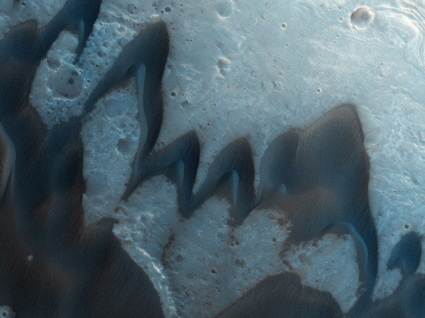
Arc-shaped Barchan sand dunes add relief to an otherwise flat area of Mars in this image released by the University of Arizona on December 11. The HiRISE camera on NASA's Mars Reconnaissance Orbiter imaged the dunes from a range of 168 miles (268 km) during an afternoon pass over the area. HiRISE is controlled from the University pf Arizona in Tucson. Image: NASA/JPL/University of Arizona
(DEC 10) Vandenberg AFB, Calif., - The launch of NASA's Wide-field Infrared Survey Explorer (WISE) mission is now rescheduled for Dec. 14, with a launch window of 6:09-6:23 a.m. PST. The first launch attempt scheduled for Dec. 11 was delayed due to an anomaly in the motion of a booster steering engine.
Mission managers have implemented a plan to completely resolve the anomaly. This plan includes removing and replacing a suspect component on Friday, Dec. 11 allowing the Delta II to be ready for Monday's launch attempt. The current weather forecast calls for an 80 percent chance of acceptable weather during the launch window.
United Launch Alliance
(DEC 4) Launch of NASA's Wide-field Infrared Survey Explorer (WISE) from Vandenberg Air Force Base in California is scheduled for Dec. 11. Launch and mission managers held a Flight Readiness Review on Friday and will reconvene at Vandenberg on Sunday to assess the "Go" for the propellant load of second stage on Monday.
The scheduled Launch Readiness Review and press conferences will move two days forward to Wednesday, Dec. 9.
Launch Weather forecast is less than favorable this week with a front moving in. The biggest concern for launch day is precipitation and thick cloud rule violation.
The WISE spacecraft will circle Earth over the poles, scanning the entire sky one-and-a-half times in nine months. The mission will uncover hidden cosmic objects, including the coolest stars, dark asteroids and the most luminous galaxies.
NASA
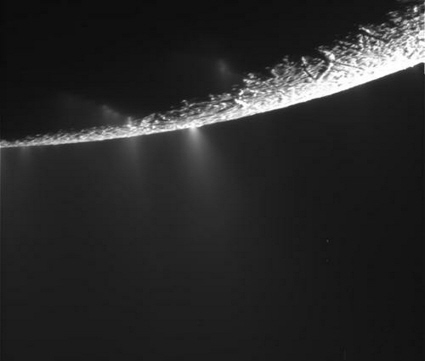
Jets of water vapor and other particles spew from fissures on the south polar region Saturn's moon Enceladus. The activity was recorded by the Cassini spacecraft during a flyby of Enceladus on November 21. The Jet Propulsion Laboratory in Pasadena, Calif. controls and manages the Cassini mission for NASA. Image courtesy JPL/NASA
(NOV 23) PASADENA, Calif. -- NASA's Spitzer Space Telescope has contributed to the discovery of the youngest brown dwarf ever observed -- a finding that, if confirmed, may solve an astronomical mystery about how these cosmic misfits are formed. More
(NOV 18) As forecasters predicted, the Leonid meteor shower peaked during the late hours of Nov. 17th, favoring sky watchers in Asia with an outburst of 100+ meteors per hour. Just as the outburst was dying down, an even bigger event took place over the western USA. Something hit Earth's atmosphere and exploded with an energy equivalent of 0.5 to 1 kiloton of TNT. Witnesses in Colorado, Utah, Idaho and elsewhere say the fireball "turned night into day" and "shook the ground" when it exploded just after midnight Mountain Standard Time. Researchers who are analyzing infrasound recordings of the blast say the fireball was not a Leonid. It was probably a small asteroid, now scattered in fragments across the countryside. Efforts are underway to measure the trajectory of the asteroid and guide meteorite recovery efforts.
(NOV 16) VANDENBERG AIR FORCE BASE, Calif. - The scheduled launch of an unarmed Minuteman III intercontinental ballistic missile has been postponed.
The mission was scheduled to launch on Nov. 18 to gather accuracy and reliability data. The postponement of this mission will allow for the completion of ground testing prior to launching.
30th Space Wing public affairs will release the new launch date when determined.
Vandenberg AFB
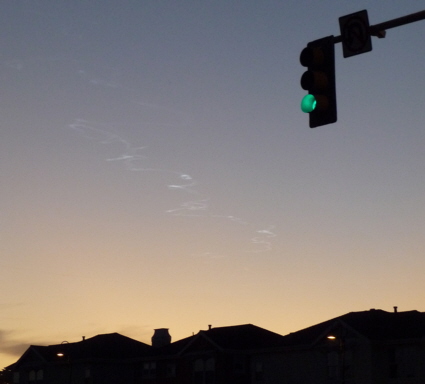
The smoke trail from a large meteor or "fireball" hangs in the sky after sunset on November 7. Chris and Gwen Wagy spotted the unusual trail while driving in Marina, California and thought it was a noctilucent cloud. Observers in northern California reported seeing the fireball streak across the sky minutes earlier at about 17:10 PDT. The incendiary display and smoky aftermath were due to a meteor and may have been part of the annual Taurid meteor shower which was in progress. Image Copyright 2009, Gwen Wagy. Used with permission.
(NOV 13) WAUKESHA, Wis. - Meteor-watchers get their big break in the coming weeks with the return of the Leonid meteor shower. This prolific shower comes at a perfect time this year, peaking the night of November 16/17 during November's New Moon. More
(NOV 4) The University of Utah announced initial observations or "first light" of its new $860,000 research telescope in southwest Utah.
The new Willard L. Eccles Observatory's 32-inch reflecting telescope took its first pictures the night of Oct. 15. The "first light" photo is an edge-on view of the spiral galaxy NGC 891, says Wayne Springer, who heads the project and is an associate professor of physics and astronomy.
The new observatory, with a telescope built by DFM Engineering, is located at an elevation of about 9,600 feet on Frisco Peak, near Milford, Utah.
University of Utah
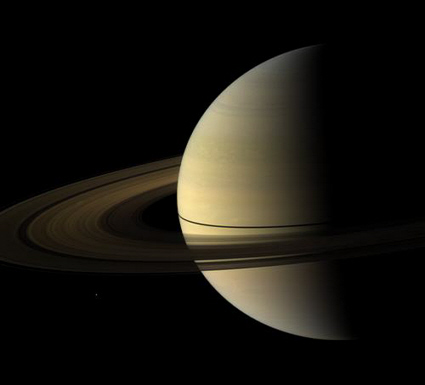
Saturn shines in natural color in this Cassini spacecraft view released by the Jet Propulsion Laboratory in Pasadena, Calif. on October 30. The scene was created using red, green, and blue images obtained with the Cassini's wide-angle camera on September 4 from a distance of approximately 1.7 million miles (2.7 million kilometers) from the planet. JPL manages the Cassini mission for NASA's Science Mission Directorate, Washington, D.C. Image: NASA/JPL/Space Science Institute
(OCT 28) SOCORRO, NM - Astronomers using the National Science Foundation's Very Large Array (VLA) radio telescope have gained tantalizing insights into the nature of the most distant object ever observed in the Universe -- a gigantic stellar explosion known as a Gamma Ray Burst (GRB). More
(OCT 20) Peering far beyond our solar system, NASA researchers have detected the basic chemistry for life in a second hot gas planet, advancing astronomers toward the goal of being able to characterize planets where life could exist. More
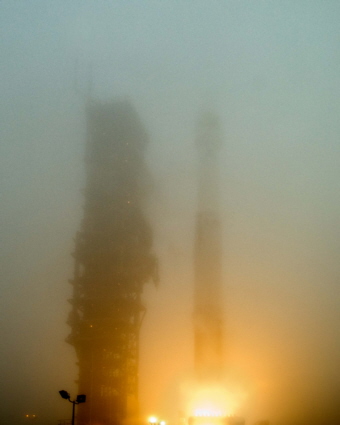
A United Launch Alliance Atlas V carrying the Air Force's Defense Meteorological Satellite Program F18 spacecraft lifts off October 18th from Vandenberg AFB. Despite a foggy day, the Atlas V flawlessly delivered DMSP F18 successfully to its assigned orbit after an 18-minute flight. Photo by Pat Corkery, United Launch Alliance.
(OCT 18) VANDENBERG AIR FORCE BASE, Calif. - Vandenberg AFB successfully launched a Atlas V rocket today at 9:12 a.m. The rocket took off from Space Launch Complex-3 carrying a Defense Meteorological Satellite Program payload.
This was Vandenberg's second Atlas V launch and the first Air Force payload to be lifted from Vandenberg aboard an Atlas V.
Atlas V is part of the Evolved Expendable Launch Vehicle family. The program, which began in the 1990s with the goal of making government space launches more affordable and reliable, resulted in the development of two launch systems, Delta IV and Atlas V.
The DMSP satellites monitor the meteorological, oceanographic and solar-terrestrial physics environments for the Department of Defense. Each DMSP satellite has a 101 minute, sun-synchronous near-polar orbit at an altitude of 830 km above the surface of the Earth. DMSP sensors collect images across a 3000 km swath, providing global coverage twice per day.
Once operational, the DMSP payload will be managed by the National Oceanographic Atmospheric Administration satellite control center in Suitland, Md., with support from the 6th Space Operations Squadron, an all Air Force Reserve unit stationed out of Schriever AFB, Colo.
Vandenberg AFB
(OCT 8) VANDENBERG AFB, Calif. - Vandenberg successfully launched a Delta II rocket from Space Launch Complex-2 today at 11:51 a.m. More
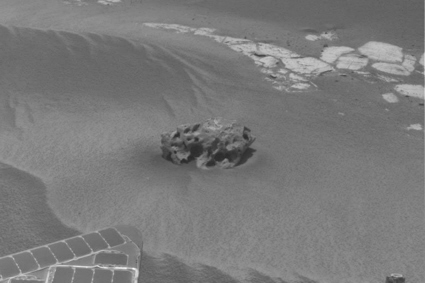
NASA's Mars Exploration Rover Opportunity used its navigation camera to take this image on October 1 of an apparent meteorite. Dubbed "Shelter Island," the new meteorite was found less than three weeks after the rover drove away from a larger meteorite. The Jet Propulsion Laboratory in Pasadena, Calif. manages the Opportunity mission on behalf of NASA. Image: NASA/JPL-Caltech
(OCT 1) Astronomers from the University of Arizona and 41 other institutions are beginning the most ambitious project yet to map the three-dimensional structure of the universe in a quest to understand dark energy. More
(SEP 25) CANOGA PARK, Calif., -- Pratt & Whitney Rocketdyne, a United Technologies Corp. (NYSE: UTX) company, helped boost two tandem Space Tracking and Surveillance System (STSS) demonstrator satellites from Cape Canaveral Air Force Station, Fla., today. The satellites were onboard a United Launch Alliance Delta II rocket launched for NASA, powered by a Pratt & Whitney Rocketdyne RS-27A engine. It was the 231st successful flight boosted by the RS-27 family of engines.
The demonstrator satellites are designed to prove the key functions of space-based sensors for the Missile Defense Agency. They will acquire, track and discriminate ballistic missiles and communicate the data to other elements of the Ballistic Missile Defense System via the Missile Defense Space Experimentation Center ground station to provide sensor information for all phases of the missiles' flight.
Pratt & Whitney Rocketdyne, Inc., a part of Pratt & Whitney, is a preferred provider of high-value propulsion, power, energy and innovative system solutions used in a wide variety of government and commercial applications, including the main engines for the space shuttle, Atlas and Delta launch vehicles, missile defense systems and advanced hypersonic engines.
Pratt & Whitney Rocketdyne
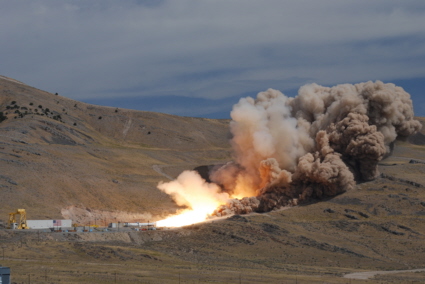
Flame and smoke pour from a rocket motor on September 10 during a test firing in the Utah desert. The event was the initial full-scale, full-duration test firing of the first stage motor for the Ares I rocket, a crew launch vehicle in development for NASA's Constellation Program. NASA image by Walt Lindblom
(SEP 18) A NASA spacecraft slated for launch from California's Vandenberg Air Force Base will survey the sky at infrared wavelengths for dim objects lurking in the vast dark spaces between planets and stars. More
(SEP 9) As the flames of the raging brush fire dubbed the Station Fire threatened the northern edge of NASA's Jet Propulsion Laboratory on Saturday, Aug. 29, the managers of NASA's Deep Space Network prepared for the worst. More
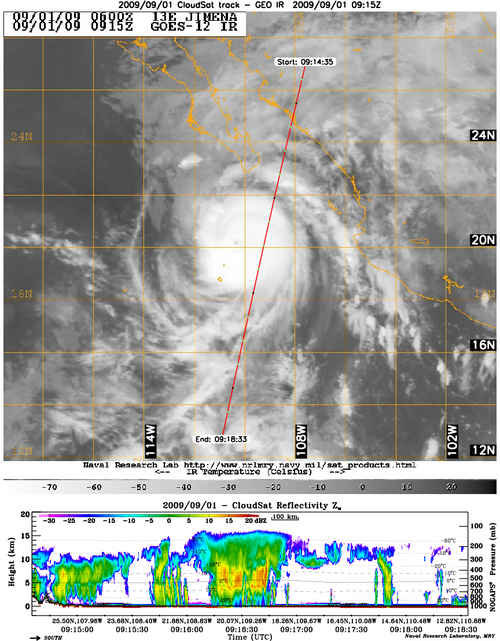
The internal structure of Hurricane Jimena (click to enlarge) is revealed in a profile from NASA's CloudSat spacecraft. CloudSat collected the microwave cross-section during an overpass of the storm as it approached Baja California on September 1. Compare the profile with an infrared view of Jimena from the GOES-12 satellite (top). CloudSat was launched from Vandenberg AFB in 2006. Image: Colorado State University Boulder
(SEP 4) WASHINGTON -- NASA and Alliant Techsystems Inc., or ATK, have rescheduled the test of the new first-stage solid rocket motor for the Ares I rocket. The static firing of the five-segment solid motor, designated development motor -1, is scheduled for 1 p.m. MDT on Thursday, Sept. 10, at the ATK test facility in Promontory, Utah. The first firing attempt on Aug. 27 was scrubbed because of an anomaly with the ground test controller.
The goal of this test is to obtain valuable thrust, roll-control, acoustics and vibration data as engineers continue to design the Ares vehicles.
The test will be carried live on the NASA media channel beginning 10 minutes prior to the firing. For NASA TV streaming video, downlink and schedule information, visit:
In addition, the NASA Ares Twitter feed will be updated throughout the day. To follow, visit:
For more information about Ares, visit:
NASA
(AUG 24) Astronomers have been mining a mother lode of astronomical data from The University of Arizona's Catalina Sky Survey and finding more "optical transients" than they can characterize during the past 17 months. More
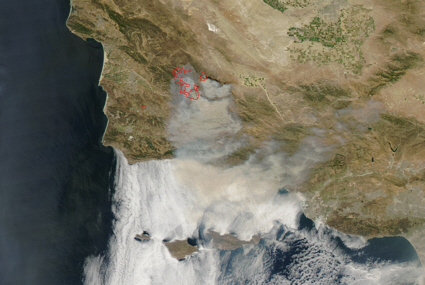
Having grown by roughly 10,000 acres (40 square kilometers), the La Brea wildfire burns north of Santa Barbara, Calif. on August 13. The MODIS instrument on NASA's Aqua satellite imaged the region during a pass the same day. In the above close-up, smoke billows from the fire while red outlines indicate where MODIS has detected unusually warm surface temperatures associated with active fires. Also visible are low clouds and fog south of Santa Barbara and the Channel Islands. Image: Jeff Schmaltz, MODIS Land Rapid Response Team, NASA GSFC
(AUG 23) VANDENBERG AIR FORCE BASE, Calif. - An unarmed Minuteman III intercontinental ballistic missile configured with a National Nuclear Security Administration test assembly launched from North Vandenberg today at 9:01 a.m.
The launch was an operational test to verify the weapon system's reliability and accuracy.
The missile carried one unarmed re-entry vehicle approximately 4,190 miles at speeds in excess of 15,000 mph to a pre-determined target near the Kwajalein Atoll in the Marshall Islands.
Col. Steven Winters, the 30th Space Wing vice commander, was the mission's launch decision authority. Col. Carl T. DeKemper, the 576th Flight Test Squadron commander, was the mission director for this test launch.
Throughout the preparation and execution of the mission, maintenance and operations task force personnel from the 341st Missile Wing, Malmstrom AFB, Mont., integrated with the 576th FLTS to perform operational tasks. Members of the 576th FLTS installed tracking, telemetry and command destruct systems on the missile to collect data and meet 30th Space Wing safety requirements.
The data collected will be used by the entire ICBM community, including the United States Strategic Command planners and Department of Energy laboratories.
Vandenberg AFB
(AUG 14) WASHINGTON -- NASA and Alliant Techsystems Inc., or ATK, will conduct the first full-scale, full-duration test of the new first-stage solid rocket motor for the Ares I rocket at 1 p.m. MDT, on Thursday, Aug. 27. The test will take place at the ATK test facility in Promontory, Utah.
The test was previously scheduled for Aug. 25. The new date allows key NASA and ATK personnel to support this test and the upcoming STS-128 space shuttle Discovery mission. Discovery is targeted for launch on Aug. 24.
The static firing of the five-segment solid motor, designated Development Motor -1, will last two minutes. The goal is to obtain valuable thrust, roll-control, acoustics and vibration data as engineers continue to design Ares I.
The first-stage solid rocket motor is managed and tested by the Ares Projects Office at NASA's Marshall Space Flight Center in Huntsville, Ala. ATK Space Systems is the prime contractor for the Ares I first stage. The Ares I rocket is designed to launch the Orion spacecraft and the next generation of NASA astronauts.
For more information about Ares, visit:
NASA

Despite having run out of liquid coolant, NASA's Spitzer Space Telescope continues to return impressive infrared views of the universe such as the one above of DR22, a cloud bursting with new stars in the constellation Cygnus. The blue areas are dusty clouds while the orange is mainly hot gas. The image was recorded by two of Spitzer's infrared detector channels that work at the spacecraft's new, warmer temperature. The Jet Propulsion Laboratory in Pasadena, Calif. manages the Spitzer Space Telescope mission for NASA. Image courtesy NASA/JPL-Caltech
(AUG 7) WASHINGTON -- NASA and Alliant Techsystems Inc. [ATK] will conduct the first full-scale, full-duration test of the new first-stage solid rocket motor for the Ares I rocket at 1 p.m. MDT, on Tuesday, Aug. 25. The test will take place at the ATK test facility in Promontory, Utah.
The static firing of the five-segment solid motor, designated Development Motor -1, will last two minutes. The goal is to obtain valuable thrust, roll-control, acoustics and vibration data as engineers continue to design Ares I.
The first-stage solid rocket motor is managed and tested by the Ares Projects Office at NASA's Marshall Space Flight Center in Huntsville, Ala. ATK Space Systems is the prime contractor for the Ares I first stage. The Ares I rocket is designed to launch the Orion spacecraft and the next generation of NASA astronauts.
For more information about Ares, visit:
NASA
(JUL 29) PASADENA, Calif. -- NASA's Jet Propulsion Laboratory is introducing a new Web site that will provide a centralized resource for information on near-Earth objects - those asteroids and comets that can approach Earth.
The new Asteroid Watch site is online at http://www.jpl.nasa.gov/asteroidwatch.
It provides information on NASA's missions to study comets, asteroids and near-Earth objects, and also provides the basic facts and the very latest in science and research on these objects. News about near-Earth object discoveries and Earth flybys will be available and made accessible on the site via a downloadable widget and RSS feed. And for those who want to learn about their space rocks on the go, a Twitter feed is offered. "Asteroid Watch" also contains a link to JPL's more technical Near-Earth Objects Web site, where many scientists and researchers studying near-Earth objects go for information.
NASA supports surveys that detect and track asteroids and comets passing close to Earth. The Near-Earth Object Observation Program, commonly called "Spaceguard," also plots the orbits of these objects to determine if any could be potentially hazardous to our planet.
JPL is a division of the California Institute of Technology in Pasadena.
Jet Propulsion Laboratory
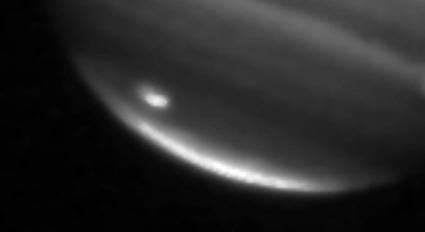
A possible impact in Jupiter's atmosphere shines brightly in this ground-based infrared image captured on July 20. Scientists at the Jet Propulsion Laboratory in Pasadena, Calif., used NASA's Infrared Telescope Facility at the summit of Mauna Kea, Hawaii to image the planet soon after the discovery of the possible impact site by amateur astronomer Anthony Wesley of Australia. Image credit: NASA/JPL/Infrared Telescope Facility
(JUL 21) SANTA BARBARA, Calif. -- Nanosized diamonds found just a few meters below the surface of Santa Rosa Island off the coast of Santa Barbara provide strong evidence of a cosmic impact event in North America approximately 12,900 years ago, according to a new study by scientists. More
(JUL 17) PASADENA, Calif. - A panel that investigated the ill-fated February 24 launch of NASA's Orbiting Carbon Observatory (OCO) from Vandenberg AFB, has completed its report. More
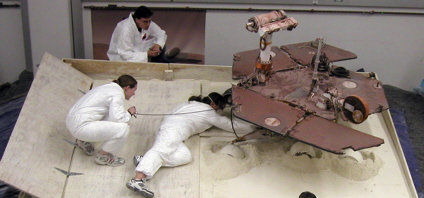
Personnel at the Jet Propulsion Laboratory, Pasadena, Calif. prepare a test setup on July 9 to determine how to free NASA's Mars rover Spirit which is mired in a patch of soft soil on the Red Planet. The testing was performed in a box that holds about 2.7 tons of a powdery mixture of diatomaceous earth and fire clay. This material has physical properties similar to the soil where Spirit is dug in. JPL manages the Spirit mission for NASA. Image Credit: NASA/JPL-Caltech
(JUL 8) The Ventura County Astronomical Society will hold its monthly meeting on July 17 at Mesa Union School, 3901 Mesa School Road, Somis, CA. The speaker will be Dr. Ben Zuckerman Professor of Physics and Astronomy at UCLA.
Dr. Zuckerman's presentation will be "Direct Imaging of Massive Extrasolar Planets". The first observational indication of the existence of rocky extrasolar planets in the zone of life of an old main-sequence star will be described.
The meeting begins at 7:30 PM. Recorded Message: Starline 805-520-9666 or go to www.vcas.org
Ventura County Astronomical Society
(JUN 29) VANDENBERG AIR FORCE BASE, Calif. - An unarmed Minuteman III intercontinental ballistic missile configured with a National Nuclear Security Administration test assembly launched from North Vandenberg today at 3:01 a.m.
The launch was an operational test to verify the weapon system's reliability and accuracy.
The missile carried three unarmed re-entry vehicles approximately 4,190 miles at speeds in excess of 24,000 mph to their pre-determined targets near the Kwajalein Atoll in the Marshall Islands.
Col. David Buck, the 30th Space Wing commander, was the mission's launch decision authority. Lt. Col. Lesa K. Toler, the 576th Flight Test Squadron commander, was the mission director for this test launch.
Throughout the preparation and execution of the mission, maintenance and operations task force personnel from the 91st Missile Wing out of Minot AFB, N.D., integrated with the 576th FLTS to perform operational tasks. Members of the 576th FLTS installed tracking, telemetry and command destruct systems on the missile to collect data and meet 30th Space Wing safety requirements.
The data collected will be used by the entire ICBM community, including the United States Strategic Command planners and Department of Energy laboratories.
Vandenberg AFB
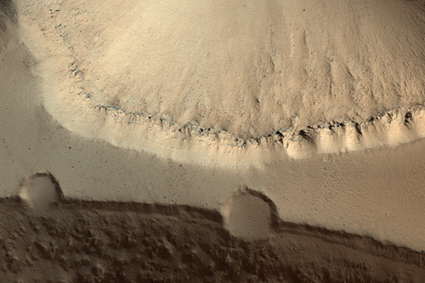
A series of flat-bottomed valleys flank Elysium Mons, a shield volcano on the planet Mars. Many of the valleys may have first formed by movement along faults. Then mud or lava flows could have widened the sides of the valleys, giving them a flat floor. The image was captured by the HiRISE camera aboard the Mars Reconnaissance Orbiter and released by the University of Arizona on June 25. The camera is controlled from the university's campus in Tucson. Image: NASA/JPL/University of Arizona
(JUN 24) VANDENBERG AIR FORCE BASE, Calif. - An unarmed Minuteman III intercontinental ballistic missile configured with a joint test assembly is scheduled to launch from North Vandenberg Monday between 3:01 a.m. to 9:01 a.m. More
(JUN 18) NASA's Quick Scatterometer, or QuikScat, mission was conceived, developed and launched less than two years after the unexpected loss of the Japan Aerospace Exploration Agency's Advanced Earth Observing Satellite-1 spacecraft, which carried the NASA Scatterometer in June 1997. More

Late spring turns to summer in British Columbia in this image captured by the MODIS instrument on the Aqua satellite on 2009 June 3. The snow is melting off the Coast Mountains and the vegetation is turning brilliant green, though to the north, hints of winter's brown remain. The image is one of many gathered by Aqua since its launch aboard a Delta rocket from California's Vandenberg Air Force Base in 2002.
(JUN 10) PASADENA, Calif. -- NASA's Wide-field Infrared Survey Explorer, or WISE, has been assembled and is undergoing final preparations for a planned Nov. 1 launch from Vandenberg Air Force Base, Calif. More
(JUN 3) EL SEGUNDO, Calif., June 3, 2009 /PRNewswire/ -- Raytheon Company (NYSE: RTN) has received confirmation from the U.S. Air Force Research Laboratory that its hyperspectral imaging sensor known as ARTEMIS has been activated aboard the TacSat-3 spacecraft and is fully functional.
The milestone continues Raytheon's 40-year history of on-orbit success. Activation also marks the beginning of the year-long TacSat-3 mission to test the payload's ability to deliver tactical surveillance information from space to military field commanders within 10 minutes of data acquisition.
ARTEMIS was developed in 15 months as an experiment in rapid deployment funded by a $15 million contract from the laboratory. Data collection is scheduled to begin within days as part of the program's goal of demonstrating the ability to design, build and field space solutions in tactically relevant time frames.
Consisting of a trio of components (telescope, spectrometer and on-board digital signal processor), the payload will image the ground at high spatial resolution in a broad range of the visible and infrared spectrum. It can be directed to search for camouflage, disturbed earth and other signs of enemy activity.
Raytheon
New radio surveys could turn up many supernovas hidden within gas and dust
(MAY 27) Berkeley -- The chance discovery last month of a rare radio supernova - an exploding star seen only at radio wavelengths and undetected by optical or X-ray telescopes - underscores the promise of new, more sensitive radio surveys to find supernovas hidden by gas and dust. More
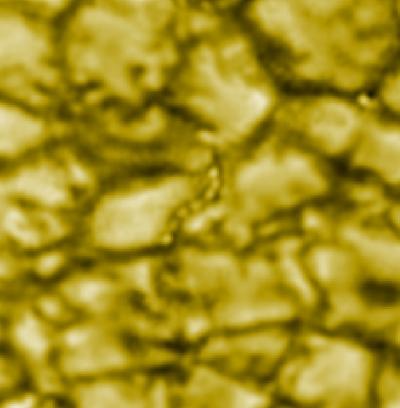
Granulation and a wealth of fine detail are visible in this "first light" image from the Big Bear Solar Observatory's new 1.6-meter clear aperture solar telescope, the largest of its kind in the world. Located high above sea level in Big Bear Lake, California, the instrument will be the pathfinder for all future, large ground-based telescopes. Image: Big Bear Solar Observatory
(MAY 20) HUNTSVILLE, Ala. -- NASA and industry engineers successfully completed the first test of the Ares I rocket's three main parachutes Wednesday. The parachutes -- the largest rocket parachutes ever manufactured -- are designed to slow the rapid descent of the rocket's spent first-stage motor, permitting its recovery for use on future flights.
The Ares I, the first rocket in NASA's Constellation Program, is designed to launch explorers aboard the Orion crew capsule on journeys to the International Space Station, the moon and beyond. The three main parachutes measure 150 feet in diameter and weigh 2,000 pounds each. They are a primary element of the rocket's deceleration system, which also includes a pilot parachute and drogue parachute. Deployed in a cluster, the main parachutes open at the same time, providing the drag necessary to slow the descent of the huge solid rocket motor to a soft landing in the ocean.
Engineers from Marshall managed the team that conducted this first cluster test at the U.S. Army's Yuma Proving Ground near Yuma, Ariz. This was the eighth in an ongoing series of flight tests supporting development of the Ares I recovery system. Researchers dropped the 41,500-pound load from a U.S. Air Force C-17 aircraft flying at an altitude of 10,000 feet. The parachutes and all test hardware functioned properly and landed safely.
NASA
(MAY 11) VANDENBERG AIR FORCE BASE, Calif. - The scheduled operational test launch of an unarmed Minuteman III intercontinental ballistic missile is delayed to allow for additional data collection while in the operational ground configuration. A new launch date has yet to be established.
"We are working with the Western Range to establish a new launch date at their earliest convenience," said Lt. Col. Lesa Toler, 576th Flight Test Squadron commander. "It's not an easy process as the Western Range, Pacific Missile Range and Reagan Test Site at Kwajalein Atoll are all extremely busy and have competing priorities to de-conflict."
"Our additional testing though will allow us to further improve the operational effectiveness of the nation's most powerful weapon system," Lieutenant Colonel Toler said.
Vandenberg Air Force Base Public Affairs will release the new launch date once it becomes available.
Vandenberg AFB
(MAY 5) VANDENBERG AFB, Calif. - Vandenberg successfully launched a Delta II rocket from Space Launch Complex-2 today at 1:24 p.m. More

A rainbow of colors depicts the average temperature of the top millimeter of the Earth's land areas over a nine year period. To create this map (click to enlarge), researchers used measurements from NASA's Terra satellite gathered between 2000 December 1 and 2008 December 31 under clear sky conditions. In this view, yellow shows the warmest temperatures (up to 45° C) and light blue shows the coldest temperatures (down to -25°C). Terra was launched from Vandenberg AFB in 1999 December. Image courtesy of NASA
(APR 30) VANDENBERG AIR FORCE BASE, Calif. -- A Delta II rocket is scheduled to launch from Space Launch Complex-2 here, between 1:24 and 1:52 p.m. May 5.
The rocket will carry an experimental satellite into polar orbit to perform the Missile Defense Agency's Space Tracking and Surveillance System Advanced Technology Risk Reduction mission.
Col. Steven Winters, the 30th Space Wing vice commander, is the Western Range launch decision authority for this mission.
The purpose of the STSS ATRR mission is to enhance MDA's Ballistic Missile Defense System. It will serve as a space based component of a multi-layered system designed to detect, track and intercept ballistic missiles.
Launch preparation is on schedule, with the final launch rehearsal scheduled for May 1; this shake-down run will be the final opportunity to work out any lingering glitches, according to mission planners.
To perform this launch, 30th Space Wing personnel are working in conjunction with the United Launch Alliance, NASA and MDA.
Vandenberg AFB
(APR 24) EDWARDS AIR FORCE BASE, Calif. -- The Boeing Company [NYSE: BA], industry teammates and the U.S. Missile Defense Agency have begun Airborne Laser (ABL) flight tests with the entire weapon system integrated aboard the ABL aircraft. More
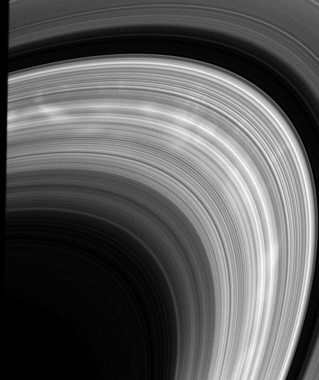
Sometimes seen by Earth-based observers, spokes within Saturn's rings are clearly visible in a Cassini spacecraft image released by the Jet Propulsion Laboratory (JPL) on April 14. Cassini acquired the view with its wide-angle camera from a distance of 510,000 miles (821,000 kilometers) from the planet. JPL, a division of the California Institute of Technology in Pasadena, manages the Cassini mission for NASA. Image courtesy NASA/JPL/Space Science Institute
(APR 18) Next Wednesday (April 22) observers in the southwestern U.S. have an opportunity to see the planet Venus perform a rare disappearing act.
Referred to as an "occultation", the event will occur as the Moon's eastward orbital motion carries it in front of the silvery-white planet, hiding it from view.
As seen from Los Angeles, Venus will disappear behind the Moon during morning twilight at 05:09 PDT. The planet will reappear from behind the Moon just before sunrise at 05:56 PDT.
The event should be easily visible to the unaided eye. However, to see it, you will need an unobstructed eastern horizon.
Brian Webb
(APR 8) MOFFETT FIELD, Calif. - Engineers have successfully ejected the dust cover from NASA's Kepler telescope.
Kepler, which launched on March 6 from Cape Canaveral, Fla., will spend three-and-a-half years staring at more than 100,000 stars in our Milky Way galaxy for signs of Earth-size planets. Some of the planets are expected to orbit in a star's "habitable zone," a warm region where water could pool on the surface. The mission's science instrument, called a photometer, contains the largest camera ever flown in space -- its 42 charge-coupled devices (CCDs) will detect slight dips in starlight, which occur when planets passing in front of their stars partially block the light from Kepler's view.
At 7:13 p.m. PDT on April 7, engineers at Kepler's mission operations center at the Laboratory for Atmospheric and Space Physics, Boulder, Colo., sent commands to pass an electrical current through a "burn wire" to break the wire and release a latch holding the cover closed. The spring-loaded cover swung open on a fly-away hinge, before drifting away from the spacecraft.
Kepler is a NASA Discovery mission. NASA's Ames Research Center Ames is the home organization of the science principal investigator, and is responsible for the ground system development, mission operations and science data analysis. Ball Aerospace & Technologies Corp., Boulder, Colo., is responsible for developing the Kepler flight system and supporting mission operations.
Ames Research Center
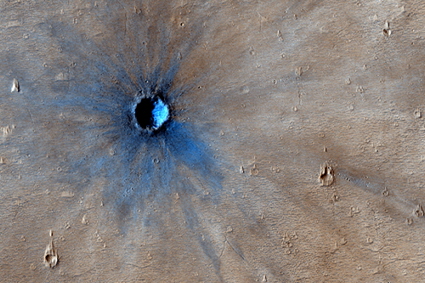
A new impact crater scars the martian surface in this Mars Reconnaissance Orbiter image released April 1. The feature formed between 2005 February and July and was captured by the HiRISE (High Resolution Imaging Experiment) camera aboard the NASA spacecraft. The camera is controlled from the University of Arizona in Tucson. Image: NASA/JPL/University of Arizona
(MAR 30) Just before dawn on Oct. 7, 2008, an SUV-sized asteroid entered Earth's atmosphere and exploded harmlessly over the Nubian Desert of northern Sudan. Scientists expected the asteroid, called 2008 TC3, had blown to dust in the resulting high-altitude fireball. More
(MAR 24) SCHRIEVER AIR FORCE BASE, Colo. -- The 2nd and 19th Space Operations Squadrons here assumed control of the Air Force's newest GPS satellite shortly after its launch from Cape Canaveral Air Force Station, Fla., March 24. More
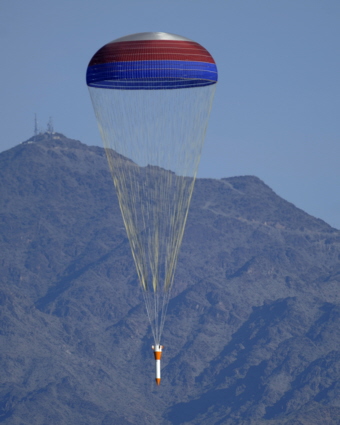
A 68-foot diameter parachute or "super-chute" lowers a dummy rocket motor to the desert floor during a test at Arizona's Yuma Proving Ground on February 28. The motor was released from a U.S. Air Force C-17 cargo aircraft flying at 25,000 feet. The test was conducted to evaluate a prototype parachute system to recover the resuable booster for Ares, NASA's program to return to the Moon. Image courtesy of NASA
(MAR 18) SACRAMENTO, Calif. -- Aerojet, a GenCorp (NYSE: GY) company, announced today that its two Terminal High Altitude Area Defense (THAAD) boost motors performed optimally during a THAAD flight test yesterday at the Pacific Missile Range in Kauai, Hawaii.
THAAD is a mobile missile defense technology designed to intercept and destroy short- to medium-range ballistic missiles during the final, or terminal, phase of their flight, and provides broad area coverage against threats to critical assets such as population centers, industrial resources and military forces.
Aerojet manufactures THAAD boost motors for Lockheed Martin Corporation, the prime contractor and systems integrator supplying the system to the Missile Defense Agency.
For this salvo test, two interceptors were launched at a single target. The incoming target was acquired by tracking radar, and both interceptors were launched to intercept the target. The first interceptor destroyed the target, and the second interceptor was destroyed by range safety officers as planned.
Aerojet
(MAR 13) A group of cockroaches recently took a ride on a high-altitude balloon launched into space by freshmen aerospace engineering students from the University of California, San Diego. More
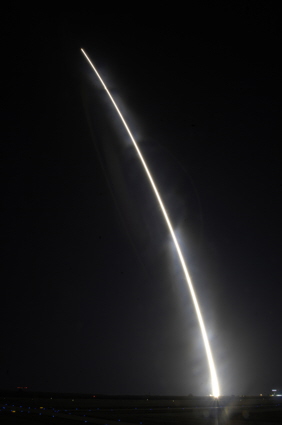
A Taurus XL rocket carrying NASA's Orbiting Carbon Observatory lifts-off from Vandenberg AFB at 1:55 a.m. on February 24. Minutes later, the payload shroud failed to separate from the Taurus, causing the vehicle and the payload to splash in the ocean near Antarctica. U.S. Air Force photo by Airman 1st Class Andrew Lee.
(MAR 5) VANDENBERG AIR FORCE BASE, Calif. - An inspection team from the Russian Federation departed here today at 8:11 a.m. after completing an on-site verification for compliance with the Strategic Arms Reduction Treaty.
The team arrived Tuesday at 7:00 p.m. to conduct the inspection. The United States sends similar teams to inspect former Soviet strategic weapon facilities. The reciprocal inspections are an element of the START I accord which was signed in 1991 and went into force in 1994.
Vandenberg AFB
(FEB 24) PASADENA -- NASA's Orbiting Carbon Observatory satellite failed to reach orbit after its 1:55 a.m. PST liftoff Tuesday from California's Vandenberg Air Force Base.
Preliminary indications are that the fairing on the Taurus XL launch vehicle failed to separate. The fairing is a clamshell structure that encapsulates the satellite as it travels through the atmosphere.
A Mishap Investigation Board will be immediately convened to determine the cause of the launch failure. For more information, visit:
Jet Propulsion Laboratory

This astronaut photograph (click to enlarge) released February 9 highlights the Santa Barbara, California, area, sometimes called the "American Riviera." The geographic setting of the city - between the Santa Barbara Channel to the south and the steep Santa Ynez Mountains to the north - and its year-round mild climate evoke the Mediterranean Riviera. The image was acquired in 2008 December with a Nikon D2Xs digital camera fitted with an 800mm lens. The photo was cropped and enhanced to improve contrast. Image courtesy of NASA
(FEB 19) VANDENBERG AIR FORCE BASE, Calif. - A Taurus XL rocket, carrying the NASA Orbiting Carbon Observatory (OCO) satellite, is scheduled to launch at approximately 1:50 a.m. Tuesday from Space Launch Complex 576-E here.
Col. David Buck, 30th Space Wing commander, will be the Western Range launch decision authority for this mission.
The OCO is the first spacecraft dedicated to the study of carbon dioxide in Earth's atmosphere. The goal of the satellite is to increase scientific understanding of not only where carbon dioxide comes from, but also where it ends up.
Vandenberg AFB
(FEB 12) Launched in September of 2007, and propelled by any one of a trio of hyper-efficient ion engines, NASA's Dawn spacecraft passed the orbit of Mars last summer. More
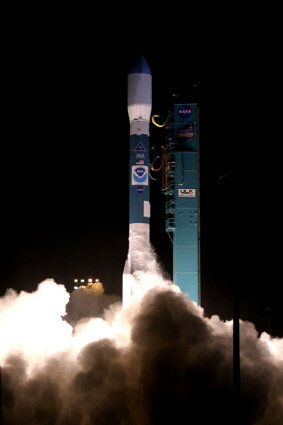
A United Launch Alliance Delta II rocket carrying the NOAA-N Prime weather satellite blasts off from Space Launch Complex-2 West at Vandenberg AFB, Calif., at 2:22 a.m. PST on February 6. After a 65-minute flight, the spacecraft was successfully placed in its assigned orbit. Photo by Carleton Bailie, United Launch Alliance
(FEB 6) Vandenberg Air Force Base, Calif. - A United Launch Alliance Delta II successfully launched the NASA NOAA-N Prime spacecraft at 2:22 a.m. PST, today. More
(JAN 30) VANDENBERG AIR FORCE BASE, Calif. - A Delta II rocket is scheduled to launch from Space Launch Complex-2 here, Wednesday.
The rocket will be carrying NOAA-N Prime polar-orbiting weather satellite for NASA and the National Oceanic and Atmospheric Administration.
Col. Dave Buck, 30th Space Wing commander, will be the western range launch decision authority for this mission.
The satellite will improve weather forecasting and monitor environmental events around the world. NOAA-N Prime is the fifth and last in the current series of five polar-orbiting satellites with improved imaging and sounding capabilities.
The satellite will collect meteorological data and transmit the information to NOAA's Satellite and Information Service, which processes the data for input to the National Weather Service for its long-range weather and climate forecasts. Forecasters worldwide also will be able to access the satellite's images and data.
NOAA-N Prime has sensors that will be used in the Search and Rescue Satellite-Aided Tracking System to monitor for distress signals around the world.
Vandenberg AFB
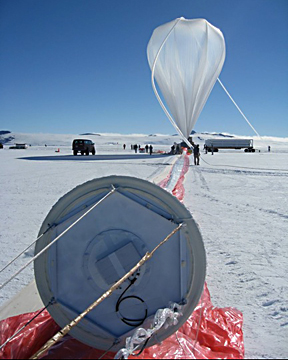
New Mexico State University's Physical Science Laboratory's Columbia Scientific Balloon Facility (CSBF) help launch a super pressure pumpkin balloon from McMurdo Station in Antarctica into a record-setting flight. Sent aloft on December 27, 2008, the balloon is the largest successful single cell super pressure balloon ever flown and has been flying at an altitude of 110,000 feet since launch. Pictured is the balloon during inflation. NMSU photo by Mike Smith, Aerostar International
(JAN 23) Picture a tree in the forest. The tree "inhales" carbon dioxide from the atmosphere, transforming that greenhouse gas into the building materials and energy it needs to grow its branches and leaves. More
(JAN 15) The UA is part of a new National Science Foundation Center for Chemical Innovation, a collaboration called the Center for Chemistry of the Universe. More

Obscured in visible light by dust, a new population of massive stars and new detail in the center of the Milky Way is revealed in a composite infrared image released January 5 by the American Astronomical Society. The panorama combines infrared imagery from the Hubble Space Telescope's Near Infrared Camera and Multi-Object Spectrometer (NICMOS) and the Spitzer Space Telescope. NICMOS was developed by a team led by the University of Arizona. Image courtesy NASA, ESA and Q.D. Wang, University of Massachusetts, Amherst
(JAN 7) Santa Barbara, Calif. -- A team of NASA-funded scientists, including two from UC Santa Barbara, have discovered cosmic radio noise that they find completely unexpected and exciting. More
Copyright © 2009-2010, Brian Webb. All rights reserved.