

2016 March 12
(DEC 29) What a way to end the year. On Dec. 31st, Venus and the slender crescent Moon will gather together high in the southwestern sky for a beautiful conjunction visible for hours after sunset. The two brightest objects in the night sky can be seen through city lights and even fireworks--so everyone can enjoy the show. Meanwhile, closer to the horizon, Mercury and Jupiter are converging for their own Dec. 31st conjunction. This one is not so easy to see, but rewarding for those who make the effort to find the two planets shining through the rosy glow of sunset.
Visit http://spaceweather.com for sky maps and photos of the converging planets.
SpaceWeather.com

Launched from California in 2002, NASA's Aqua spacecraft continues to provide a wide range of data including stunning Earth images. During a daylight pass over Europe on December 22, Aqua recorded this view of northern Italy, Switzerland, Austria, southern Germany and France, and the snow-capped Alps. Image courtesy Jeff Schmaltz MODIS Land Rapid Response Team, NASA GSFC
(DEC 23) Hawthorne, CA - NASA today announced its selection of the SpaceX Falcon 9 launch vehicle and Dragon spacecraft for the International Space Station (ISS) Cargo Resupply Services (CRS) contract award. The contract is for a guaranteed minimum of 20,000 kg to be carried to the International Space Station. The firm contracted value is $1.6 billion and NASA may elect to order additional missions for a cumulative total contract value of up to $3.1 billion.
Under the CRS contract, SpaceX will deliver pressurized and unpressurized cargo to the ISS, and return cargo back to Earth. Cargo may include both NASA and NASA-sponsored payloads requiring a pressurized or unpressurized environment. SpaceX will provide the necessary services, test hardware and software, and mission-specific elements to integrate cargo with the Dragon delivery capsule.
In 2006, SpaceX was named a winner under NASA's Commercial Orbital Transportation Services (COTS) competition. Under the existing COTS agreement, SpaceX will conduct the first flight of its Falcon 9 launch vehicle and Dragon spacecraft in 2009. The final flight, currently scheduled for 2010, will demonstrate Dragon's ability to berth with the ISS.
SpaceX
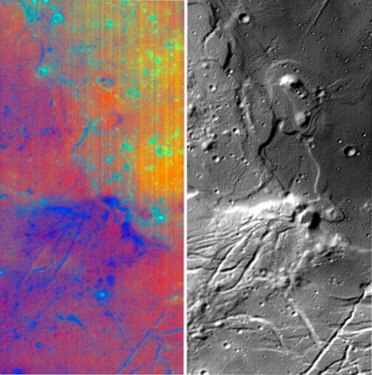
Different wavelengths of light provide new information about the Moon's Orientale Basin in this image from NASA's Moon Mineralogy Mapper. The instrument was designed and built by the Jet Propulsion Laboratory in Pasadena, Calif. and is now orbiting the Moon aboard the India's Chandrayaan-1 spacecraft. On the left is a composite of data from 28 wavelengths of reflected light. The colors reveal rock and mineral composition with green indicating the abundance of iron-bearing minerals. The strip on the right is from a single wavelength of light that contains thermal emission. Image courtesy NASA/JPL/Brown University
(DEC 19) ST. LOUIS -- The Boeing Company [NYSE: BA], through its commercial launch business, has received a contract to launch the fourth satellite for the COSMO-SkyMed (Constellation of Small Satellites for Mediterranean basin Observation) program for Thales Alenia Space Italia, prime contractor of the Italian Space Agency.
The COSMO-SkyMed spacecraft is expected to be launched in 2010 from Vandenberg Air Force Base, Calif., on a Delta II vehicle in the 7420-10 configuration.
Boeing Launch Services will procure the launch vehicle and related support from United Launch Alliance, a Boeing-Lockheed Martin joint venture.
To support a rapid initial operating capability, Boeing successfully launched the first three COSMO-SkyMed satellites from Vandenberg within the 17-month period between June 2007 and October 2008.
Thales Alenia Space Italia developed the COSMO-SkyMed program for the Italian Space Agency and the Italian Ministry of Defense. It is an end-to-end Earth-observation system comprised of four medium-sized satellites and supporting ground stations, which provide orbit-control systems and data reception and processing. The system takes imagery of the Earth using an X-Band Synthetic Aperture Radar instrument capable of operating in all visibility conditions. Its institutional and commercial users include members of the civil, scientific and defense communities.
Boeing
(DEC 16) PASADENA, Calif. -- Oceanography data that will help scientists around the world better understand climate change are now available. The data come from the Ocean Surface Topography Mission, also known as OSTM/Jason-2, a spacecraft developed jointly by NASA and the French space agency. More
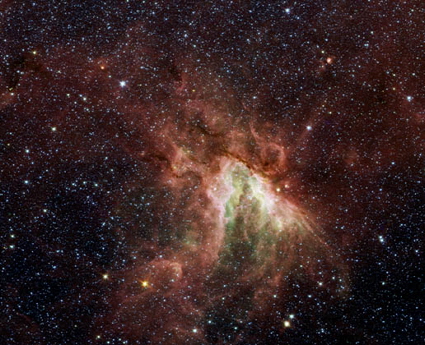
NASA's Spitzer Space Telescope has captured a new, infrared view of the choppy star-making cloud called M17, or the Swan nebula. The cloud, located about 6,000 light-years away in Sagittarius, is dominated by a central group of massive stars. The stars give off intense flows of expanding gas, which rush like rivers against dense piles of material, carving out the deep pocket at center of the picture. Winds from the region's other massive stars push back against these oncoming rivers, creating bow shocks. Spitzer operations are conducted at the Spitzer Science Center at Cal Tech in Pasadena, Calif. Image courtesy NASA/JPL-Caltech/Univ. of Wisc.
(DEC 12) Earth is entering a stream of debris from extinct comet 3200 Phaethon, and this is causing the annual Geminid meteor shower. The shower is expected to peak on Dec. 13th and 14th. Normally, as many as 100 meteors per hour shoot out of the constellation Gemini, but this year a bright Moon will interfere with the display, reducing hourly counts to only 20 or so. That's could still be a nice show. For best results, watch the sky from 10 pm local time on Saturday night (Dec 13th) until dawn on Sunday morning (Dec. 14th).
SpaceWeather.com
(DEC 8) Members of the Alaska National Guard launch an anti-missile interceptor from Vandenberg AFB and direct it to a successful intercept of a mock warhead above the Pacific Ocean. More
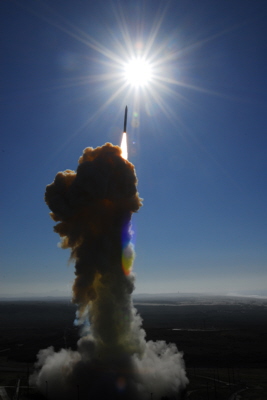
A Ground Based Interceptor lifts-off from Vandenberg AFB as part of a missile test conducted on December 5. A kill vehicle aboard the interceptor successfully homed-in on a mock warhead launched from Kodiak, Alaska and destroyed it in a high-speed collision. U.S. Air Force photo by Joe Davila
(DEC 5) VANDENBERG AIR FORCE BASE, Calif., -- The Boeing Company [NYSE: BA], working with industry teammates and the U.S. Missile Defense Agency, today completed the successful intercept of a target warhead in the most challenging test to date of the United States' only long-range ballistic missile defense system. More
VANDENBERG AIR FORCE BASE, Calif. - The Missile Defense Agency is scheduled to conduct a test of the ground-based interceptor system between noon and 4 p.m. here Friday.
During the evaluation, an interceptor launched from the Ronald W. Reagan Missile Defense Site here will be tested against a target missile, launched from Alaska's Kodiak Island.
The main objective of Friday's test will be to exercise the operational configuration of the interceptor missile.
Vandenberg AFB
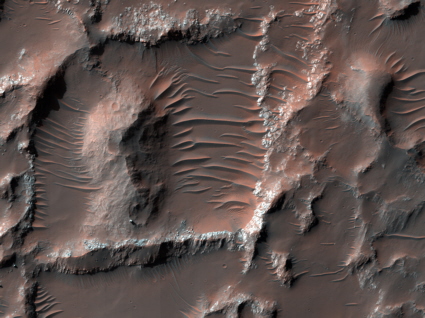
A mix of color and landforms creates spectacular terrain near Mars' Holden Crater in this recently released image. The HiRISE camera on-board NASA's Mars Reconnaissance Orbiter recorded the scene during an afternoon pass over the Margaritifer Terra region in late September. HiRISE was built by Ball Aerospace and Technology Corporation in Colorado and is operated by the University of Arizona. Image courtesy NASA/JPL/University of Arizona
This Thanksgiving weekend, the sky's two brightest planets stand poised to pass each other in evening twilight. A slim crescent Moon will join the pair December 1.
(NOV 25) WAUKESHA, Wis. - Keep your eyes on the early evening sky for the next week, and you will witness the most dramatic planetary alignment of 2008. More
(NOV 24) LOS ALAMOS, N.M. - A Los Alamos National Laboratory cosmic-ray observatory has seen for the first time two distinct hot spots that appear to be bombarding Earth with an excess of cosmic rays. More
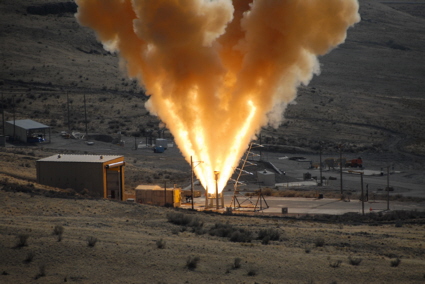
Flames shoot more than 100 feet above the Alliant Techsystems facility in Promontory, Utah during the November 20 test firing of an Orion launch abort motor. The motor is being developed for NASA's next generation spacecraft, the Orion crew exploration vehicle. The abort motor will provide a half-million pounds of thrust to lift the crew module off the Ares I rocket, pulling the crew away safely in the event of an emergency on the launch pad or during the first 300,000 feet of the rocket's climb to orbit. Image courtesy of NASA
(NOV 13) NASA has awarded the University of Colorado at Boulder $2 million for graduate students to design, build and launch four payloads on sounding rockets from the White Sands Missile Range in New Mexico to study X-ray emissions from the edges of the solar system and beyond. More
(NOV 20) EL SEGUNDO, Calif. -- Raytheon Company has completed integration, baseline performance characterization, and vibration testing of a space-based sensor intended to help NASA scientists better understand the effect of aerosols on global warming and climate change.
The Aerosol Polarimetry Sensor will conduct a three-year climate monitoring mission from NASA's Glory satellite. With 161 optical elements, including six precision-aligned telescopes, the sensor is designed to distinguish and characterize various aerosols and accurately measure their global distribution and lifetime.
The device will next undergo electromagnetic interference and thermal vacuum testing to confirm its performance in space-like conditions. Raytheon expects to complete the environmental tests in time to deliver the sensor in the first quarter of 2009.
Glory is scheduled for launch from Vandenberg AFB in mid-2009.
Raytheon
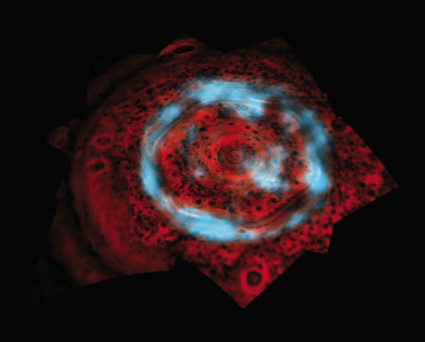
A newly discovered type of aurora (blue) circles Saturn's north pole as heat from the planet's interior (red) silhuettes details in the atmosphere. The view was released by the Jet Propulsion Laboratory in California on November 12 and combines Cassini spacecraft images taken at two wavelengths in the infrared. JPL manages the Cassini mission for NASA's Science Mission Directorate, Washington, D.C. Image courtesy NASA/JPL/University of Arizona
(NOV 13) LIVERMORE, Calif. -- Astronomers for the first time have taken snapshots of a multi-planet solar system, much like ours, orbiting another star. More
(NOV 12) PASADENA, Calif. - NASA's first spacecraft dedicated to studying carbon dioxide, the leading human-produced greenhouse gas driving changes in Earth's climate, has arrived at Vandenberg Air Force Base, Calif., to begin final launch preparations. More
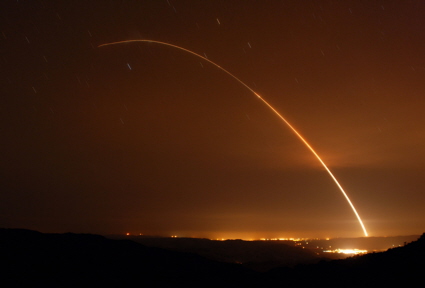
The test launch of a Minuteman III ICBM traces an arc across the sky early on the morning of November 5th. The vehicle lifted-off from an underground silo at Vandenberg Air Force Base and hurled an unarmed warhead on a 30-minute flight to an impact area at Kwajalein in the central Pacific. Brian Lockett recorded the powered portion or "boost phase" of the launch in this time exposure taken from the mountains northwest of Santa Barbara. Image Copyright 2008, Brian Lockett. Used with permission
(NOV 6) The annual Taurid meteor shower is underway and it could be a good show. 2008 is a "swarm year" for the Taurids. Between Nov. 5th and 12th, Earth is due to pass through an unusually dense swarm of gritty debris from parent comet 2P/Encke. When a similar encounter happened in 2005, sky watchers observed a slow drizzle of midnight fireballs for nearly two weeks. Whether 2008 will be as good as 2005, however, remains to be seen. In 2005, the swarm encounter was more central; Earth passed through the middle of the cloud. In 2008, forecasters believe we are closer to the outskirts. How much this will affect the shower, no one knows. The best time to look is during the hours around midnight when the constellation Taurus is high in the sky.
Visit http://spaceweather.com for sky maps and photos of the ongoing shower.
spaceweather.com
(NOV 5) VANDENBERG AIR FORCE BASE, Calif. -- A Minuteman III intercontinental ballistic missile configured with a National Nuclear Security Administration test assembly was launched from North Vandenberg today at 1 a.m. More
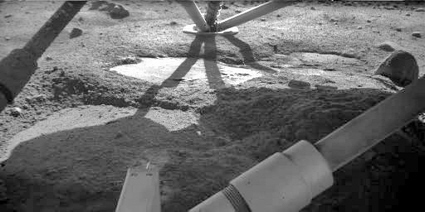
The Robotic Arm Camera on NASA's Phoenix Mars Lander provides a view under the spacecraft in an image released October 30. The lander took the image on October 18 during the 142nd Martian day, or sol, since landing. The flat patch in the center of the image has the informal name "Holy Cow," based on researchers' reaction when they saw the initial image of it only a few days after the 2008 May 25 landing. The Phoenix Mission is led by the University of Arizona, Tucson, on behalf of NASA. Image NASA/JPL-Caltech//University of Arizona/Max Planck Institute
(NOV 2) If you're located in the Americas, you might want to mark November 3rd on your calendar. That's when the Moon's orbit will carry it past another bright object - Jupiter.
As seen from Los Angeles, closest approach for the two bodies occurs that afternoon. However, at 17:53 PST (45 minutes after sunset) the Moon and Jupiter will still be fairly close with a separation of 2.5 degrees.
The separation will slowly increase as the evening progresses and the Moon continues its eastward motion.
Brian Webb
(OCT 31) VANDENBERG AIR FORCE BASE, Calif. - An unarmed Minuteman III intercontinental ballistic missile (ICBM) configured with one joint test assembly is scheduled to launch from North Vandenberg Wednesday morning as an operational test to determine the weapon system's reliability and accuracy. More
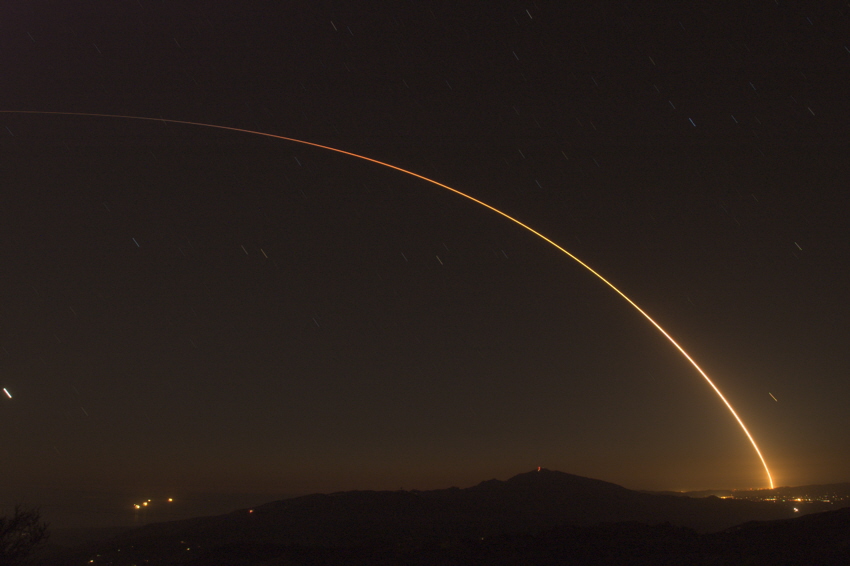
A Boeing Delta II rocket arcs across the sky (click to enlarge) on the evening of October 24 following liftoff from Vandenberg Air Force Base. The Delta delivered Italy's COSMO-3 Earth Observation satellite into a near-polar orbit. The webmaster recorded the first few minutes of the launch in this retouched time exposure made from the mountains north of Santa Barbara. Stars appear as short dashes. Visible in the left is the planet Venus and the lights of offshore oil platforms. Image Copyright 2008, Brian Webb
(OCT 24) VANDENBERG AFB, Calif. - Vandenberg AFB successfully launched a Delta II rocket today at 7:28 p.m. More
(OCT 23) A Delta II rocket is scheduled for launch this Friday evening from Vandenberg AFB. The Delta is scheduled to lift-off from Space Launch Complex 2-West, at 19:28:21 PDT during a one-second launch window.
The Delta will rise vertically for a few seconds before slowly pitching over and heading south. The booster will later deliver Italy's COSMO-3 satellite into a near-polar orbit.
After it becomes operational, COSMO-3 will provide high-resolution radar images of Earth for military and civil users.
Weather permitting, Friday's launch should be visible to the unaided eye for hundreds of miles.
Brian Webb

Driven by powerful Santa Ana winds, wildfires (click to enlarge) raged northwest of Los Angeles, California, in mid-October 2008. Not only did the winds fan the fires' flames, they also sent the smoke far out to sea. NASA's Aqua satellite imaged the fires at 2:20 p.m. local time (21:20 UTC) on October 13. Counter-clockwise swirls of smoke within the plume suggest shifting wind directions as the smoke moves westward. Further evidence of the Santa Ana winds' strength appears in the south, where a faint plume of dust mimics the smoke plume's general movement. Image: Jeff Schmaltz MODIS Land Rapid Response Team, NASA GSFC
(OCT 15) PALMDALE, Calif. - Engineers and technicians from NASA, the German Space Agency and the Deutsches SOFIA Institut recently reinstalled the German-built primary mirror assembly into NASA's Stratospheric Observatory for Infrared Astronomy, or SOFIA, airborne observatory.
Technicians removed the glass mirror from the modified 747SP observatory in April 2008 and transported it to NASA's Ames Research Center, Moffett Field, Calif., where it received its reflective aluminum coating in a vacuum chamber in June 2008. The coating, five one-millionths of an inch thick, will be reapplied as necessary during the 20-year life of the program.
"The reinstallation of the mirror is a significant program milestone on the path to science observations with the SOFIA observatory in the summer of 2009," said Bob Meyer, SOFIA program manager at NASA's Dryden Flight Research Center, Edwards, Calif.
SOFIA is a joint program between NASA and the German Space Agency. The SOFIA program is managed at NASA Dryden and the aircraft is based at the Dryden Aircraft Operations Facility. NASA Ames manages the SOFIA science and mission operations in cooperation with the University Space Research Association, or USRA, and the DSI.
Dryden Flight Research Center
(OCT 15) Schoolchildren, families and citizen scientists around the world will gaze skyward after dark from Oct. 20 to Nov. 3, 2008, looking for specific constellations and then sharing their observations through the Internet. More
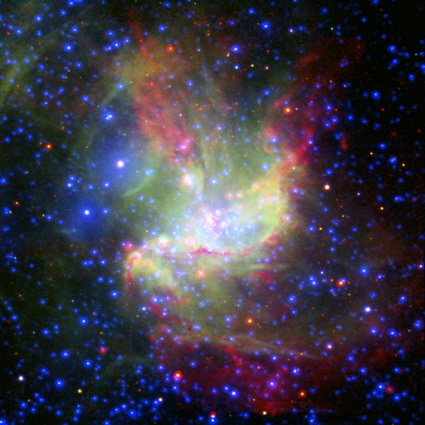
This portrait of star-forming cloud NGC 346 combines multiwavelength light from NASA's Spitzer Space Telescope (infrared), the European Southern Observatory's New Technology Telescope (visible), and the European Space Agency's XMM-Newton space telescope (X-ray). The infrared observations highlight cold dust in red, visible data show glowing gas in green, and X-rays show very warm gas in blue. Ordinary stars appear as blue spots with white centers, while young stars enshrouded in dust appear as red spots with white centers. Spitzer operations are conducted at the Spitzer Science Center at Cal Tech in Pasadena, Calif. Image: NASA/JPL-Caltech/ESA/ESO/MPIA
(OCT 9) PASADENA, Calif. - A NASA/university team has published the first global satellite maps of the key greenhouse gas carbon dioxide in Earth's mid-troposphere, an area about 8 kilometers, or 5 miles, above Earth. More
(OCT 7) The Ventura County Astronomical Society (VCAS) will hold it's monthly membership meeting on Friday, October 17th at 7:30 PM at Vista Elementary School, 2175 Wisteria, Simi Valley. The speaker will be Mr. David Doody, from JPL, and is currently the Flight Operations Lead engineer for Cassini's Mission Support and Services Office. David started working with JPL's Deep Space Network in 1982, then joined Voyager in the outer solar system three years later. After then serving as a member of the Venus-mapping Magellan flight team, Dave joined Cassini in 1994. The presentation will include information about the European Huygens Probe, which Cassini carried, and completed a spectacular descent through Titan's atmosphere. Dave will describe the complex spacecraft, and share some of the stunning discoveries from Saturn and its moons, the planet's unexpected features, flying through an Old Faithful-size geyser that issues continuously from the tiny frozen moon Enceladus, the two-tone puzzle that is Iapetus, and the rivers and lakes on haze-enshrouded Titan. A report from Cassini wouldn't be complete without also enjoying views from high above Saturn's cloud tops, showing off the magnificent ring system in unprecedented detail from every perspective. The public is invited join us for a very interesting evening of learning about the wonderful world of Saturn.
Ventura County Astronomical Society
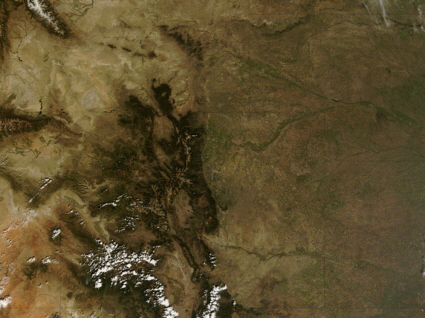
Western Colorado's Roan Plateau contains a variety of natural resources and scenic terrain: high ridges, deep valleys, waterfalls, cutthroat trout, mountain lions, bears, rare plants, and oil and natural gas. On September 25 the MODIS instrument on NASA's Terra satellite imaged the region through nearly cloud-free skies. The plateau assumes shades of green, brown, and beige, and deep canyons form branching, tree-like patterns on the landscape. Image: MODIS Rapid Response Team, NASA Goddard Space Flight Center
(OCT 1) Using a powerful radio telescope to peer into the early universe, a team of California astronomers has obtained the first direct measurement of a nascent galaxy's magnetic field as it appeared 6.5 billion years ago. More
(SEP 30) New Mexico State University astronomy department head Jim Murphy has been recognized by the NASA Phoenix Lander mission for outstanding performance and his lasting contribution to the success of the Phoenix Mars lander.
A representative from NASA's Jet Propulsion Laboratory awarded a certificate in late September for Murphy's research support of the surface environment characterization of Mars and for the design and operations of future spacecraft that could potentially land on Mars. Basically, Murphy's research focuses on the atmosphere of the planet Mars and its climate, weather and wind patterns.
Murphy has been teaching at NMSU for 11 years, and is in his 4th year as a department head.
New Mexico State University
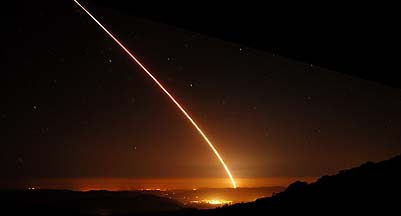
A Chimiera missile lifts-off just before midnight on September 23 from Vandenberg Air Force Base on California's Central Coast. The launch coincided with a pass of the NFIRE satellite which observed the missile to collect data for the U.S. missile defense program. Aerospace photographer Brian Lockett captured the event in this time exposure taken near Refugio Pass in Santa Barbara County. Copyright 2008, Brian Lockett.
(SEP 25) WASHINGTON - Members of the public can send their names around Earth on NASA's Glory satellite, the first mission dedicated to understanding the effects of particles in the atmosphere and the sun's variability on our climate.
The "Send Your Name Around the Earth" Web site enables everyone to take part in the science mission and place their names in orbit for years to come. The Web site, where participants can submit their information, is located at:
http://polls.nasa.gov/utilities/sendtospace/jsp/sendName.jsp
Participants will receive a printable certificate from NASA and have their name recorded on a microchip that will become part of the spacecraft. The deadline for submitting names is Nov. 1, 2008.
Glory is scheduled for launch in June 2009 from Vandenberg Air Force Base in California.
NASA
(SEP 24) VANDENBERG AIR FORCE BASE, Calif. - Vandenberg successfully launched a space launch vehicle, the Chimera target launch vehicle, which is a modified Minuteman booster vehicle with a simplified target payload at 11:57 p.m. today from North Vandenberg. More

The THEMIS instrument on the Mars Odyssey spacecraft imaged complex terrain in the Red Planet's Iani Chaos region. The original image had a resolution of 18 meters (about 55 feet) and was centered on -0.8° N, 343.7° E. THEMIS is controlled and operated from the Arizona State University campus in Tempe, Arizona. Image Credit: NASA/JPL/ASU
(SEP 18) TUCSON, Ariz. -- Raytheon Company (NYSE: RTN) has been awarded a $10 million Missile Defense Agency contract to continue research and development of the Network Centric Airborne Defense Element. More
(SEP 16) SANTA BARBARA, Calif. - Westmont's Carroll Observatory reopens for free public viewings Friday, Sept. 19, at dusk. Weather permitting, stargazers will look through the powerful Keck Telescope at Jupiter in the southern sky.
Thomas Whittemore, instructor of physics, says the moon will not be visible until late Friday night, creating better viewing conditions for deep space.
"We may also be able to see objects near the zenith such as the Ring Nebula in Lyra," he says. "This is the remnants of a dying star, shedding its gaseous envelop into space. Similar to what will eventually happen to our sun, but in about four or five billion years."
Whittemore says some globular clusters may be visible as the winter Milky Way starts to move higher and higher into the evening sky.
The Carroll Observatory is open to the public every third Friday of the month.
Westmont College
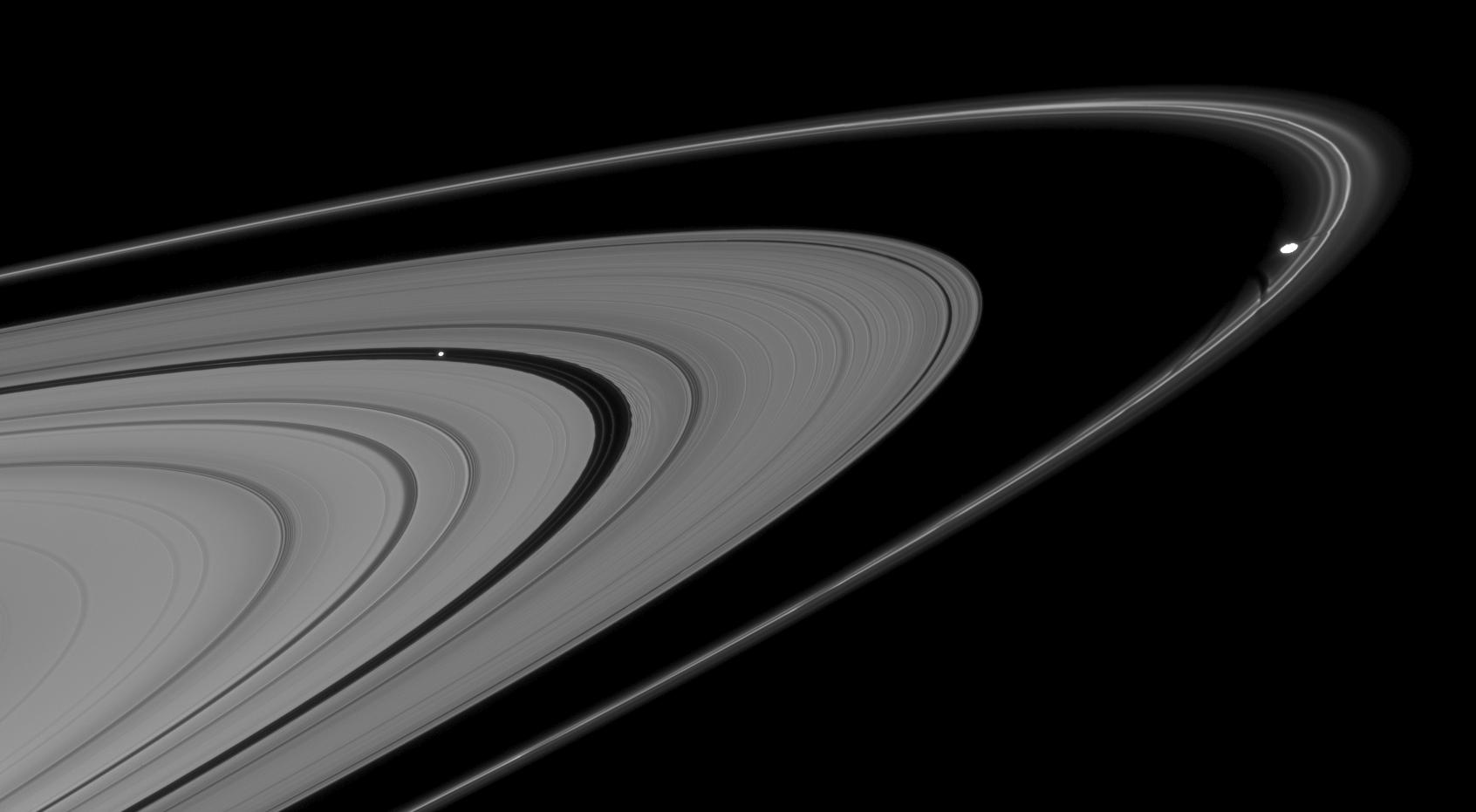
Saturn's moons Pan and Prometheus create features in the planet's nearby rings in this Cassini spacecraft mosaic (click to enlarge) released September 12. Pan (17 miles, or 28 kilometers across), in the Encke Gap at left, is trailed by a series of edge waves in the outer boundary of the gap. Prometheus (53 miles, or 86 kilometers across at its widest point) just touches the inner edge of Saturn's F ring at right, and is followed by a series of dark channels in the ring, which were caused by the passage of Prometheus through the F ring on previous orbits. The Cassini orbiter and its onboard cameras were designed, developed and assembled at JPL in Pasadena, Calif. Image: NASA/JPL/Space Science Institute
(SEP 11) TUCSON, Ariz. -- NASA's Phoenix Mars Lander has photographed several dust devils dancing across the arctic plain this week and sensed a dip in air pressure as one passed near the lander. More
(SEP 8) EDWARDS AIR FORCE BASE -- The Boeing Company [NYSE: BA], industry teammates and the U.S. Missile Defense Agency on Sept. 7 achieved a major milestone in the development of the Airborne Laser (ABL) missile defense program by firing a high-energy chemical laser onboard the ABL aircraft for the first time during ground testing at Edwards Air Force Base, Calif. More
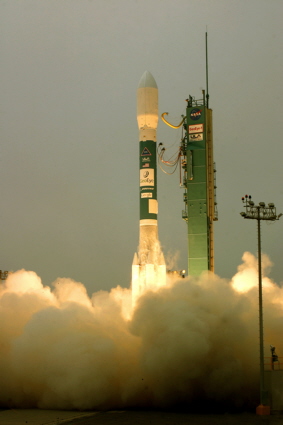
A Delta II booster carrying the GeoEye-1 spacecraft lifts-off from Space Launch Complex 2-West at Vandenberg Air Force Base on September 6. The Delta successfully inserted the commercial reconnaissance satellite into a circular Sun-synchronous orbit where the satellite will collect high-resolution images of the Earth for government and commercial customers. Boeing Company photo by Carleton Bailie
(SEP 6) VANDENBERG AFB, Calif. - Vandenberg AFB successfully launched a Delta II rocket from Space Launch Complex-2 at 11:51 a.m. today.
The rocket carried the GeoEye-1 Satellite into a circular Sun-synchronous orbit where the satellite will begin its mission of collecting multispectral or color images of the Earth for both government and commercial organizations.
Col. David J. Buck, 30th Space Wing commander, was the spacelift commander for this mission.
"This launch is a testament to the tremendous team effort between the Team Vandenberg and our industry partners," Colonel Buck said. "We have one opportunity to be successful with each launch, 100 percent mission success and perfection is our standard."
The Delta II is an expendable launch, medium-lift vehicle. It carries civil and commercial payloads into low-earth, polar, geosynchronous transfer and stationary orbits.
Vandenberg is commemorating 50 years of Space Power. For half a century, Vandenberg has proudly worked with its industry partners to grant America assured access to space.
Vandenberg AFB
(SEP 4) Boeing announced that the commercial launch of the GeoEye-1 earth-imaging satellite is scheduled for Sept. 6 aboard a Delta II rocket.
The launch will take place from Space Launch Complex-2 at Vandenberg Air Force Base, Calif., with a launch window of 84 seconds opening at 11:50:57 a.m. Pacific Daylight Time.
GeoEye-1, owned by GeoEye, Inc., of Dulles, Va., will have the highest resolution of any commercial imaging system capable of collecting images with a ground resolution of 0.41-meters or 16 inches in the panchromatic or black and white mode, and multispectral (color) imagery at 1.65-meter ground resolution. The satellite was built by General Dynamics Advanced Information Systems.
A Delta II 7420-10 configuration launch vehicle is expected to deploy the GeoEye-1 spacecraft approximately 58 minutes after liftoff.
Boeing will broadcast the launch throughout the continental Unites States at:
Satellite: AMC-1 C17
Orbital Location: 103 Degrees West
Uplink Frequency: 6265 MHz Vertical
Downlink Frequency: 4040 MHz Horizontal
Audio: 6.2 and 6.8
The broadcast begins at 11:00 a.m., PDT with bars and tone and ends about 1:00 p.m.
Boeing will web cast the launch at: http://www.boeing.com/defense-space/space/bls/missions/335/
Viewers may also access the live web cast at: www.geoeye.com or http://launch.geoeye.com
Adapted from a Boeing media advisory
(SEP 2) VANDENBERG AFB, Calif. - The launch of a Delta II rocket has been rescheduled for no earlier than 7 September at 11:50 a.m. due to Hurricane Hanna affecting the availability of key launch personnel located at Cape Canaveral. The rocket will lift off from Space Launch Complex-2 carrying United Launch Alliance's GeoEye-1 Satellite.
Boeing will broadcast the launch throughout the continental United States at:
Satellite: AMC-1 C17
Orbital Location: 103 Degrees West
Uplink Frequency: 6265 MHz Vertical
Downlink Frequency: 4040 MHz Horizontal
Audio: 6.2 and 6.8
The broadcast begins at 11:00 a.m., PDT with bars and tone and ends about 1:00 p.m. A one-hour test signal will be broadcast Sept. 6 from VAFB beginning at 1:00 p.m. PDT.
Boeing will web cast the launch at: http://www.boeing.com/defense-space/space/bls/missions/335/
Viewers may also access the live web cast at: geoeye.com or http://launch.geoeye.com.
Vandenberg AFB
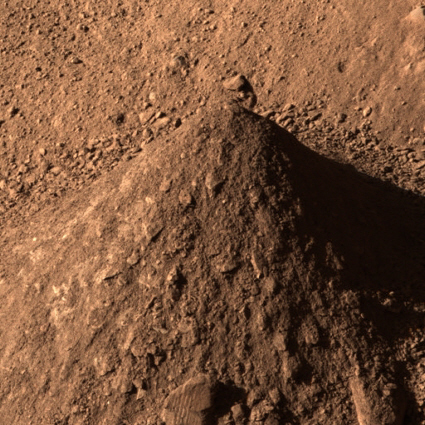
On the late afternoon of its 88th Martian day after landing, the Phoenix Mars lander imaged a debris pile deposited by the spacecraft's robotic arm. Observations of the pile provide information, such as the slope of the cone and the textures of the soil, that helps scientists understand properties of material excavated from the trenches. The Jet Propulsion Laboratory in Pasadena, Calif. operates the Phoenix spacecraft for NASA. Image NASA/JPL-Caltech/University of Arizona/Texas A&M University
(AUG 28) VANDENBERG AIR FORCE BASE, Calif. - Vandenberg is scheduled to launch a United Launch Alliance Delta II rocket carrying the GeoEye-1 Satellite from Space Launch Complex-2 on North Vandenberg Thursday, Sept. 4, at approximately 11:50 a.m.
The GeoEye-1 satellite will collect high resolution imagery for a wide array of commercial and government applications.
Col. David J. Buck, 30th Space Wing commander, will be the spacelift commander for this mission.
Boeing Launch Services procured the launch vehicle and associated support services from United Launch Alliance. A Delta II 7420-10 configuration launch vehicle is expected to deploy the GeoEye-1 spacecraft approximately 58 minutes after liftoff.
Vandenberg AFB
(AUG 27) Fleischmann Planetarium and Science Center on the University of Nevada, Reno campus offers two breathtaking immersive theater experiences beginning Sept. 5 -- "Solar Max," a large-format feature film by John Weiley, and "Extreme Planets," a full-dome digital star show by Clark Planetarium Productions. More
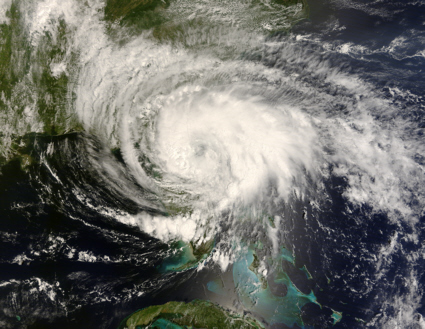
Tropical Storm Fay hovers over the southeastern United States in this image captured by the MODIS instrument on the Terra satellite on August 21. Fay hit Florida two days earlier causing what Florida's governor called catastrophic flooding. Thus far, several deaths have been attributed to the the storm. Terra was launched from Vandenberg AFB, California in 1999. Image: Jeff Schmaltz, MODIS Land Rapid Response Team, NASA GSFC
(AUG 20) TUCSON, Ariz. -- NASA's Phoenix Mars Lander scientists and engineers are continuing to dig into the area around the lander with the spacecraft's robotic arm, looking for new materials to analyze and examining the soil and ice subsurface structure. More
(AUG 20) Black holes are sometimes huge cosmic beasts, billions of times the mass of our sun, and sometimes petite with just a few times the sun's mass. But do black holes also come in size medium? A new study suggests that, for the most part, the answer is no. More
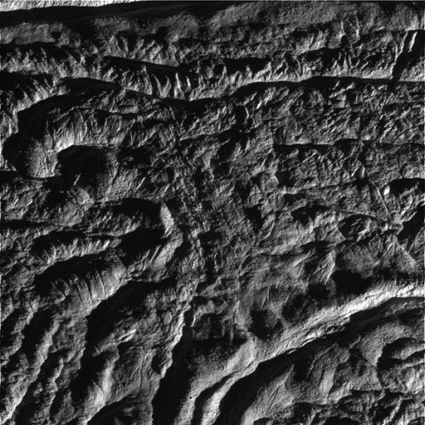
The Cassini spacecraft performed a close flyby of Saturn's moon Enceladus on August 11th, providing the most detailed views of the mysterious moon's surface (above). The flyby also allowed researchers to pinpoint the sources of icy jets that erupt from Enceladus' surface. Cassini imaging operations are managed from the Space Science Institute in Boulder, Colorado. Image: NASA/JPL/Space Science Institute
(AUG 14) TUCSON, Ariz. - NASA's Phoenix Mars Lander has taken the first-ever image of a single particle of Mars' ubiquitous dust, using its atomic force microscope. More
(AUG 13) VANDENBERG AIR FORCE BASE, Calif. - A Minuteman III intercontinental ballistic missile configured with a National Nuclear Security Administration, or NNSA, test assembly was launched from North Vandenberg today at 1:01 a.m. More
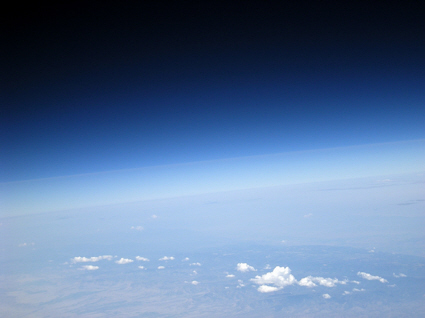
Sunlit terrain and atmosphere contrast starkly with the blackness of space in this image from a balloon launched by Utah's Weber State University on July 28th. The latex, helium-filled balloon, called the High Altitude Reconnaissance Balloon for Outreach and Research (HARBOR) rose to a height of approximately 15 miles, where it burst from increased pressure, releasing a parachute that carried a capsule containing a modified digital camera and several other experiments. Image: Weber State University
(AUG 7) Fractures, or "tiger stripes," where icy jets erupt on Saturn's moon Enceladus will be the target of a close flyby by the Cassini spacecraft on Monday, Aug. 11. More
(AUG 5) WAUKESHA, Wis. - Campers, early commuters, and casual sky observers can watch shooting stars in the predawn sky August 12 when one of the year's best meteor showers peaks. More
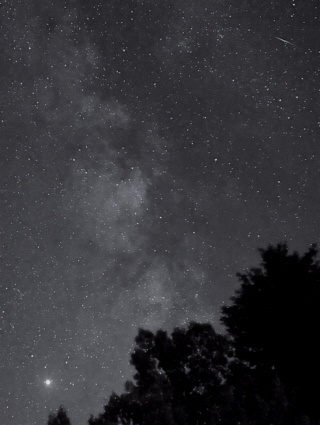
The subtle glow of the summer Milky Way graces the sky above Divide, Colorado. Also visible are a meteor in the upper right and Jupiter in the lower left. Astrophotographer Ginger Mayfield recorded the view on August 2nd with a tripod-mounted Canon EOS 30D camera, 24mm lens, and a 9-second exposure at f/1.8 and ISO 1600. Copyright 2008, Ginger Mayfield.
(JUL 31) TUCSON, Ariz. -- Laboratory tests aboard NASA's Phoenix Mars Lander have identified water in a soil sample. More
(JUL 30) PASADENA, Calif. - Less than a month after launch, the NASA-French space agency Ocean Surface Topography Mission (OSTM)/Jason 2 oceanography satellite has produced its first complete maps of global ocean surface topography, surface wave height and wind speed. More
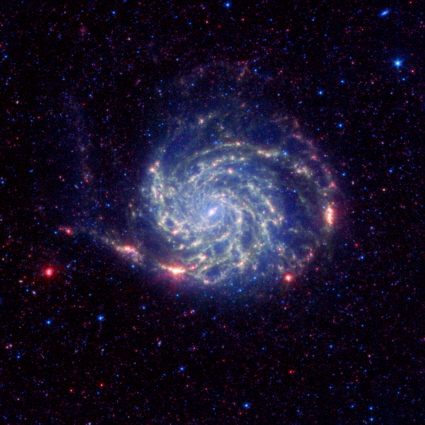
The Pinwheel Galaxy, otherwise known as Messier 101, sports bright reddish edges in this new infrared image from NASA's Spitzer Space Telescope. Research from Spitzer has revealed that this outer red zone lacks organic molecules present in the rest of the galaxy. The organics, called polycyclic aromatic hydrocarbons, are dusty, carbon-containing molecules that help in the formation of stars. Scientists believe this space dust has the potential to be converted into the stuff of life. In this view, light with a wavelength of 3.6 microns is colored blue; 8-micron light is green; and 24-micron light is red. The Spitzer Space Telescope mission is managed for NASA by the Jet Propulsion Laboratory in Pasadena, Calif. Image: NASA/JPL-Caltech/STScI
(JUL 24) HUNTSVILLE, Ala. -- NASA and industry engineers have successfully completed the first drop test of a drogue parachute for the Ares I rocket. The drogue parachute is designed to slow the rapid descent of the spent first-stage motor, cast off by the Ares I rocket during its climb to space.
The successful test is a key early milestone in development and production of the Ares I rocket, the first launch vehicle for NASA's Constellation Program that will send explorers to the International Space Station, the moon and beyond. The drogue parachute will permit recovery of the reusable first-stage motor for use on future Ares I flights.
Engineers from NASA's Marshall Space Flight Center in Huntsville, Ala., managed the team that conducted the first Ares I drogue chute test on July 24 at the U.S. Army's Yuma Proving Ground near Yuma, Ariz.
Researchers dropped the 68-foot-diameter drogue parachute and its 36,000-pound load -- simulating the first-stage motor -- from a U.S. Air Force C-17 aircraft flying at an altitude of 25,000 feet. The parachute and all test hardware functioned properly and landed safely.
NASA
(JUL 24) WASHINGTON -- NASA and Internet Archive, a non-profit digital library based in San Francisco, made available the most comprehensive compilation ever of NASA's vast collection of photographs, historic film and video Thursday. More
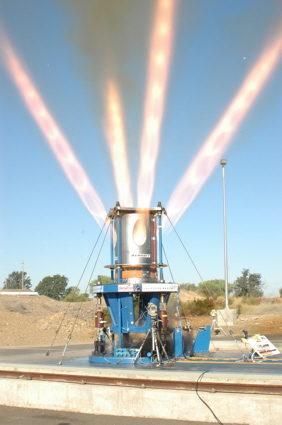
A full-scale rocket motor fires at Aerojet's Sacramento, Calif. facility on July 17th. NASA and Aerojet conducted the test to develop the motor for use on Orion, a manned exploration vehicle that will fly to the International Space Station and be part of the spaceflight system to conduct sustained human exploration of the moon. The motor will separate the spacecraft's launch abort system from the crew module during launch. Image: Aerojet
(JUL 18) Four missile defense sensors including the Upgraded Early Warning Radar at California's Beale AFB were exercised during a complex test conducted July 18th. More
(JUL 16) A satellite launched last month from Vandenberg Air Force Base will help predict hurricane intensity and improve tsunami warning models. More
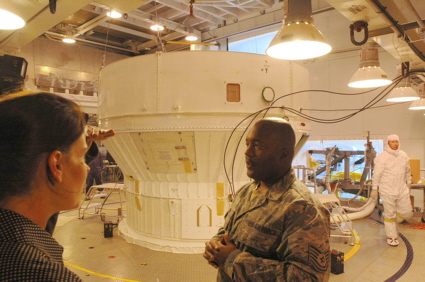
A sergeant briefs the news media as technicians groom an Atlas booster at Vandenberg Air Force Base's Space Launch Complex-3 ("Slick Three"). The Atlas is scheduled to carry a DMSP military weather satellite into orbit in September. Visible here is the top of the rocket where the spacecraft and payload faring will be attached. SLC-3 was one of the venues the media visited as part of a Media Day held at Vandenberg on July 9th. Image Copyright 2008, Brian Webb
(JUL 11) Stop the presses! The sun is behaving normally. More
(JUL 10) GILBERT, Ariz - General Dynamics Advanced Information Systems announced today that it has shipped GeoEye-1, a next-generation earth imaging satellite, to its launch site at Vandenberg Air Force Base, Calif. More

Mars' Kassei Valles is revealed in detail by the HiRISE camera aboard NASA's Mars Reconnaissance Orbiter. Carved by one or more catastrophic floods, today the feature is very dusty and home to sand dunes formed by wind blowing through channels. The camera is controlled from the HiRISE Operations Center at the University of Arizona in Tucson. Image: NASA/JPL/University of Arizona
(JUL 2) WAUKESHA, Wis. - Jupiter, largest of the planets, reaches maximum brilliance on July 9th and will be a good target for small telescopes. More
(JUL 2) MOFFETT FIELD, Calif. - The main mirror for NASA's new airborne eye on the universe is now ready for installation after being transformed from a carefully shaped and polished piece of glass into a highly reflective optical component at NASA's Ames Research Center. More
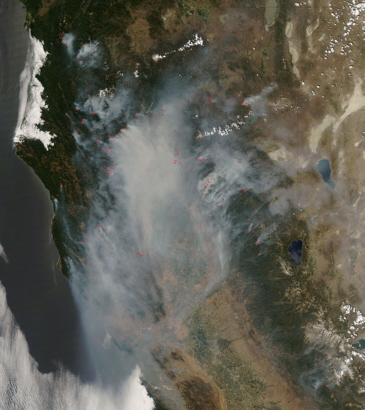
Numerous fires in California ravage wildlands while creating smoke that affects areas hundreds of miles away. The MODIS instrument on NASA's Aqua spacecraft recorded the catastrophe during a pass over the region on June 25th. Although fire activity is concentrated in Northern California, the largest fire in the scene is the Indians Fire south of Salinas. Image: Jeff Schmaltz MODIS Land Rapid Response Team, NASA GSFC
(JUN 26) Hawthorne, California-based Space Exploration Technologies Corp. (SpaceX) successfully conducted a full launch dress rehearsal and hold down firing of the Falcon 1 Flight 3 vehicle on June 25, 2008 (Marshall Island Time) on Omelek Island, SpaceX's launch site at the Kwajalein Atoll. This test is the final step before launch of the Falcon 1 rocket.
This marks the first launch pad firing of SpaceX's new Merlin 1C regeneratively cooled engine, which operated at full power with only the hold-down system restraining the rocket from flight. In the coming weeks, SpaceX will conduct a thorough review of all data prior to the opening of the launch window for flight, which runs from late July through early September.
The Falcon 1 will carry the Trailblazer satellite for the Jumpstart Program of the Department of Defense's Operationally Responsive Space Office (ORS). Additional secondary payloads include an adapter system developed by the government of Malaysia that holds two small NASA satellites.
SpaceX
(JUN 25) PASADENA, Calif. -- New analysis of Mars' terrain using NASA spacecraft observations reveals what appears to be by far the largest impact crater ever found in the solar system. More
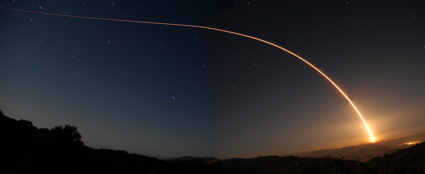
A Delta II rocket streaks across the sky on the morning of June 20th following lift-off from California's Vandenberg AFB. The Delta later inserted the U.S.-French OSTM/Jason-2 oceanographic satellite into a near-circular orbit inclined 66° to the equator. Photographer Brian Lockett set up two digital cameras near Refugio Pass in Santa Barbara County to record different portions of the Delta's flight and later combined ten time exposures to create this panorama. Image Copyright 2008, Brian Locket. Used with permission.
(JUN 20) Scientists relishing confirmation of water ice near the surface beside NASA's Phoenix Mars Lander anticipate even bigger discoveries from the robotic mission in the weeks ahead. More
(JUN 20) VANDENBERG AFB, Calif. - Vandenberg AFB successfully launched a Delta II rocket from Space Launch Complex-2 at 12:46 a.m. today.
The rocket carried the OSTM/Jason-2 Satellite into an 830-mile near-circular orbit.
Col. Steve Tanous, 30th Space Wing commander, was the spacelift commander for this mission.
"This launch is a testament to the tremendous team effort between NASA, the 30th Space Wing and our industry partners," Colonel Tanous said. "We have one opportunity to be successful with each launch and 100 percent mission success is our standard."
The primary role of the spacecraft will be to measure and gather information about ocean topography. The OSTM/Jason-2 Satellite will provide new perspectives on Earth's oceans using the five instruments it has aboard.
The Delta II is an expendable launch, medium-lift vehicle. It carries civil and commercial payloads into low-earth, polar, geosynchronous transfer and stationary orbits.
Vandenberg AFB
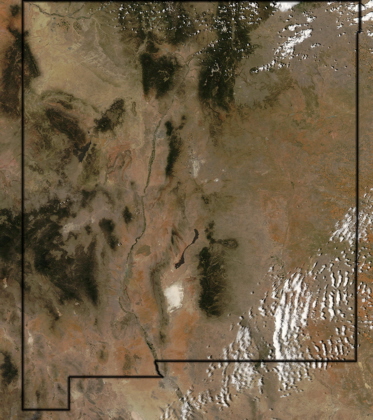
A relatively clear day over New Mexico gave NASA's Aqua spacecraft this view on 2008 June 3. New Mexico has a varied landscape ranging from mountains to desert, and even some heavily forested areas. The Rio Grande River runs down the center of the state and appears as a curving gray line. Image courtesy Jeff Schmaltz MODIS Land Rapid Response Team, NASA GSFC
(JUN 12) It was a learning experience for students and former students from Fredericksburg High School when they launched an experimental rocket out of West Center 50 at White Sands Missile Range May 31. More
(JUN 11) CAPE CANAVERAL, Fla. -- The launch of the Ocean Surface Topography Mission, or OSTM/Jason 2, aboard a Delta II rocket is scheduled for Friday, June 20, from Vandenberg Air Force Base in California. The launch window extends from 12:46 a.m. to 12:55 a.m. PDT. The satellite will be placed in an 830-mile-high orbit at an inclination of 66 degrees after separating from the Delta II 55 minutes after liftoff.
The five primary science instruments of the Ocean Surface Topography Mission aboard the Jason 2 spacecraft are dedicated to measuring ocean surface height. These measurements will be used to evaluate and forecast climate changes and improve weather forecasting. The results also are expected to help forecasters better predict hurricane intensity.
The mission is an international collaboration between NASA, the National Oceanic and Atmospheric Administration (NOAA), the French space agency Centre National d'Etudes Spatiales (CNES), and the European Organisation for the Exploitation of Meteorological Satellites (EUMETSAT). NASA's Jet Propulsion Laboratory in Pasadena, Calif., manages the mission for NASA. NASA's Kennedy Space Center's Launch Services Program is responsible for the agency's launch management of the Delta II rocket.
NASA
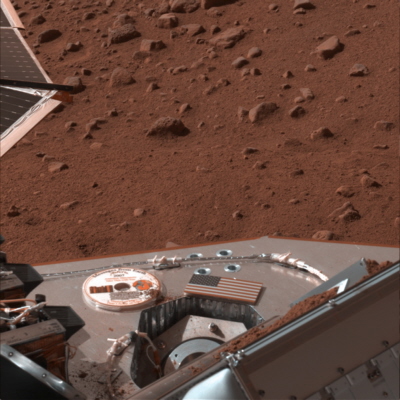
A soil sample (bottom left) sits ready for analysis by NASA's Phoenix Mars lander on June 6th. The craft's robotic arm scooped the sample from the martian tundra and placed it on one of the doors of Thermal and Evolved-Gas Analyzer (TEGA). Soil is visible on both sides of the open doors of TEGA's #4 oven, but sensors indicate no soil passed through a screen and into the oven. The Phoenix Mission is led by the University of Arizona, Tucson, on behalf of NASA. Image courtesy NASA/JPL-Caltech/University of Arizona/Texas A&M University
(JUN 6) NASA's Phoenix Mars Lander made its first dig into Martian soil for science studies and is poised to deliver the scoopful to a laboratory instrument on the lander deck. More
(JUN 2) PASADENA, Calif. -- The search for gravitational waves has revealed new information about the core of one of the most famous objects in the sky: the Crab Pulsar in the Crab Nebula. More
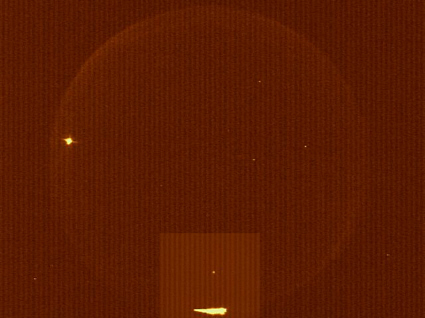
A fireball streaks across the southern New Mexico sky on the morning of May 31. Astronomy enthusiast Thomas Ashcraft recorded the 4:28 MDT (10:28 UTC) event with his all-sky video system. He also logged 7-minutes of enhanced VHF reception as the meteor's ionized trail reflected the signals of distant television stations. Image copyright 2008, Thomas Ashcraft. Used with permission.
(MAY 29) TUCSON, Ariz. - NASA's Mars lander is returning more detailed images from the Martian surface and is now preparing its instruments for science operations. More
(MAY 27) New measurements from the Sloan Digital Sky Survey telescope in New Mexico reveal the Milky Way has lost a trillion suns' worth of weight. More
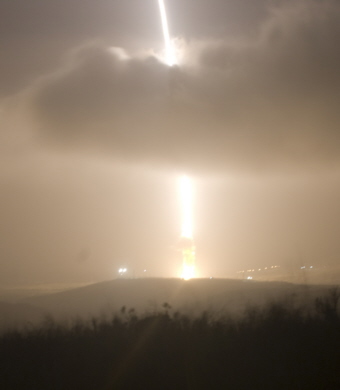
A Minuteman III ICBM lifts off from Vandenberg AFB early on the morning of May 22. The missile departed silo LF-10 and sent an unarmed Mk-21 reentry vehicle (warhead) on a ballistic trajectory to a target in the Pacific Ocean southwest of Guam. U.S Air Force photo by Airman 1st Class Nathaniel Prost
(MAY 22) VANDENBERG AIR FORCE BASE, Calif. - A Minuteman III intercontinental ballistic missile configured with a National Nuclear Security Administration joint test assembly was launched at 3:04 a.m. today from North Vandenberg. More
(MAY 19) VANDENBERG AIR FORCE BASE, Calif. - A Minuteman III intercontinental ballistic missile configured with a National Nuclear Security Administration (NNSA) joint test assembly (JTA) is scheduled to launch from North Vandenberg Thursday morning as an operational test to determine the weapon system's reliability and accuracy. The six-hour launch window is from 3:01 a.m. to 9:01 a.m.
The missile will launch under the direction of the 576th Flight Test Squadron.
Col. Steve M. Tanous, 30th Space Wing commander, is the spacelift commander for this mission. Lt. Col. Lesa K. Toler, 576th FLTS commander, is the mission director.
Members of the 576th FLTS installed tracking, telemetry and command destruct systems on the missile to collect data and meet safety requirements.
The missile's single unarmed re-entry vehicle is expected to travel approximately 5,250 miles, hitting a pre-determined target in the ocean 230nm south of Guam.
The entire ICBM community, including the Department of Defense and the Department of Energy, will use the data collected from this mission.
Vandenberg AFB
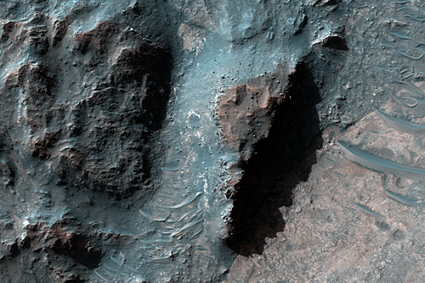
A mixture of light- and dark-toned material is visible in the central uplift of a martian impact crater south of Valles Marineris. Some of the light-toned material appears angular and blocky, consistent with material that has been disrupted and uplifted by an explosion associated with the crater's formation. Many light-toned geologic units are made of sulfates and may indicate that sulfate-rich rocks are buried beneath the plains at this location. The HiRISE camera on NASA's Mars Reconnaissance Orbiter recorded the image from a distance of 161 miles (258 kilometers). HiRISE was built by Ball Aerospace and Technology Corporation and is operated by the University of Arizona. Image and caption courtesy NASA/JPL/University of Arizona
(MAY 15) DENVER - The U.S. Air Force today announced that a team led by Lockheed Martin [NYSE: LMT] has won the competition to build the next-generation Global Positioning System (GPS) Space System program, known as GPS III. More
(MAY 15) PASADENA, Calif. -- NASA news briefings, live commentary and updates before and after the scheduled Sunday, May 25 arrival of the agency's Phoenix Mars Lander will be available on NASA Television and on the Web. More

Since its launch in 1999, NASA's Terra spacecraft has monitored numerous natural disasters. On May 5 Terra's MODIS instrument recorded the extensive flooding in Myanmar (Burma) from Cyclone Nargis. The country's once distinct coastline resembles an irregular mix of islands and water (this is especially evident in the lower left). The entire coastal plain is flooded and fallow agricultural areas appear to have been especially hard hit. Several large cities are in the affected area and Yangon (population over 4 million) is almost completely surrounded by floods. MODIS was built by Santa Barbara Remote Sensing in California. Image and caption NASA Goddard Spaceflight Center
(MAY 9) When NASA's Phoenix Mars Lander descends to the surface of the Red Planet on May 25, few will be watching as closely as the men and women who have spent years planning, analyzing and conducting tests to prepare for the dramatic and nerve-wracking event known as EDL -- Entry, Descent and Landing. More
(MAY 7) Two decades of scrutinizing Saturn are finally paying off, as scientists have discovered a wave pattern, or oscillation, in Saturn's atmosphere only visible from Earth every 15 years. More
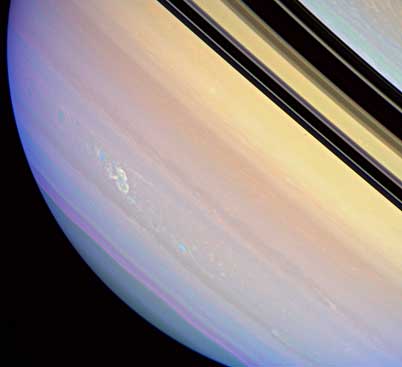
A long-lived storm on Saturn appears as a light area in this Cassini spacecraft image released by California's Jet Propulsion Laboratory (JPL) April 29th. The powerful electrical storm produces lightning bolts 10,000 times more powerful than those found on Earth. Storms on Saturn have diameters of several thousand miles and radio signals produced by their lightning are thousands of times more powerful than those produced by terrestrial thunderstorms. Cassini's radio plasma wave instrument detects the storm every time it rotates into view. JPL, a division of Caltech, manages the Cassini mission for NASA's Science Mission Directorate. Image and caption courtesy JPL.
(MAY 1) WASHINGTON -- NASA invites people of all ages to join the lunar exploration journey with an opportunity to send their names to the moon aboard the Lunar Reconnaissance Orbiter, or LRO, spacecraft.
The Send Your Name to the Moon Web site enables everyone to participate in the lunar adventure and place their names in orbit around the moon for years to come. Participants can submit their information at http://lro.jhuapl.edu/NameToMoon/index.php, print a certificate and have their name entered into a database. The database will be placed on a microchip that will be integrated onto the spacecraft. The deadline for submitting names is June 27, 2008.
LRO will also create a comprehensive atlas of the moon's features and resources that will be needed as NASA designs and builds a planned lunar outpost. The mission will support future human exploration while providing a foundation for upcoming science missions. LRO is scheduled for launch in late 2008.
NASA
(APR 30) PASADENA, Calif. -- A NASA and French Space Agency (CNES) spacecraft designed to continue a long-term survey of Earth's oceans has arrived at Vandenberg Air Force Base, Calif., for final launch preparations. More
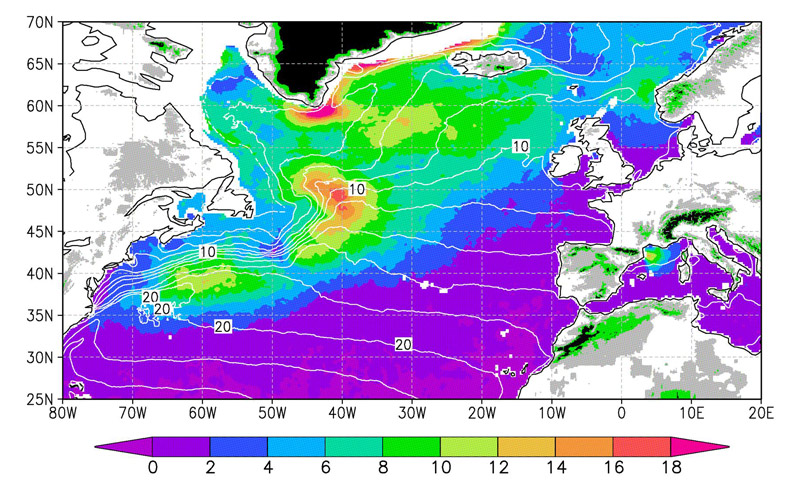
The frequency of high winds above the Gulf Stream during winter is revealed in this map created from data collected by NASA's QuikScat satellite. Lower wind speeds are depicted in purple and higher wind speeds in red. The contour lines show sea surface temperatures in degrees Celsius. QuikScat was launched aboard a converted Titan II ICBM from Vandenberg Air Force Base, California in 1999. Image credit: NASA/JPL/University of Hawaii at Manoa
(APR 23) A small motor in the robotic arm of NASA's Mars Exploration Rover Opportunity that began stalling occasionally more than two years ago has become more troublesome recently. More
(APR 22) NASA's Jet Propulsion Laboratory, Pasadena, Calif., will welcome members of the public to its Open House on Saturday, May 3, and Sunday, May 4. Children will be able to participate in many hands-on activities. More
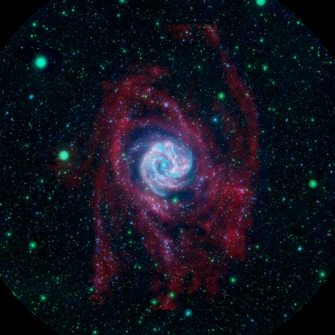
The outlying regions of the galaxy M83 are highlighted in this composite image from NASA's Galaxy Evolution Explorer (GALEX) and the National Science Foundation's Very Large Array (VLA) radio telescope in New Mexico. GALEX ultraviolet observations, shown in blue (far-UV) and green (near-UV), highlight the galaxy's farthest-flung clusters of young stars up to 140,000 light-years from its center. VLA radio observations at 21 centimeters appear in red. They highlight gaseous hydrogen atoms, or raw ingredients for stars, which make up the lengthy, extended arms. Caltech in Pasadena, California, hosts the GALEX science center and has overall responsibility for the project. Image courtesy NASA/JPL-Caltech/VLA/MPIA
(APR 16) Boeing Launch Services has been awarded a contract to launch DigitalGlobe's second WorldView Earth-imaging satellite. The payload is slated to lift-off from California's Vandenberg AFB in mid-2009 aboard a Delta II rocket. More
(APR 15) MINNEAPOLIS -- Alliant Techsystems (NYSE: ATK) has received a contract option worth $134 million from Northrop Grumman Corporation (NYSE: NOC) to refurbish components and replace propellant on Minuteman III Stage 1, 2 and 3 rocket motors. This award is the seventh full-rate production option under the ICBM Propulsion Replacement Program.
The option is for 50 motor sets and will extend the program through August 2009.
The Minuteman III Propulsion Replacement Program (PRP) began in 1998 as a Joint Venture between ATK and Pratt & Whitney. All work content was transitioned to ATK in the 2003-2004 timeframe following a contract restructure. Most of the work on the contract will be performed at the company's facilities in Utah.
Alliant Techsystems
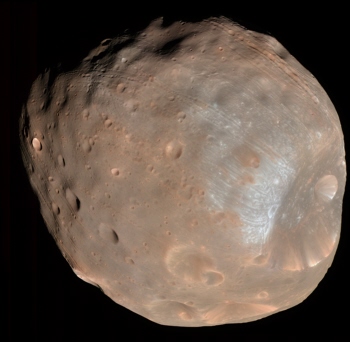
The battered surface of the martian moon Phobos is revealed in this Mars Reconnaissance Orbiter image released by the University of Arizona. The spacecraft's High Resolution Imaging Science Experiment (HiRISE) imaged the moon on March 23rd from a distance of about 4,200 miles (6,800 kilometers). Clearly visible are the large impact crater Stickney (right) and a series of grooves and crater chains. The University of Arizona operates the HiRISE camera for NASA. Image courtesy the University of Arizona
(APR 9) MOFFETT FIELD, Calif. -- NASA is preparing to send a small spacecraft to the moon in 2011 to assess the lunar atmosphere and the nature of dust lofted above the surface. More
(APR 9) The University of Colorado at Boulder's own version of "The Rocket Boys" (and Girls) will help to launch a CU payload on a sounding rocket to measure ultraviolet radiation from the sun from the White Sands Missile Range in New Mexico April 10. More
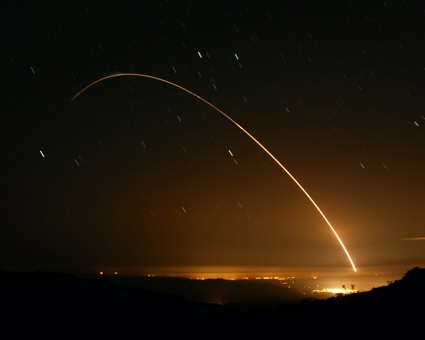
A Minuteman III missile lights up the night sky above California. The ICBM lifted-off from Vandenberg AFB at 01:01 PDT on April 2nd and sent an unarmed warhead some 4,800 miles downrange to a predetermined target at Kwajalein in the Central Pacific. Aerospace photographer Brian Lockett recorded the launch in this impressive time exposure taken from the mountains northwest of Santa Barbara. Copyright 2008, Brian Locket. Used with permission.
(APR 2) VANDENBERG AIR FORCE BASE, Calif. - A Minuteman III intercontinental ballistic missile configured with a National Nuclear Security Administration (NNSA) test assembly was launched from North Vandenberg today at 1:01 a.m. More
(MAR 31) VANDENBERG AIR FORCE BASE, Calif. - An unarmed Minuteman III intercontinental ballistic missile is scheduled to launch from North Vandenberg Wednesday morning as an operational test to determine the weapon system's reliability and accuracy. The six-hour launch window is from 1:01 a.m. to 7:01 a.m.
The missile will launch under the direction of the 576th Flight Test Squadron.
Col. Michael E. Fortney, 30th Space Wing vice commander, is the spacelift commander for this mission. Lt. Col. Lesa K. Toler, 576th FLTS commander, is the mission director.
Members of the 576th FLTS installed tracking, telemetry and command destruct systems on the missile to collect data and meet safety requirements.
The missile's single unarmed re-entry vehicle is expected to travel approximately 4,200 miles, hitting a pre-determined water target in the Marshall Islands.
The entire ICBM community, including the Department of Defense and the Department of Energy, will use the data collected from this mission.
Vandenberg AFB
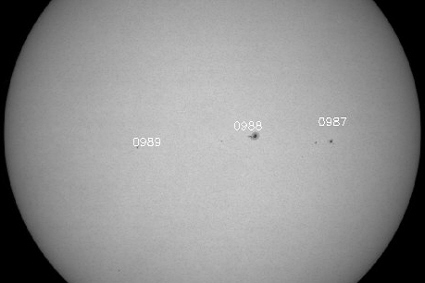
To the delight of solar observers, three diminutive sunspots recently emerged on the Sun. The spots, which are numbered 987, 988, and 989 are visible in this SOHO satellite image taken March 30th. Despite their small size, the solar blemishes have been having an impact. On March 25th, sunspot 989 produced a sizable solar flare. Meanwhile, increased solar activity associated with the spots improved high frequency (shortwave) radio transmission and reception. Image courtesy NASA
(MAR 27) California-based SpaceX reports the firm conducted the first three-engine firing of its Falcon 9 medium to heavy lift rocket at its facility outside McGregor, Texas on March 8, 2008. At full power the engines generated over 270,000 pounds of force, and consumed 1,050 lbs of fuel and liquid oxygen per second. A total of nine Merlin 1C engines will power the Falcon 9 rocket.
The test series continues with the addition of two engines for a total of five, then finally the full compliment of nine engines. With all engines firing, the Falcon 9 can generate over one million pounds of thrust in vacuum - four times the maximum thrust of a 747 aircraft.
The Merlin 1C next generation liquid fueled rocket booster engine is among the highest performing gas generator cycle kerosene engines ever built, exceeding the Boeing Delta II main engine, the Lockheed Atlas II main engine, and on par with the Saturn V F-1 engine.
The first Falcon 9 remains on-schedule for delivery to Cape Canaveral, Florida, by the end of 2008.
Space Development Corporation (SpaceX)
(MAR 26) PASADENA, Calif. -- NASA's Cassini spacecraft tasted and sampled a surprising organic brew erupting in geyser-like fashion from Saturn's moon Enceladus during a close flyby on March 12. Scientists are amazed that this tiny moon is so active, "hot" and brimming with water vapor and organic chemicals. More
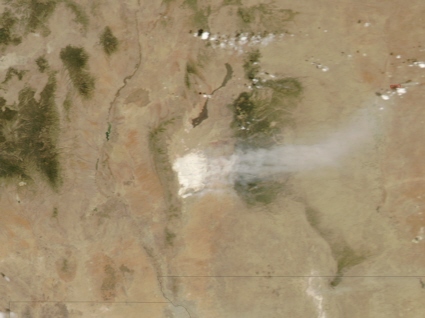
Winds blow gypsum sand from White Sands National Monument, New Mexico across the southern part of the state. Pale gypsum sand covers some 275 square miles (715 square kilometers) of desert at White Sands, providing ample material for storms when strong winds strike. NASA's Aqua spacecraft imaged the event as it passed overhead on March 14. Image courtesy Jeff Schmaltz MODIS Land Rapid Response Team, NASA GSFC
(MAR 21) VANDENBERG AFB, Calif. - The crew of the STS-123 Endeavour Space Shuttle is traveling with a unique payload that was designed by a lieutenant here. More
(MAR 18) Researchers from the California Institute of Technology and other institutes have detected water vapor in the spinning disks of particles surrounding two newly formed stars. More
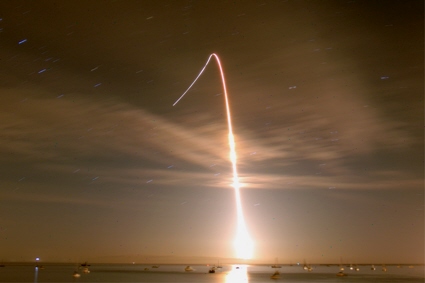
The first-ever Atlas V launch from Vandenberg AFB traces an arc in the early morning sky on March 13. Matt Batryn captured the event in this time exposure from Port San Luis, California. Clearly visible are the rocket's trajectory including a lateral maneuver and numerous star trails caused by the Earth's rotation. Batryn used a Nikon D70S digital SLR and an exposure of 207 seconds at f/3.5 and ISO 200. Copyright 2008, Matt Batryn. Used with permission.
(MAR 13) Vandenberg Air Force Base, Calif., - Adding to the Atlas rocket's legacy of launches from the west coast that began in 1959, United Launch Alliance's Atlas V made its debut flight from Space Launch Complex-3 East here at 3:02 a.m. PDT, today. More
(MAR 11) VANDENBERG AIR FORCE BASE, Calif. - Vandenberg is scheduled to launch an Atlas V rocket carrying a National Reconnaissance Office payload, Thursday with a current launch window of 2:00 a.m. to 4:00 a.m. from Space Launch Complex-3 on south Vandenberg.
Col. Steve Tanous, 30th Space Wing commander, will be the spacelift commander for this mission.
This will be the first Atlas V launched from Vandenberg as well as the first launch of the year.
Vandenberg AFB
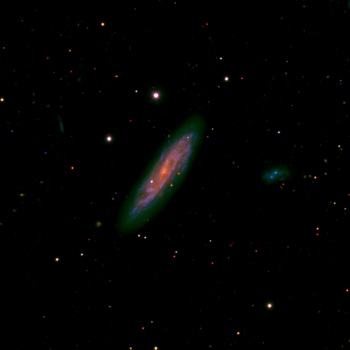
On March 6 the University of Arizona released the first images from the Large Binocular Telescope (LBT) including this false-color view of the galaxy NGC 2770. The image combines ultraviolet, green, and deep red light and enhances the detailed structure of hot, moderate and cool stars in the galaxy. Billed as the world's most powerful telescope, the LBT sits atop Mount Graham in southeastern Arizona and has a light-collecting area equivalent to a single 11.8-meter (39-foot) surface. Image courtesy Large Binocular Camera team, Rome Observatory
(MAR 9) If the sky is clear this Friday (March 14), look for the close encounter of the Moon and Mars. From Los Angeles, closest approach occurs at about 19:58 PDT (02:58 UTC) during evening twilight. At that time, the first quarter Moon will lie about 1.3° north of the + 0.5 magnitude Red Planet.
The close pairing of the two objects is somewhat misleading. Although they will be lined up in the same part of the sky, the Moon will be about 247,000 miles from Earth while Mars will be 109 million miles further away.
(MAR 6) With just binoculars, you might see a relatively bright star wink out briefly as a moon of the asteroid (45) Eugenia covers it; this rare event will be visible across the southern USA Saturday evening, March 8. More
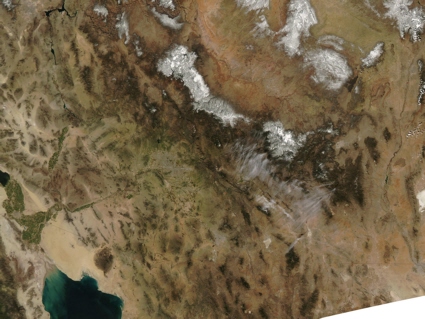
NASA's Aqua spacecraft recorded this view of the American Southwest during a daylight pass on February 26. Visible are New Mexico, Arizona, Nevada, California, and Mexico as well several landmarks. Near the top left the Grand Canyon appears as a long, curved, slightly brown crack. Left of center, Phoenix resembles a sprawling gray patch. Image courtesy Jeff Schmaltz MODIS Land Rapid Response Team, NASA GSFC
(MAR 2) The Moon will occult (pass in front of) the planet Venus on March 5 for observers across in the central U.S., Mexico, and the portions of Southwest. The unusual daylight event should be easily visible in binoculars or small telescopes.
As seen from Los Angeles, Venus will disappear behind the Moon at 20:25 UTC (12:25 PST) and emerge at 20:38 UTC (20:38 PST). The disappearance and reappearance times for selected cities are as follows:
| Location | Disappears (UTC) |
Reappears (UTC) |
|---|---|---|
| Albuquerque, NM | 20:14 | 21:13 |
| Denver, CO | 20:25 | 21:06 |
| Las Vegas, NV | 20:27 | 20:45 |
| Phoenix, AZ | 20:11 | 21:05 |
| Reno, NV | --- | --- |
| Salt Lake City, UT | --- | --- |
| San Francisco, CA | --- | --- |
--- Not visible
(FEB 27) VANDENBERG AIR FORCE BASE, Calif. - The Atlas V rocket that was scheduled to launch from Space Launch Complex 3 here, Feb. 29, has been postponed as a precautionary move to avoid possible debris from the non-functional National Reconnaissance Office satellite, which was intercepted Feb. 20.
The rocket carrying a NRO payload will be delayed for approximately two weeks, and will be the first Atlas V launch from Vandenberg as well as the first launch of the year.
When established, a revised launch date will be posted.
Vandenberg AFB
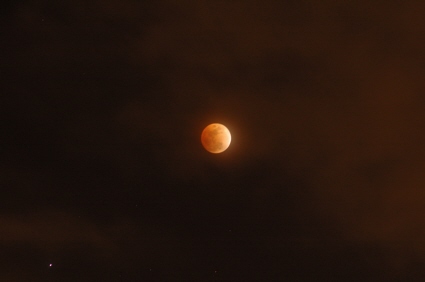
The Moon disappears behind a band of clouds during the February 20 total lunar eclipse. The last such event visible from the Southwest until late 2010, the eclipse occurred at a convenient hour but viewing was hampered for many by cloudcover. The webmaster recorded this view of the totally eclipsed Moon at 19:19 PDT (03:19 UTC) using a Nikon D70 digital camera, vintage 180mm lens, and a 4-second exposure at f/4 and ISO 400. The bright speck in the lower left is the planet Saturn. Copyright 2008, Brian Webb
(FEB 20) A network of land-, air-, sea- and spaced-based sensors confirms that the U.S. military intercepted a non-functioning National Reconnaissance Office satellite which was in its final orbits before entering the earth's atmosphere.
At approximately 10:26 p.m. EST today, a U.S. Navy AEGIS warship, the USS Lake Erie (CG-70), fired a single modified tactical Standard Missile-3 (SM-3) hitting the satellite approximately 247 kilometers (133 nautical miles) over the Pacific Ocean as it traveled in space at more than 17,000 mph. USS Decatur (DDG-73) and USS Russell (DDG-59) were also part of the task force.
The objective was to rupture the fuel tank to dissipate the approximately 1,000 pounds (453 kg) of hydrazine, a hazardous fuel which could pose a danger to people on earth, before it entered into earth's atmosphere. Confirmation that the fuel tank has been fragmented should be available within 24 hours.
Due to the relatively low altitude of the satellite at the time of the engagement, debris will begin to re-enter the earth's atmosphere immediately. Nearly all of the debris will burn up on reentry within 24-48 hours and the remaining debris should re-enter within 40 days.
The payload, known as "USA 193", was launched aboard a Delta II rocket from Vandenberg AFB on 2006 December 14.
Adapted from a Department of Defense news release
(FEB 19) MOFFETT FIELD, Calif. - Sensitive detectors that may help find habitable planets orbiting distant stars as part of NASA's Kepler Mission are undergoing tests at Ames Research Center, Moffett Field, Calif. More
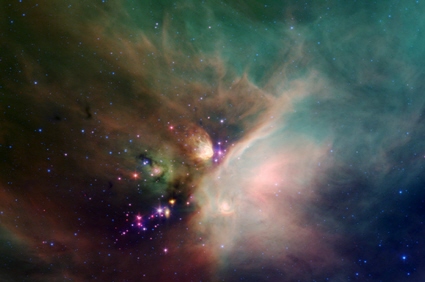
Newborn stars peek out from beneath their natal blanket of dust in this dynamic image of the Rho Ophiuchi dark cloud from NASA's Spitzer Space Telescope. Called "Rho Oph" by astronomers, it's one of the closest star-forming regions to our own solar system. In this false-color view, blue, green, and red represent light at wavelengths of 3.6-, 8-, and 24-microns, respectively. Spitzer science operations are conducted at the Spitzer Science Center at the California Institute of Technology in Pasadena, Calif. Image courtesy NASA/JPL-Caltech/Harvard-Smithsonian CfA
(FEB 15) A decaying U.S. satellite carrying approximately 1,000 pounds of hazardous material will be "engaged" the Defense Department announced Thursday.
Known as "USA 193", the classified payload failed following launch from Vandenberg AFB in California in late 2006. It is expected to reenter the atmosphere in early March.
Because the satellite was never operational, analysis indicates that approximately 2,500 pounds of satellite mass will survive reentry, including 1,000 pounds of hazardous hydrazine propellant.The DoD plans to intercept the satellite using a ship-launched Aegis SM-3 ballistic missile interceptor. The U.S. government said the purpose of the intercept is to eliminate the threat from the hydrazine to people on the ground.
From VOA News, the Department of Defense, and other sources
(FEB 11) The last total lunar eclipse until December 20, 2010, will thrill observers throughout North America February 20. More
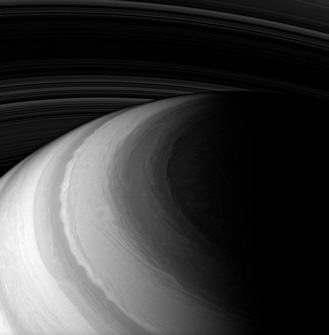
The Cassini spacecraft uses polarized infrared light to peer beneath hazes that obscure the flowing cloud bands in Saturn's atmosphere. The brighter areas are features higher in the atmosphere than the darker areas. The view was obtained last month from a distance of approximately 577,000 miles (929,000 kilometers) and released this week by the Jet Propulsion Laboratory (JPL) on February 6. Located in Pasadena, Calif., JPL manages the Cassini mission for NASA and also designed, developed, and assembled the orbiter and its onboard cameras.
(FEB 5) One of Saturn's rings does housecleaning, soaking up material gushing from the fountains on Saturn's tiny ice moon Enceladus, according to new observations from the Cassini spacecraft. More
(FEB 3) VANDENBERG AIR FORCE BASE, Calif. -- Vandenberg AFB opened its doors to members of the local and national media for their first encounter with an Atlas V rocket as it was being prepared Thursday at Space Launch Complex-3. More
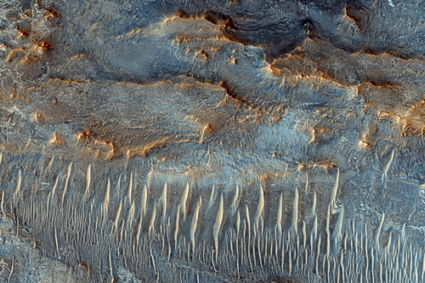
The Nili Fossae are valleys that have cut into the ancient crust of Mars, exposing clay minerals. These minerals formed in the presence of water and may be the result of interaction between hot water and rocks and thus a possible location for ancient Martian life. This Mars Reconnaissance Orbiter HiRISE camera image released February 1 is part of the search for a landing site for NASA's Mars Science Laboratory. The HiRISE instrument is operated by the University of Arizona. Image courtesy NASA/JPL/University of Arizona
(JAN 28) Data from an instrument developed by the Jet Propulsion Laboratory is helping scientists overturn long-standing assumptions about powerful explosions called novae and has produced specific information about one nearby nova. More
On February 1, see the solar system's brightest planets appear their closest together.
(JAN 28) WAUKESHA, WI -- Venus, the planet nearest to Earth, and Jupiter, the solar system's biggest world, are headed for a morning meeting. As the brightest planets in the sky, the pair makes a conspicuous sight in eastern twilight.
During the next week, watch Jupiter edge ever closer to Venus. As the solar system's brightest planets draw together, they'll begin to resemble a pair of celestial headlights -- an appropriate comparison for an event that graces the morning commute.
How to see Venus and Jupiter
Between January 25 and February 1, look low in the southeast in the hour before dawn. The two brightest star-like objects are Venus and Jupiter. Venus is the brighter of the two
Astronomy Magazine
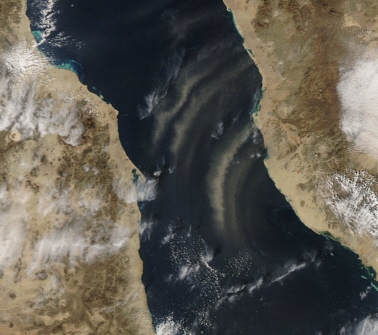
Dust plumes blow off the coast of Saudi Arabia and over the Red Sea in this Aqua satellite image taken on January 16. The spacecraft's MODIS instrument captured the view on the second day of dust activity. Aqua was launched from California's Vandenberg AFB in 2002. Image courtesy Jeff Schmaltz, MODIS Land Rapid Response Team, NASA GSFC
(JAN 25) Scientists at NASA's Jet Propulsion Laboratory in Pasadena, Calif., have obtained the first images of asteroid 2007 TU24 using high-resolution radar data. More
(JAN 23) PASADENA, Calif.- The California Institute of Technology has received an eight-year $24 million grant from the W. M. Keck Foundation to establish the W.M. Keck Institute for Space Studies, which will bring together scientists and engineers to develop new space-mission concepts and technology. More
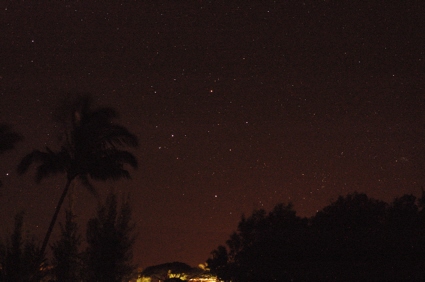
Invisible from nearly all of the United States due to its southerly location, the Southern Cross makes a brief pre-dawn appearance above the horizon of Hawaii's Big Island. It is perhaps the best known southern hemisphere asterism and is featured on the flags of Australia and New Zealand and the patch of the U.S. First Marine Division. The webmaster, a California resident, recorded this digital image from Waikoloa Colony on January 13 using a 13-second exposure at f/3.5 and ISO 1600. Copyright 2008, Brian Webb
(JAN 18) An arms control inspection is under way at Vandenberg Air Force Base in Santa Barbara County. KCLU's Brian Webb reports the visiting inspection team isn't American - it's from the former Soviet Union. More
(JAN 17) Edwards Air Force Base, Calif. - NASA's Stratospheric Observatory for Infrared Astronomy, or SOFIA, has passed a significant mission milestone. It has completed the first phase of experimental flight tests, which confirmed the structural integrity and performance of the modified 747SP SOFIA aircraft that carries a huge infrared telescope. More
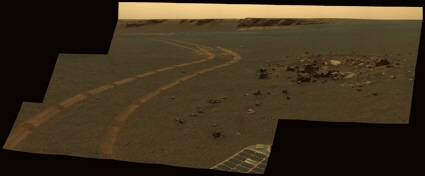
Tracks from the Opportunity Mars rover mark the bleak martian landscape in this color view released January 2. Opportunity made the curving tracks last year while testing a navigational capability called "Field D-star," which enables the rover to plan long-range drives around any obstacles using the safest, most direct route. The Jet Propulsion Laboratory in Pasadena, Calif. manages the Opportunity mission for NASA. Image courtesy NASA/JPL-Caltech/Cornell University
(JAN 4) Solar physicists have been waiting for the appearance of a reversed-polarity sunspot to signal the start of the next solar cycle. The wait is over. A magnetically reversed, high-latitude sunspot emerged today. This marks the beginning of Solar Cycle 24 and the first step toward a new solar maximum. Intense solar activity won't begin right away. Solar cycles usually take a few years to build from solar minimum (where we are now) to Solar Max (expected in 2011 or 2012). It's a slow journey, but we're on our way!
Visit http://spaceweather.com for pictures of the new sunspot and updates.
www.SpaceWeather.com
The Quadrantids, one of the best but least-known meteor showers, will shine in the new year.
(JAN 2) WAUKESHA, WI -- The annual Quadrantid meteor shower is one of the year's best. In 2008, this shower will be especially good because it's at its best under a nearly New Moon. So, not only will observers see bright meteors easily, they'll also count quite a few fainter "shooting stars."
The Quadrantids peak between 1 a.m. and dawn January 4. This is the best time to see the meteors. New Moon occurs January 8, so when the thin crescent Moon rises around 5 a.m. on the 4th, its light won't create much of a distraction.
Observers will need a clear, dark sky to see more than just a few Quadrantids. "Dark" means at least 40 miles from the lights of a large city. No equipment is necessary to view this spectacle; the eyes alone work best because they provide the largest field of view.
Astronomy Magazine
Copyright © 2008-2016, Brian Webb. All rights reserved.